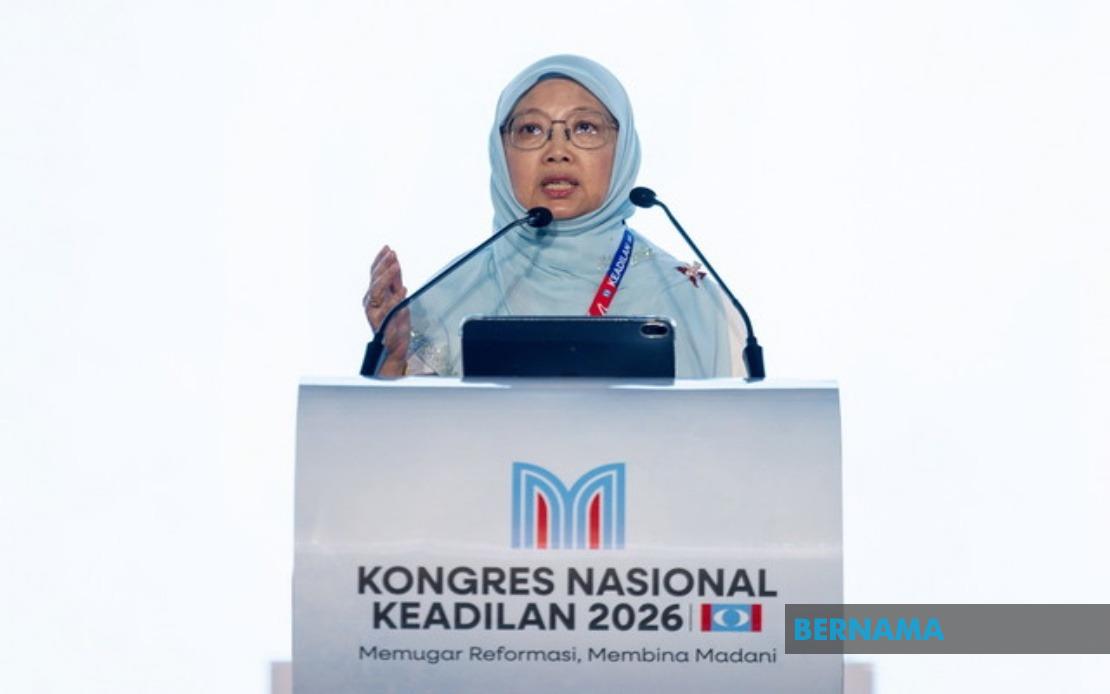
Entering government represents the commencement, not the completion, of the Reformasi movement, according to Parti Keadilan Rakyat deputy president Datuk Seri Dr Zaliha Mustafa. Speaking during her closing remarks at PKR's 2026 National Congress held at Melaka International Trade Centre on August 16, Zaliha stressed that the party now faces its greatest examination—demonstrating the fortitude and discernment necessary to translate reform commitments into tangible institutional and governance improvements.
The decade-spanning struggle that PKR has championed ought not to be diminished as merely a campaign mechanism to occupy Putrajaya, Zaliha contended. Rather, the movement's fundamental ambition stretches far deeper: to recalibrate the mechanisms through which Malaysia is administered and governed. She challenged the notion that nearly three decades of advocacy could be reduced to a vehicle for transferring administrative control between competing political factions. Such a narrowed interpretation, she suggested, would underestimate the breadth and significance of what the party had set out to accomplish across more than two decades.
Having assumed governmental responsibility, PKR shoulders the considerable obligation to operationalise its reform platform through substantive institutional reinforcement, improved governance structures, systematic corruption eradication, and curtailment of power misuse. Simultaneously, party members must cultivate sufficient courage to hold one another accountable when shortcomings materialise within their own ranks. This internal accountability mechanism, Zaliha implied, serves as a critical test of the movement's integrity and commitment to the principles it has long articulated.
Zaliha emphasised that executing reform requires not merely zeal but equally important—strategic wisdom. Transforming a nation's administrative apparatus cannot occur uniformly across all sectors within compressed timeframes. Priorities must be identified with clarity, distinguishing between initiatives suitable for immediate implementation and those demanding extended periods of negotiation, consultation, and groundwork to ensure durability. Drawing parallels to the historical precedent of Khalifah Umar Abdul Aziz, invoked by PKR president Datuk Seri Anwar Ibrahim during the congress's opening session, Zaliha illustrated how purposeful change executed through measured phases need not compromise ultimate objectives.
The gradual approach to reform does not equate to hesitation or diminished determination, Zaliha clarified for party members. Exercising caution neither signals lost nerve nor abandonment of reform commitments. What distinguishes effective governance from mere rhetoric is maintaining unambiguous directional clarity—understanding precisely which systemic elements require correction and maintaining unwavering momentum towards those predetermined targets, even when the path proceeds methodically rather than precipitously.
As Member of Parliament for Sekijang, Zaliha identified a substantial institutional weakness: PKR's internal communication apparatus requires substantial recalibration to ensure government initiatives translate into public comprehension and tangible benefit perception. Mere policy implementation, she argued, does not automatically generate citizen awareness or appreciation. The government cannot reasonably expect populations to organically understand accomplishments without deliberate, structured communication efforts designed to bridge the gap between administrative action and public perception.
Following the congress, Zaliha advocated for establishing communication systems characterised by greater organisational coherence, accelerated information dissemination, and messaging calibrated directly to popular vernacular understanding. The party's capacity to effectively articulate its narrative to ordinary citizens represents, in her assessment, an underappreciated dimension of modern political sustainability. Failure to actively shape this communicative space invites opponents to monopolise public discourse and establish competing interpretations of governmental performance.
Control over social media narrative architecture constitutes another domain requiring urgent party attention, Zaliha emphasised. Allowing opposition forces to dominate digital platforms where electoral movements increasingly unfold represents a strategic vulnerability that undermines even substantial policy achievements. The intersection of administrative success and public acceptance hinges critically upon narrative dominance rather than factual superiority alone; citizens respond not merely to objective policy efficacy but to the emotional resonance and persuasive framing of political messaging.
Zaliha's observations carry particular relevance for Malaysian political observers assessing whether reformasi movements can sustain momentum once power is secured. Historically, anti-establishment coalitions frequently encounter difficulties translating protest energy into coherent governance, particularly when confronting entrenched bureaucratic resistance and competing stakeholder demands. PKR's capacity to maintain internal unity, demonstrate measurable governance improvements, and successfully communicate achievements to an often-sceptical electorate will substantially determine whether the reformasi narrative retains mobilising potency during coming electoral cycles. The party's performance on these dimensions may ultimately establish precedents influencing whether similar reform movements across Southeast Asia successfully consolidate political gains into durable institutional transformation.

