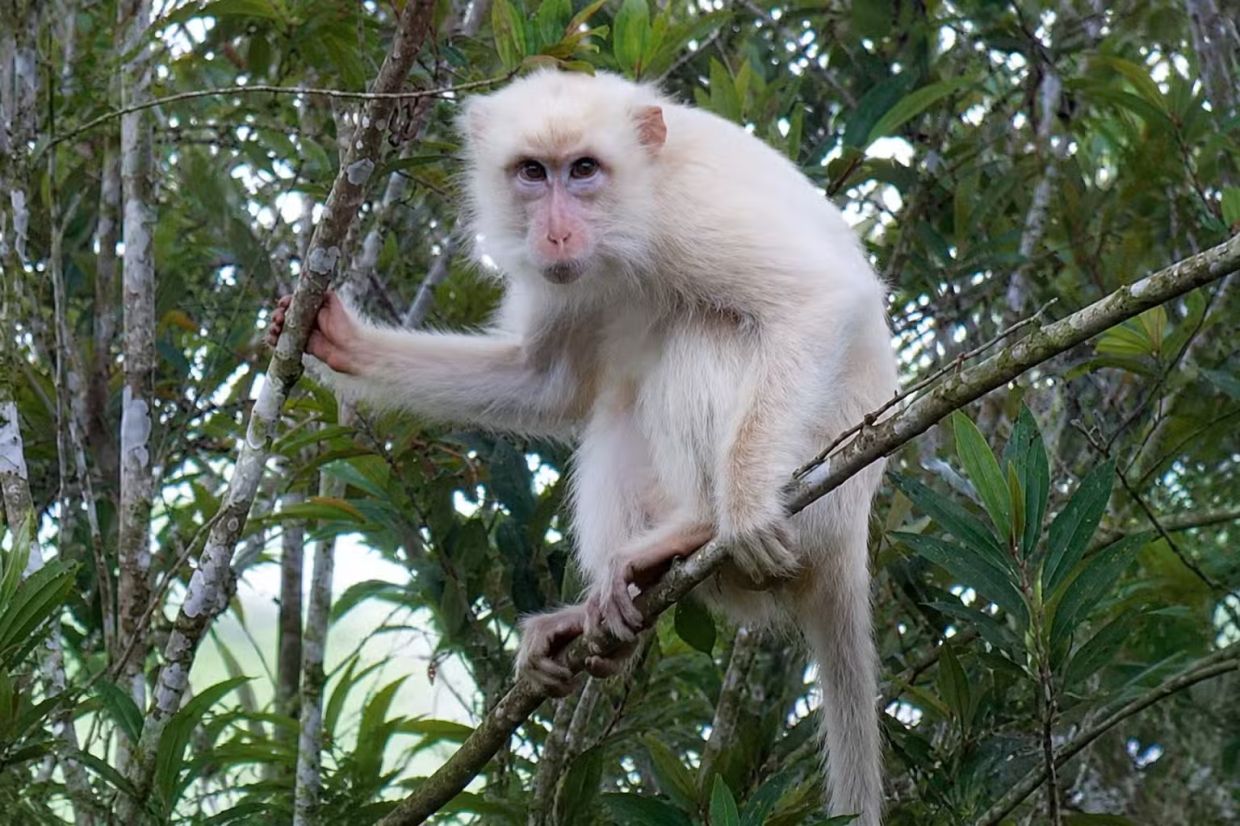
A strikingly pale macaque that has inhabited a forest in Sultan Kudarat province for nearly a decade has become the focus of an intense protection campaign after photographs and videos of the animal spread rapidly across social media platforms. The unusual creature, believed to be a Philippine long-tailed macaque with a rare pigmentation anomaly, has prompted government agencies and local officials to establish protective measures around its habitat, reflecting broader concerns about how digital exposure can endanger vulnerable wildlife populations in Southeast Asia.
The animal's distinctive appearance has long intrigued residents of Senator Ninoy Aquino town, where it has been observed moving through the forested landscape since 2016. What remained a local curiosity for years transformed into a conservation emergency once the macaque's image circulated online, drawing attention from people far beyond the immediate community. The Department of Environment and Natural Resources Region XII and the municipal government responded by implementing access restrictions to the area where the monkey is frequently sighted, recognizing that public interest, while often well-intentioned, can pose serious risks to endangered or unusual wildlife.
Initially, observers suspected the macaque suffered from albinism, a condition that completely eliminates pigmentation. However, a field validation conducted by a composite monitoring team from DENR Region XII revealed more nuanced biological details. The team observed that the animal possessed brown to dark brown eyes, a characteristic inconsistent with typical albinism, which usually produces pink or pale eyes. This finding suggests the macaque instead exhibits leucism or another pigmentation disorder that affects fur coloration while preserving normal eye pigmentation. Wildlife experts have yet to complete definitive scientific verification, underscoring how even dramatic physical anomalies require rigorous examination before researchers can draw firm conclusions.
The risks posed by increased visibility have become apparent to conservation authorities. Beyond the inherent dangers of habitat disturbance from curious visitors, the animal faces more sinister threats including poaching, illegal capture for the exotic pet trade, and inclusion in wildlife trafficking networks. The Philippines and broader Southeast Asia struggle with persistent illegal wildlife trafficking, making any animal of unusual appearance vulnerable once its location becomes public knowledge. The DENR explicitly warned that unchecked public interest could transform the macaque into a target for criminal activity, potentially removing it from its native habitat entirely.
During their assessment, the monitoring team confirmed that despite human pressure, the macaque's environment remains ecologically viable. Secondary forest vegetation continues to flourish in the area, and natural food sources remain sufficient to support the resident macaque population. This finding provided some reassurance that the animal's immediate survival prospects depend less on ecological restoration and more on limiting human interference and preventing illegal collection. The habitat itself requires protection as much as the individual animal, since the forest ecosystem provides the foundational resources necessary for long-term population survival.
Local authorities have moved decisively to implement protection frameworks. The municipal government imposed a temporary closure of the area where the white macaque is commonly observed, effectively prohibiting unauthorized access and reducing the likelihood of disturbance or capture attempts. Barangay Bugso, the administrative unit encompassing the sighting location, has begun drafting a formal ordinance designed to institutionalize legal protections for not only the white macaque but also its habitat and the broader forest ecosystem. This multi-layered approach reflects recognition that individual species protection requires corresponding landscape and community-level safeguards.
Pending the ordinance's formal enactment, entry to the immediate vicinity of reported sightings remains legally prohibited. The barangay government has also committed to conducting tree-planting initiatives and habitat restoration activities that will strengthen overall biodiversity conservation while demonstrating to residents the connection between forest health and wildlife welfare. These efforts signal an intention to transform a reactionary protection response into a sustainable conservation model that engages local communities as stewards rather than merely restricting their access to natural resources. Responsible ecotourism development also features in planning discussions, suggesting authorities envision eventual managed public engagement that balances scientific interest with species protection.
The legal framework underpinning these protection efforts rests on Republic Act No. 9147, the Wildlife Resources Conservation and Protection Act, which designates all wildlife in the Philippines as protected species. The law explicitly prohibits hunting, capturing, collecting, possessing, transporting, trading or disturbing wildlife without appropriate government permits. Violations carry criminal penalties, providing enforcement teeth beyond voluntary compliance. DENR has appealed directly to online content creators, photographers, journalists and social media users to refrain from revealing exact locations of wildlife sightings or sharing geotagged photographs that might guide others to protected animals, a crucial intervention given how digital platforms accelerate information spread in ways traditional conservation awareness campaigns cannot match.
The agency has committed to ongoing scientific work, submitting comprehensive documentation on the white macaque to the Biodiversity Management Bureau for technical evaluation and formal characterization of its pigmentation condition. Beyond this immediate research agenda, DENR Region XII plans to maintain continuous habitat monitoring, strengthen coordination mechanisms with local government partners and community stakeholders, and intensify public information campaigns emphasizing wildlife protection principles. These initiatives reflect understanding that conservation requires sustained institutional commitment and community engagement rather than one-time interventions.
The white macaque's trajectory from unremarkable local resident to protected species emblematic of broader conservation challenges carries implications extending well beyond Sultan Kudarat. The case demonstrates how social media amplification can transform wildlife welfare concerns into urgent policy issues, how provincial communities possess both capability and willingness to implement sophisticated conservation strategies when provided support, and how unusual biological characteristics can become conservation liabilities in an era of instantaneous global information sharing. For Malaysian and regional observers, the Philippine response model offers practical lessons in coordinating multi-level governance for wildlife protection and managing public engagement with endangered species during the digital age.

