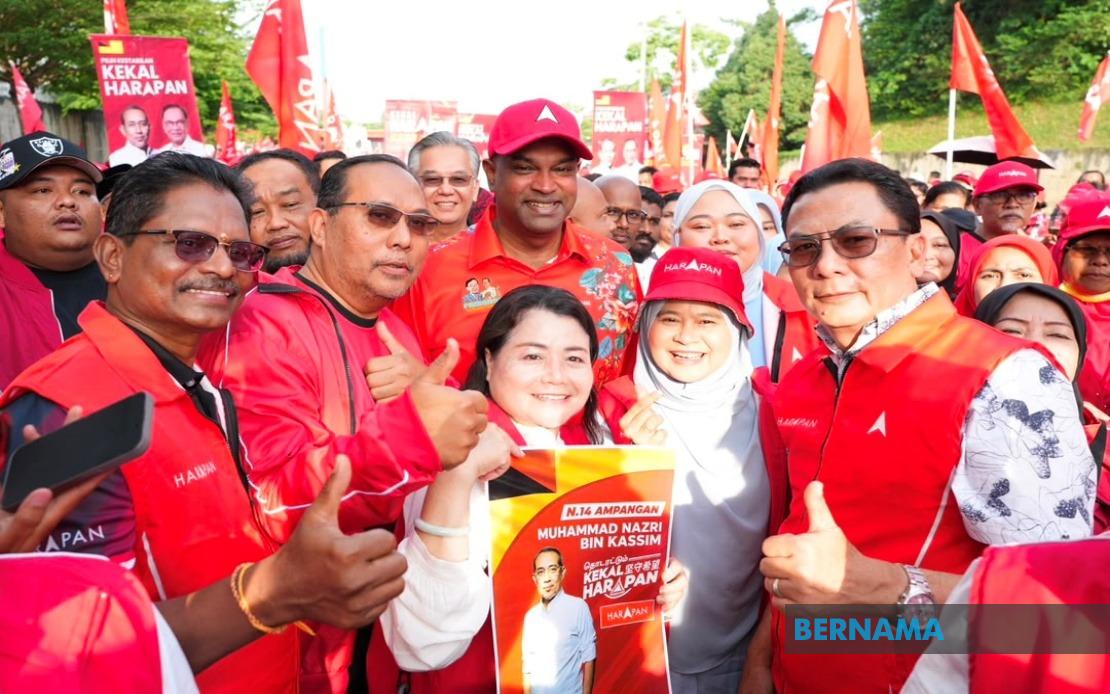
Senior Pakatan Harapan leaders mobilised their party machinery at the Seremban City Council Building on July 18, throwing visible backing behind six coalition candidates preparing to contest the upcoming Negeri Sembilan state election. Datuk Seri R. Ramanan, who serves as both PKR vice-president and Sungai Buloh Member of Parliament, led the effort alongside DAP deputy secretary-general Steven Sim to galvanise grassroots support across key constituencies in the state.
The six candidates receiving support encompassed a cross-section of Pakatan's representation in the peninsular state. Nor Azman Mohamad aims to win Sikamat, while Datuk Muhammad Nazri Kassim is the coalition nominee for Ampangan. The slate further includes Zarinna Abu Zarin contesting Lenggeng, Chew Seh Yong in Lobak, J. Arul Kumar pursuing Nilai, and Ho Weng Wah seeking to retain Temiang. The presence of multiple party leaders at the nomination phase signals Pakatan's intention to defend and potentially expand its foothold in a state where the coalition has faced mounting competition from other political forces.
Ramanan interpreted the visible gathering of party supporters and campaign workers at the nomination venue as an indicator of deeper organisational vigour within Pakatan's ranks. He articulated confidence that this momentum would persist throughout the official campaign period, which commenced immediately following the completion of nominations on July 18 and extends through July 31. The emphasis on grassroots machinery reflects recognition within the coalition that state elections often hinge on ground-level voter engagement rather than broader national narratives alone.
The PKR leader's remarks underscored Pakatan's strategic framing of the contest as fundamentally about governance continuity and developmental progress in Negeri Sembilan. By positioning the election as a choice between stability and disruption, Ramanan sought to establish the terms on which voters should evaluate the competing coalitions and individual candidates. This messaging approach assumes that voters prioritise economic and infrastructure concerns over other electoral determinants, a calculation that varies in validity across different demographic and geographic constituencies.
Negeri Sembilan's political trajectory has witnessed significant shifts in recent years, with the dissolution of the 36-seat State Legislative Assembly on June 5 creating space for fundamental realignment. The Election Commission's scheduling of early voting for July 28 and polling day for August 1 compressed the campaign window considerably, placing emphasis on efficient use of the limited nomination-to-polling interval. For Pakatan, a coalition facing its own internal dynamics across member parties, concentrated leadership appearances at nomination centres serve dual purposes: energising party members while generating media coverage that amplifies campaign reach beyond physical gatherings.
The geographic spread of the six candidates reflects Pakatan's efforts to compete across diverse constituencies within Negeri Sembilan, from urban centres to semi-rural areas. Each constituency presents distinct electoral dynamics shaped by demographic composition, economic dependence patterns, and historical voting behaviours. The coalition's deployment of national-level leadership figures to support local candidates suggests both confidence in these individuals and recognition that voter decisions in state elections increasingly interconnect with national political developments.
Ramanan's assertion that campaign efforts would remain relentless throughout the official period contained implicit acknowledgment of the competitive landscape Pakatan confronts in Negeri Sembilan. The coalition must simultaneously defend existing state-level positions, maintain internal cohesion among PKR, DAP, and other members, and make gains against incumbent or rival coalitions. The intensity of leadership engagement during the nomination phase thus foreshadowed broader campaign strategies that would likely emphasise mobilisation and voter turnout throughout the remaining weeks.
The reference to ensuring developmental continuity represents a substantive campaign theme for a state where economic priorities centre on manufacturing, palm oil processing, and agricultural activities. Negeri Sembilan's position within Malaysia's economic geography makes infrastructure investment, employment generation, and business environment management critical voter concerns. Pakatan's emphasis on these dimensions attempts to shift electoral discussion toward policy performance metrics rather than alternative narratives that might disadvantage the coalition.
For Malaysian and Southeast Asian observers of regional politics, the Negeri Sembilan election constitutes one of several state-level contests through which voter sentiment toward incumbent coalitions and emerging political alternatives crystallises. The visible presence of prominent national figures at nomination events provides early indication of campaign resource allocation and strategic prioritisation. Pakatan's investment of senior leadership capital in supporting these six candidates, supported by demonstrated party machinery mobilisation, suggests the coalition judges the state politically consequential for broader national positioning.
The compressed campaign schedule from late July through August 1 polling means traditional campaign activities must accelerate rapidly. Door-to-door canvassing, community forums, social media campaigns, and traditional media engagement all compress into a narrow timeframe. Leadership visibility during the nomination phase generates initial momentum and organisational signals that can sustain or dissipate depending on subsequent campaign execution. For the six Pakatan candidates, the backing of figures like Ramanan and Sim provides both tangible campaign support and symbolic endorsement that may influence voter perceptions of viability and coalition confidence.
Negeri Sembilan's electoral composition, encompassing both urbanised areas and constituencies with substantial rural and semi-rural populations, creates heterogeneous voter preferences that campaign strategies must address with corresponding diversity. Pakatan's multi-party structure, bringing together PKR with its base among urban and Malay-majority constituencies, DAP with predominantly Chinese urban support, and other coalition members, requires careful messaging calibration to maintain internal cohesion while appealing across demographic divides. The nomination centre gathering provided an early platform for demonstrating such unity ahead of the more intensive campaign phase.

