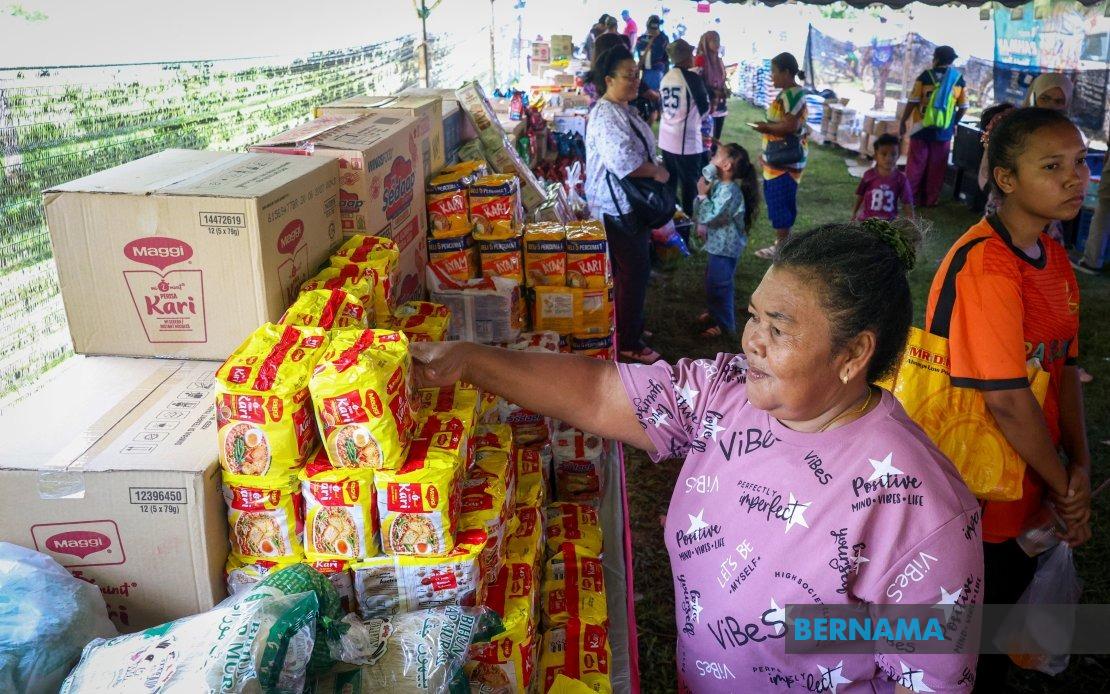
Over 1,000 Temiar indigenous residents living at the Pasik Resettlement Scheme (RPS) in Gua Musang can now access the Rahmah MADANI Sales Programme (PJRM), a government-backed initiative that has brought affordable essential goods directly to their community for the first time. The programme allows residents to make purchases using SARA credit—their Rahmah Basic Contribution balance stored on their MyKad identity cards—eliminating the need to travel long distances to obtain necessities at competitive prices.
Previously, community members had no choice but to undertake gruelling trips to Kampung Jerek, roughly two and a half hours away by vehicle, to participate in PJRM offerings. Ramli Chimbong, a 51-year-old resident of Kampung Ayong within the settlement, described the burden these journeys imposed. Beyond the exhausting travel time itself, residents incurred substantial direct costs including vehicle rental charges, meals consumed en route, and miscellaneous expenses that frequently totalled around RM600 per trip. Such financial outlay, while necessary for accessing better-priced goods, represented a significant strain on household budgets already stretched by limited incomes and high costs of living in remote areas.
The arrival of PJRM at Pasik RPS has transformed the economics of shopping for these vulnerable communities. Chimbong highlighted the stark price differential that now benefits local shoppers. A nine-kilogramme bag of rice, which normally retails at approximately RM40 in village shops, can be purchased through the programme for just RM29—representing savings of nearly 30 percent on a single staple item. These discounts compound across multiple purchases, allowing families to stretch limited budgets further and redirect savings towards other pressing needs. For communities where poverty remains persistent and economic opportunities are scarce, such price reductions have tangible real-world impacts on family welfare and nutritional security.
The logistical operation behind bringing the programme to Pasik RPS demonstrates both government commitment and practical entrepreneurship. SMS Maju Solution, the company managing the initiative at this location, mobilised an impressive inventory of goods encompassing 100 different essential items. The initial delivery included 300 bags of rice, 300 trays of eggs, and 300 live chickens, indicating careful consideration of community preferences and dietary patterns. The enthusiastic early response from residents—many arriving as early as 9 am on the first day of operations—suggests genuine pent-up demand for affordable shopping options.
Sabariah Mohamed Sayuti, owner of SMS Maju Solution, observed that many residents retained substantial untapped SARA balances in their MyKad accounts. Rather than depleting their credit allocations, many community members possessed reserves ranging between RM300 and RM800, with few having balances below RM100. This situation indicates either underutilisation of previous PJRM opportunities due to inaccessibility, or successful financial management by households that accumulated the credits but could not previously spend them. The programme's arrival at their doorstep now enables conversion of these credits into tangible goods that directly improve living standards.
However, the expansion of PJRM to remote Orang Asli settlements encounters genuine infrastructural challenges. The team delivering goods to Pasik RPS experienced a vehicle breakdown when rough terrain—comprising rocky and muddy road conditions—caused a tyre to burst while transporting supplies. Such incidents underscore the difficulties of reaching isolated communities and highlight the real operational costs beyond those visible to consumers. Road conditions in resettlement schemes frequently remain poor, creating transport hazards and limiting accessibility for commercial operations.
Mohd Azmawi Fikri Abdul Ghani, the assemblyman representing Nenggiri, contextualised the PJRM expansion within broader government efforts to address rural cost-of-living pressures. As inflation and global commodity prices continue affecting household budgets nationwide, rural and indigenous communities face disproportionate impacts because their income levels tend to lag significantly behind urban counterparts while transport costs inflate local retail prices. Government programmes that directly subsidise or reduce consumer prices for essential goods represent a meaningful policy lever for alleviating this burden, particularly for vulnerable populations including the Orang Asli.
The assemblyman's statement indicating hope for expansion to all Orang Asli settlements signals recognition that Pasik RPS represents merely one node within a larger network of indigenous communities scattered across Malaysia's interior regions. Many such settlements remain geographically isolated, poorly served by commercial retail infrastructure, and home to populations with limited purchasing power. Systematically extending PJRM to these locations could substantially improve access to affordably-priced necessities across multiple communities simultaneously, though substantial logistical planning and resource allocation would be necessary.
For Malaysian policymakers and programme administrators, the Pasik RPS expansion offers lessons about targeted service delivery to marginalised communities. The success hinges on three factors: ensuring vulnerable populations actually possess credit balances to utilise, positioning points of sale sufficiently near their residences, and maintaining adequate inventory of goods that match community preferences and dietary requirements. The enthusiastic uptake demonstrated at Pasik RPS suggests that when these elements align, previously excluded populations actively engage with government assistance programmes.
The PJRM initiative also reflects evolving approaches to rural economic policy that move beyond simple cash transfers towards enabling market access and consumer choice. By maintaining the SARA credit system rather than distributing cash, the government maintains some flexibility in directing purchasing patterns and ensuring resources support essential consumption. From the community perspective, this approach proves acceptable provided the goods offered are genuinely useful and priced competitively against alternatives—conditions satisfied at Pasik RPS.
Looking forward, successful replication of this model across other Orang Asli settlements depends on sustained commitment to solving infrastructure challenges and ensuring consistent supply. The difficulties encountered with vehicle breakdowns suggest that permanent or semi-permanent sales outlets, rather than periodic mobile visits, might prove more reliable in deeply remote areas. Additionally, engaging private sector operators like SMS Maju Solution demonstrates that commercial companies can profitably participate in government initiatives when proper coordination and support systems exist, creating a sustainable model less dependent on sustained government subsidy.

