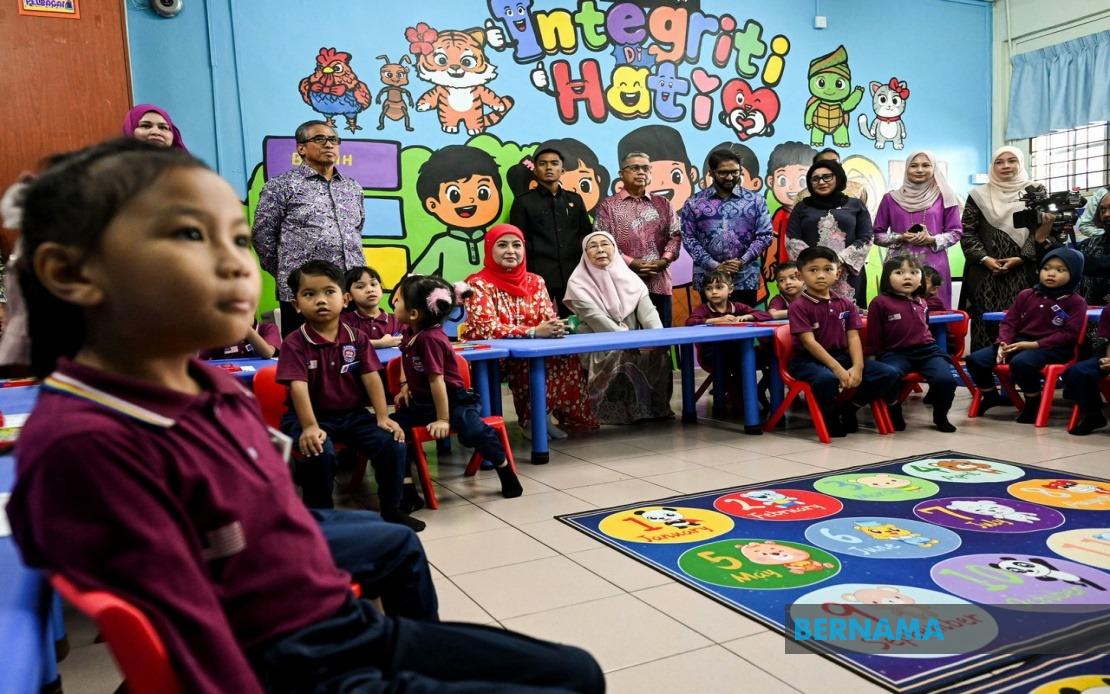
Queen Raja Zarith Sofiah officially opened the Children's Integrity Module (MIKa) at Tabika Perpaduan Taman Bukit Cheras in Kuala Lumpur on Tuesday, marking a significant step in Malaysia's effort to embed ethical foundations in the youngest learners. The initiative represents a coordinated national strategy to develop moral character and integrity from the earliest educational stages, with ambitions to reshape how values are taught across the country's sprawling early childhood sector.
The ceremony reflected the government's commitment to this agenda, with National Unity Minister Datuk Aaron Ago Dagang and Chief Secretary to the Government Tan Sri Shamsul Azri Abu Bakar—who chairs the Malaysian Institute of Integrity (IIM)—present to support the launch. Bandar Tun Razak Member of Parliament Datuk Seri Dr Wan Azizah Wan Ismail also attended the event at 9.45 am. The Queen's personal involvement underscores the programme's importance within Malaysia's governance framework and signals royal endorsement for this values-based educational approach.
MIKa focuses specifically on children aged between two and six years old, a developmental window increasingly recognised internationally as critical for establishing behavioural patterns and moral reasoning. Rather than introducing integrity through abstract rules or punishment-based systems, the programme emphasises experiential learning and habituation to ethical practices. The Queen observed classroom simulations and interacted directly with pupils, gaining first-hand insight into how the module translates abstract concepts into age-appropriate activities and interactions that young learners can understand and internalise.
The Malaysian Institute of Integrity has been developing MIKa since 2024, drawing on the expertise of 35 early childhood education specialists. This substantial research and consultation process reflects recognition that effective values education requires deep understanding of child psychology, pedagogical best practices, and Malaysia's diverse cultural and religious contexts. The collaborative approach has involved support from multiple government ministries, various federal agencies, universities, and private organisations operating within early childhood education, creating a broad coalition around this common objective.
Shamsul Azri articulated a fundamental philosophy underpinning MIKa: that integrity cannot be imposed through legislation alone but must become ingrained behaviour established during formative years. This approach contrasts with reactive anti-corruption strategies and instead targets prevention through cultural transformation. By cultivating habits of honesty, trustworthiness, and principled conduct before children internalise competing values from peers or society, the programme aims to create a generation for whom ethical behaviour feels natural rather than imposed. The CSO emphasised that responsibility sharing extends to parents, whose modelling of integrity provides essential reinforcement beyond institutional settings.
The ambitions attached to MIKa are substantial. By 2030, the government targets implementation across Malaysia's entire early childhood education ecosystem, encompassing more than 31,000 registered childcare centres, kindergartens, and preschool facilities nationwide. This scale demonstrates confidence in the programme's replicability and potential impact, though also reveals the logistical complexity of coordinating curriculum change across predominantly private-sector institutions. The timeline suggests a structured rollout plan, moving from pilot phases to comprehensive coverage over the next six years.
For Malaysian policymakers, this initiative addresses persistent concerns about institutional integrity and public trust. Corruption and mismanagement remain significant challenges affecting governance legitimacy and economic development. By beginning values education at ages two to six rather than waiting until adolescence or adulthood, authorities hope to reduce reliance on formal enforcement mechanisms and create citizens who instinctively prioritise honesty and accountability. This preventive approach represents a long-term investment in Malaysia's institutional culture and social capital.
The programme's scope extends beyond academic instruction into identity formation. Children internalising integrity values during these formative years are expected to carry these principles into primary education, secondary schooling, and eventually professional and civic roles. If successful at scale, MIKa could measurably influence Malaysia's governance standards and public sector culture within a generation. However, programme effectiveness ultimately depends on consistent implementation across thousands of independent institutions with varying resource levels, staff training, and management quality.
Regionally, Malaysia's emphasis on early childhood values education reflects broader Southeast Asian trends toward cultivating ethical frameworks within national development strategies. Neighbouring countries face similar challenges around institutional trust and governance quality, suggesting that successful Malaysian models could inform regional education policy. The intersection of early childhood development, cultural values, and anti-corruption strategy positions MIKa as potentially influential beyond Malaysia's borders.
The programme also reflects demographic realities shaping Malaysian education. As the early childhood sector expands to accommodate increasing female workforce participation and urbanisation, establishing consistent ethical standards becomes more important for maintaining social cohesion. MIKa provides structured methodology that childcare operators can implement regardless of institutional size or location, creating standardised outcomes while respecting Malaysia's plural society through inclusive curriculum design.
Implementation challenges remain substantial. Training 31,000 institutions' staff to competently deliver integrity education requires sustained investment in professional development and curriculum materials. Monitoring quality and consistency across such dispersed networks demands robust accountability mechanisms. Additionally, integrating MIKa with existing early childhood curricula in ways that enhance rather than burden educators requires careful change management and resource allocation.
Looking forward, MIKa represents Malaysia's recognition that combating corruption and strengthening institutional integrity requires cultural shifts beginning in early childhood. The programme assumes that ethical habits formed before age six generate more resilient personal commitments to honesty and responsibility than values imposed through external regulation alone. Whether this theoretical framework translates into measurable improvements in institutional culture depends substantially on implementation rigour and sustained political commitment beyond the initial launch phase.

