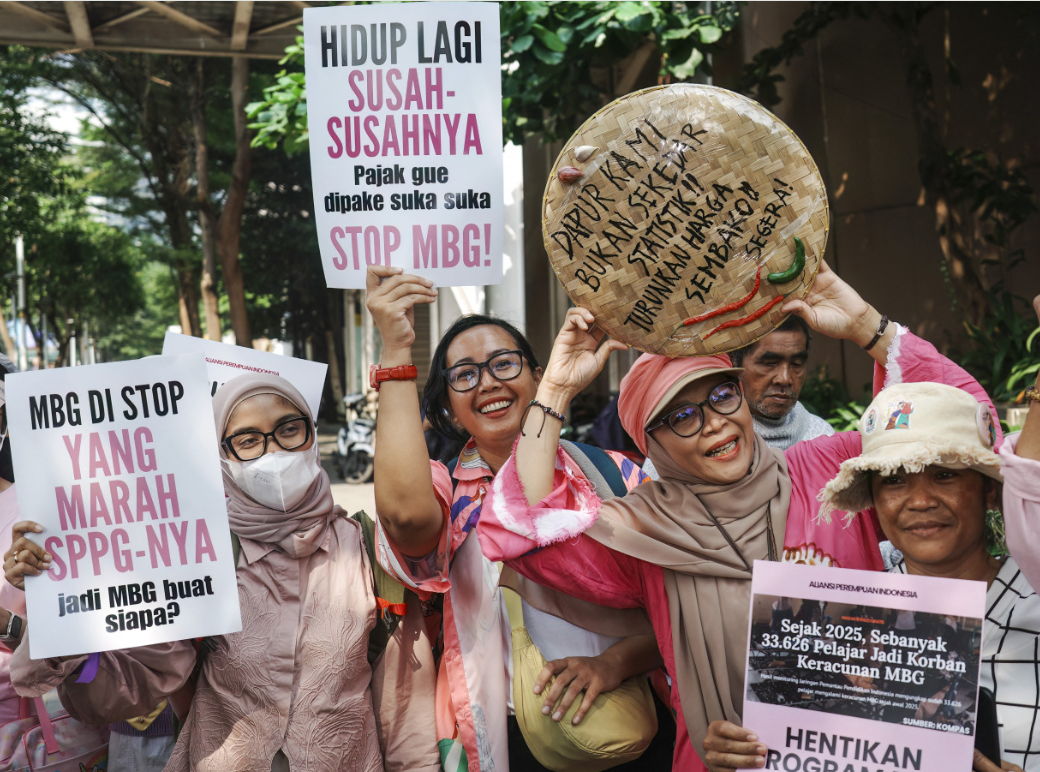
President Prabowo Subianto's signature free nutritious meal initiative faces mounting criticism from the very people it was designed to help, with some beneficiaries and activist groups openly questioning whether the programme should continue in its current form. The initiative, intended to combat childhood stunting and malnutrition, has instead become mired in controversy over food quality, governance failures, and questions about whether the massive government investment is reaching those most in need. The tension reflects deeper anxieties about Indonesia's ability to implement large-scale social programmes effectively, a challenge that carries significant implications for Southeast Asia's most populous nation and its development agenda.
The quality crisis crystallised dramatically when Nesti Nagari, a mother from Kediri in East Java, received what appeared to be an unidentifiable white paste supposedly destined for her eight-month-old infant. Her social media post documenting the meal sparked immediate public outrage, accumulating over 11,000 engagements and prompting her to reject the assistance entirely. Nagari revealed that she preferred to prepare nutritious food herself rather than feed such questionable material to her child, and she has become emblematic of a broader sentiment among beneficiaries: the willingness to forgo government support rather than accept substandard provisions. Her willingness to see the programme suspended temporarily or even terminated entirely, arguing the budget might be better spent on education and healthcare, articulates a frustration that extends far beyond her individual circumstances.
Similar experiences plague other programme participants across Indonesia's major population centres. Diah Farika, a nursing mother in Semarang, Central Java, enrolled in May but has repeatedly complained about meal quality, including instances of unripe oranges and portions she considers inadequate for nutritional needs. When she raised concerns with the nutrition fulfilment service units responsible for food preparation, her complaints were dismissed rather than addressed. Farika's position—that the programme concept itself is sound but execution varies dramatically depending on which kitchen manages operations—points to a systemic implementation problem rather than a flaw inherent to the policy design. Her support for a temporary suspension specifically to allow the National Nutrition Agency to conduct comprehensive kitchen inspections reflects beneficiary pragmatism about what reform might actually restore the programme's credibility and effectiveness.
Activist groups have amplified these grassroots concerns into formal pressure on government. The Indonesian Women's Alliance recently staged a rally in Central Jakarta demanding a halt and comprehensive review, channelling the frustrations of mothers and vulnerable groups into organised political action. These demonstrations signal that concerns about the programme have transcended individual complaints to become a matter of public accountability. For Malaysian observers, the Indonesian situation illustrates how even well-intentioned social safety net expansions can generate political backlash if quality and transparency fail to match the scale of expenditure and the rhetoric surrounding implementation.
The governance dimension complicates the picture considerably. A recent corruption scandal involving former leaders of the National Nutrition Agency prompted new management to suspend further expansion of the kitchen network, which currently comprises approximately 27,000 facilities nationwide. This decision has alarmed programme operators and investors who have committed substantial capital—reportedly hundreds of billions of rupiah—to build these food preparation facilities. The clash between the desire to expand reach and improve quality on one hand, and the need to investigate governance failures on the other, has created uncertainty that undermines stakeholder confidence and potentially compromises the programme's future sustainability.
Funding disruptions have exacerbated implementation challenges. Several kitchens experienced temporary closures in early June due to delayed budget transfers, though some subsequently reopened once payments resumed. These interruptions created supply gaps affecting beneficiaries precisely when the programme should operate most reliably. For developing nations in Southeast Asia contemplating similar food assistance schemes, the Indonesian experience underscores the critical importance of establishing robust financial transfer mechanisms and maintaining consistent budget flows to prevent service disruptions that erode public trust.
Independent scrutiny has revealed troubling patterns in beneficiary selection and programme targeting. Research by the Center of Economic and Law Studies, conducted through an oversight platform established by civil society groups, found that approximately 34 percent of current beneficiaries—around 61 million children and pregnant women—are not among those most economically vulnerable. These include households with adequate purchasing power and existing access to nutritious food who arguably require less government intervention than extremely poor families. This targeting problem represents a significant fiscal inefficiency, particularly acute given that the 2026 budget, initially set at Rp 335 trillion (approximately US$18.74 billion), was only trimmed to Rp 268 trillion following public pressure about the programme's cost implications for education funding.
In response, the National Nutrition Agency has begun narrowing its beneficiary pool, removing recipients deemed capable of meeting nutritional needs independently. By Thursday, the agency had removed 76 schools across Java from the programme, affecting over 39,000 beneficiaries. Deputy head Agustina Arumsari characterised this refocusing as essential to ensuring the programme reaches Indonesian citizens who genuinely require government support. This corrective measure acknowledges the targeting failures that public scrutiny exposed, though it also raises questions about how such determinations are made and whether adequate grievance mechanisms exist for families incorrectly classified as not needing assistance.
The agency is simultaneously implementing austerity measures designed to improve efficiency and performance. These include eliminating daily incentive payments to kitchen operators during non-operational periods and scrutinising facilities identified as underperforming. The combination of beneficiary reduction and operational cost-cutting suggests the government is attempting to salvage the programme through both narrower targeting and improved management rather than wholesale programme redesign. For Malaysian policymakers examining Indonesia's experience, these measures offer both cautionary tales and potential lessons about programme administration and the political necessity of demonstrating fiscal responsibility alongside social impact.
What distinguishes the current Indonesian controversy is that criticism originates not primarily from political opponents or fiscal conservatives, but from intended beneficiaries themselves and civil society advocates focused on programme effectiveness. This creates an unusual political dynamic where defending the programme's continuation becomes difficult even for its architects, particularly when beneficiaries articulate willingness to forgo assistance rather than accept poor quality. The emerging consensus—among mothers, activists, and increasingly among government officials—that the programme requires substantial reform rather than straightforward expansion or continuation reflects a mature understanding that good intentions and large budgets alone cannot guarantee social policy success.
The path forward will likely involve the government demonstrating its capacity to deliver consistently high-quality meals through accountable kitchen operations, properly targeted to those most in need, and at costs aligned with other social spending priorities. Until these preconditions are satisfied, the programme will face continued political vulnerability, particularly given Indonesia's history of implementation challenges with large-scale social initiatives. For neighbouring Southeast Asian nations, Indonesia's experience serves as a crucial reminder that scaling social programmes requires not merely financial commitment but institutional capacity, transparency mechanisms, and genuine responsiveness to beneficiary feedback—the very elements that appear insufficiently developed in the current iteration of this flagship initiative.
%22%2F%3E%3C%2Fpattern%3E%3C%2Fdefs%3E%3Crect%20width%3D%22100%25%22%20height%3D%22100%25%22%20fill%3D%22url(%23pho14fg)%22%2F%3E%3Crect%20width%3D%22100%25%22%20height%3D%22100%25%22%20fill%3D%22url(%23pho14fp)%22%2F%3E%3Ctext%20x%3D%2250%25%22%20y%3D%2250%25%22%20text-anchor%3D%22middle%22%20dominant-baseline%3D%22central%22%20fill%3D%22rgba(255%2C255%2C255%2C0.95)%22%20font-family%3D%22Georgia%2C%20'Times%20New%20Roman'%2C%20serif%22%20font-weight%3D%22700%22%20font-size%3D%22320%22%20letter-spacing%3D%22-0.02em%22%3EUS%3C%2Ftext%3E%3C%2Fsvg%3E)
%22%2F%3E%3C%2Fpattern%3E%3C%2Fdefs%3E%3Crect%20width%3D%22100%25%22%20height%3D%22100%25%22%20fill%3D%22url(%23phg9xbg)%22%2F%3E%3Crect%20width%3D%22100%25%22%20height%3D%22100%25%22%20fill%3D%22url(%23phg9xbp)%22%2F%3E%3Ctext%20x%3D%2250%25%22%20y%3D%2250%25%22%20text-anchor%3D%22middle%22%20dominant-baseline%3D%22central%22%20fill%3D%22rgba(255%2C255%2C255%2C0.95)%22%20font-family%3D%22Georgia%2C%20'Times%20New%20Roman'%2C%20serif%22%20font-weight%3D%22700%22%20font-size%3D%22320%22%20letter-spacing%3D%22-0.02em%22%3EPAS%3C%2Ftext%3E%3C%2Fsvg%3E)
%22%2F%3E%3C%2Fpattern%3E%3C%2Fdefs%3E%3Crect%20width%3D%22100%25%22%20height%3D%22100%25%22%20fill%3D%22url(%23ph3lkhpg)%22%2F%3E%3Crect%20width%3D%22100%25%22%20height%3D%22100%25%22%20fill%3D%22url(%23ph3lkhpp)%22%2F%3E%3Ctext%20x%3D%2250%25%22%20y%3D%2250%25%22%20text-anchor%3D%22middle%22%20dominant-baseline%3D%22central%22%20fill%3D%22rgba(255%2C255%2C255%2C0.95)%22%20font-family%3D%22Georgia%2C%20'Times%20New%20Roman'%2C%20serif%22%20font-weight%3D%22700%22%20font-size%3D%22151%22%20letter-spacing%3D%22-0.02em%22%3EPerikatan%3C%2Ftext%3E%3C%2Fsvg%3E)