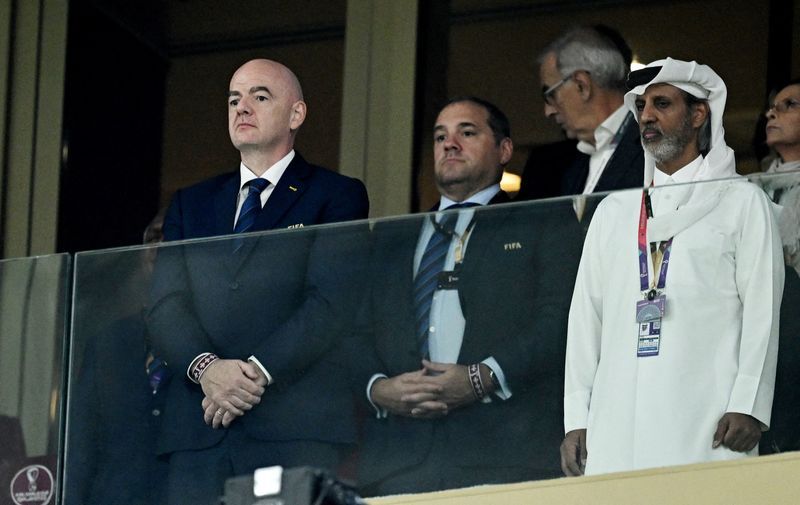
The Qatar Football Association has escalated an increasingly acrimonious dispute with Asian Football Confederation officials, maintaining that the regional body breached its own protocols by publicly criticising FIFA President Gianni Infantino without first seeking approval from its member nations. In a third consecutive letter made available to the media, QFA President Hamad bin Khalifa Al-Thani has rejected the AFC's explanations as inadequate, framing the exchange as a fundamental governance question rather than a disagreement over policy substance.
The underlying crisis centres on Infantino's FIFA Forward Enterprise proposal, an ambitious plan to inject private capital into the World Cup tournament structure. The initiative triggered unprecedented backlash from UEFA and CONCACAF confederations, who collaborated on an open letter that challenged both the proposal's merits and Infantino's stewardship of world football. The AFC subsequently appended its institutional endorsement to this criticism, a move that has now become the source of considerable diplomatic friction within Asian football circles and raises questions about the decision-making processes governing continental bodies.
Infantino's position as FIFA President has come under notable strain following the failed private investment bid. His planned reelection campaign next year now unfolds against a backdrop of rare institutional rebellion, with confederations abandoning the customary deference traditionally shown to FIFA's supreme office holder. The open criticism from multiple continental bodies represents a serious challenge to his authority and signals emerging fractures within the global football governance system that could influence voting dynamics when he seeks renewal of his mandate.
Al-Thani's latest correspondence focuses on procedural legitimacy rather than ideological positioning. The Qatari official contends that AFC President Sheikh Salman bin Ebrahim Al-Khalifa acted beyond his constitutional remit by signing the joint statement without either consulting the AFC's executive committee or seeking individual approval from the confederation's 47 member associations. This argument strikes at the heart of institutional accountability, suggesting that even if the policy position itself were defensible, the manner of its adoption violated established governance norms that protect member nations' decision-making authority.
The public nature of this exchange represents a remarkable departure from AFC convention. The confederation traditionally conducts sensitive disputes through confidential channels and behind-the-scenes negotiations, maintaining a facade of institutional unity to the outside world. This visible rupture between senior administrators signals either a fundamental breakdown in diplomatic relations or a calculated effort by Qatar to establish a formal documentary record of the AFC's governance failures, potentially for future reference in FIFA or legal proceedings.
Sheikh Salman's response on Tuesday directly challenged Qatar's framing, insisting he possessed both the constitutional authority and operational responsibility to defend Asian football's interests through decisive action. The Bahraini administrator rejected suggestions that he had overstepped institutional boundaries, essentially arguing that confederation presidents have traditional prerogatives to make significant public statements on matters affecting their sport. He dismissed Qatar's emphasis on procedural technicalities as obstructionist positioning that subordinated football's greater good to bureaucratic nitpicking.
Yet Al-Thani's counter-argument focuses on a distinction between past statements and the Infantino letter. The Qatari official acknowledges that AFC leadership has previously issued joint public positions, most notably expressing unified support for Qatar's hosting of the 2022 World Cup despite extraordinary international pressure and controversy. However, Al-Thani characterises those earlier statements as reflecting institutional consensus around an AFC organizational interest, whereas the Infantino letter represented a split position that should have required explicit member consultation given its divisive nature.
This distinction carries significant implications for Malaysian readers and broader Southeast Asian football governance. AFC members including Malaysia, along with other regional nations, face questions about their voices and voting rights within the confederation's decision-making architecture. If senior administrators can commit the entire confederation to major policy positions without mandatory member consultation, the practical power of individual nations becomes largely ceremonial. This dispute essentially concerns whether AFC remains accountable to its membership or whether concentrated executive authority has supplanted collective governance.
Qatar's unusual willingness to conduct this disagreement openly may reflect its unique position within Asian football. As host of the recently completed World Cup and a nation with substantial financial resources and political influence, Qatar possesses leverage that smaller confederation members lack. The country's early declaration of support for Infantino, alongside five other AFC nations, positioned it as a counterweight to the AFC leadership's public opposition, creating a factional dynamic that may have emboldened the Qatari challenge.
The dispute also illuminates deeper tensions within FIFA's governance structure. The primary complaint against Infantino's FFE proposal was precisely that it was developed without proper confederation consultation and instead pitched directly to FIFA's 211 individual member associations, effectively circumventing regional bodies. The irony that AFC leadership has now been accused of adopting a similar top-down approach—imposing a confederation position without member input—suggests that consultation failures may constitute a systemic problem rather than an isolated leadership failing.
For Malaysian football administrators and other Southeast Asian representatives, this public row demonstrates the stakes involved in AFC governance. The confederation's actions influence everything from tournament allocation decisions to championship format changes, resource distribution, and Asia's positioning in global football politics. Members must determine whether their AFC executives genuinely represent their interests through consultative processes or whether continental decision-making has become an elite function in which ordinary members have minimal practical influence.
The AFC has not yet responded to Al-Thani's latest correspondence, suggesting either that leadership is considering its position or preparing a fresh reply. Either way, this exchange has created a permanent documentary record of governance disputes that may influence future AFC leadership elections and member nations' willingness to accept confederation decisions without explicit authorization. The dispute ultimately reflects broader questions about accountability, legitimacy, and the proper balance between executive efficiency and democratic participation in international sports governance structures.

