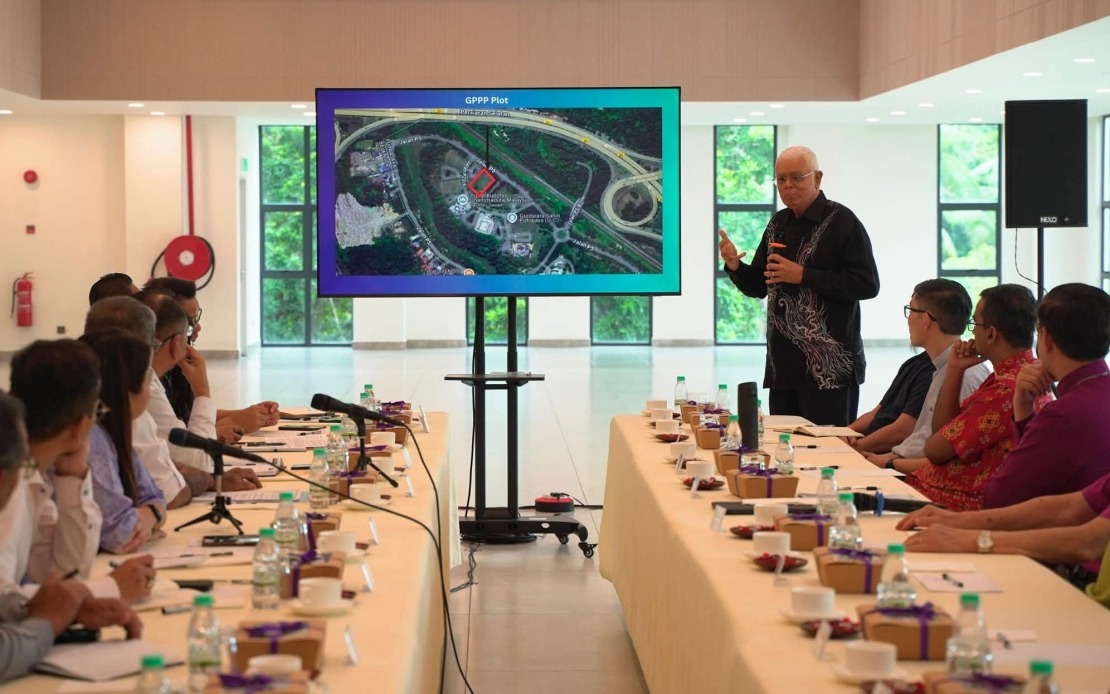
The federal government has established Putrajaya's Precinct 20 as a dedicated interfaith worship precinct, marking over a decade of intentional urban planning to accommodate diverse faith communities. National Unity Minister Datuk Aaron Ago Dagang confirmed the strategic land allocation initiative commenced in 2013, reflecting a commitment to structured religious pluralism within Malaysia's federal territory.
The designation of Precinct 20 as a multi-faith spiritual zone represents a deliberate architectural and governance choice that extends beyond merely providing real estate. Rather than scattering places of worship across the capital, the concentrated precinct model enables coordinated infrastructure development—shared facilities, parking, community spaces, and security—creating operational efficiencies while emphasizing the physical proximity of different faiths as a symbolic commitment to coexistence.
According to Aaron, this approach directly implements Policy 17 of the Putrajaya Structure Plan 2050, officially titled "Putrajaya Towards an Inclusive Compassionate Community." The policy framework acknowledges that inclusive urban design serves as a foundation for social cohesion, moving beyond reactive tolerance to proactive spatial planning that celebrates religious diversity. By embedding interfaith considerations into the structure plan rather than treating them as afterthoughts, planners signal that religious accommodation is central to the capital's identity.
The precinct currently hosts the Prince of Peace Church, recently inaugurated with ministerial attendance from both the National Unity Ministry and the Federal Territories portfolio. Simultaneously, the Dhammaduta Malaysia Buddhist Centre has operated since 2023, providing an established Buddhist sanctuary that predates several newer initiatives. These existing institutions anchor the precinct's interfaith credentials while demonstrating that the concept has progressed from planning documents to tangible community use.
Underway are multiple construction projects that will significantly expand religious capacity. The Gurdwara Sahib Putrajaya will serve the Sikh community, while the Hindu temple Dewi Sri Lalithaambigai Alayam and the San Qing Taoist Temple represent commitments to smaller faith communities whose worship needs are often overlooked in urban development. Additionally, land has been reserved for a Roman Catholic church, ensuring that Malaysia's Christian denominations benefit from the interfaith infrastructure.
The ministerial initiative connects to the broader Harmoni MADANI framework, launched by the National Unity Ministry in 2024. This initiative codifies the philosophy of "Understand, Respect, Accept and Celebrate" as the operational template for Malaysia's multireligious society. By tethering Precinct 20's development to this national narrative, officials position the physical spaces as practical manifestations of MADANI principles, transforming abstract values into architectural reality.
For Malaysia and Southeast Asia, this model addresses persistent urban planning questions: How do multicultural democracies accommodate religious expression equitably without privileging majorities? Putrajaya's approach suggests that designated interfaith precincts reduce ad-hoc conflicts over land use, prevent marginalization of minority communities, and create deliberate spaces for interreligious dialogue and mutual understanding. The concentrated hub model also facilitates monitoring and coordination by authorities concerned with community relations and security.
The interfaith hub concept carries implications beyond Putrajaya's borders. As Southeast Asian cities grapple with rapid urbanization and increasingly diverse populations, Precinct 20 offers a replicable template. Singapore, Jakarta, Bangkok, and Manila all face similar challenges of accommodating multiple faiths within finite urban space. Putrajaya's experience—particularly the integration of worship spaces with broader community facilities—could inform regional best practices for religious pluralism in urban contexts.
However, the success of such initiatives ultimately depends on sustained political commitment and genuine community participation. Designating land is administratively straightforward; ensuring equitable access, preventing discrimination in permit processes, and fostering authentic interfaith engagement requires ongoing institutional attention. The presence of ministers at ribbon-cuttings symbolizes governmental support, but the precinct's long-term effectiveness hinges on whether dialogue opportunities materialize and whether worshippers from different faiths develop genuine relationships rather than merely occupying adjacent spaces.
The Malaysian experience also reflects regional trends wherein governments increasingly recognize religious harmony as a governance priority rather than peripheral concern. As social media amplifies communal tensions and as urbanization creates previously unknown interactions between faith communities, deliberate interfaith architecture represents preventive policy—addressing potential conflict sources through design rather than reactive intervention.
Looking forward, Precinct 20's evolution will likely inform how Putrajaya and other Malaysian cities balance religious accommodation with urban efficiency. The precinct's success metrics will extend beyond occupancy rates to encompassing community perception, intercommunal activities, and whether the designated spaces genuinely strengthen social cohesion. Officials have framed the initiative as aligned with Malaysia's constitutional commitments to religious freedom and harmony, situating interfaith urban planning as essential governance rather than optional charity.
The designation of Precinct 20 as a multifaith worship precinct demonstrates that religious pluralism, when supported by deliberate policy and adequate resources, can be operationalized through urban planning. Whether this initiative becomes a model for regional cities or remains particular to Putrajaya will depend on replicating not merely the spatial design but also the sustained institutional commitment and community engagement that such initiatives demand.

