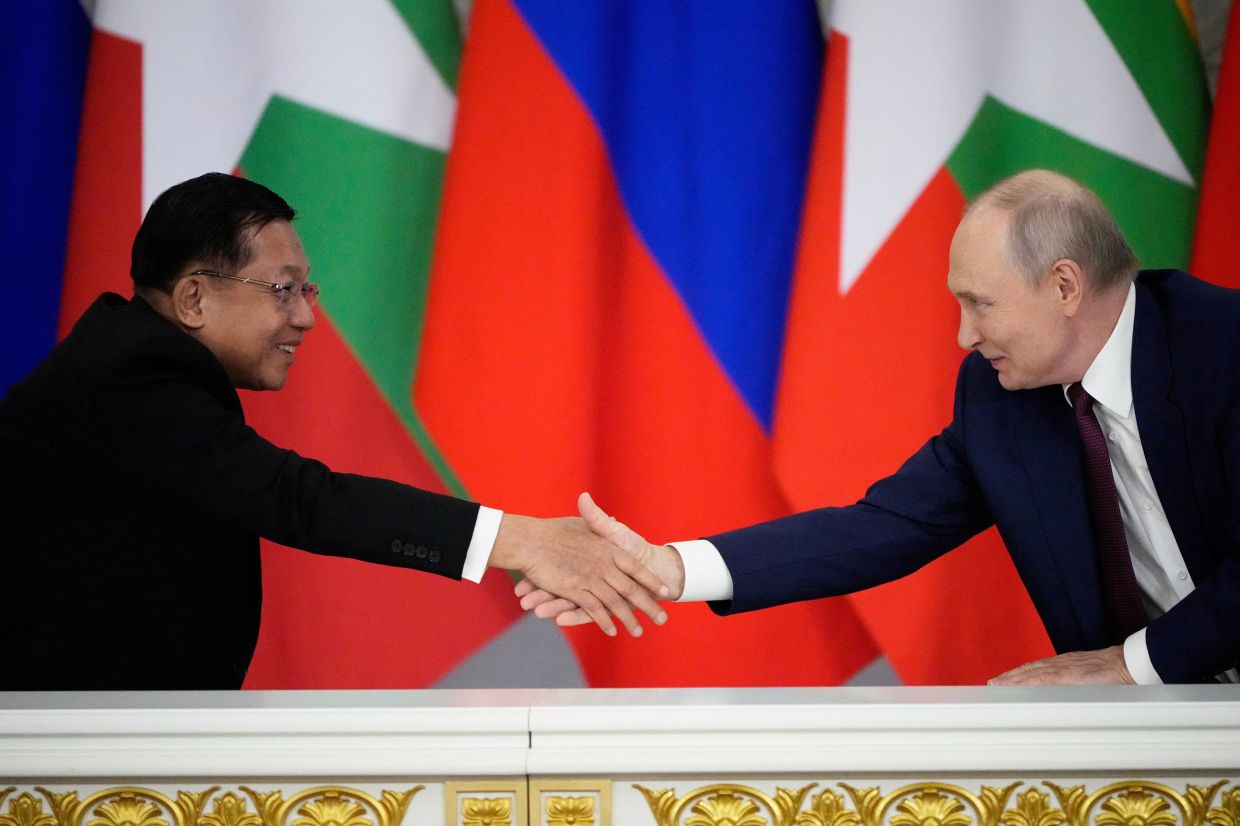
Russian President Vladimir Putin has underscored the expanding strategic partnership between Moscow and Myanmar, receiving country leader Min Aung Hlaing at the Kremlin in what marks the latter's first visit to his nation's closest ally since assuming the presidency in April. The Tuesday meeting in the Russian capital demonstrated the resilience of bilateral ties despite international isolation facing Myanmar's military establishment, with Putin characterising the relationship as having grown "especially trusting" in recent years.
The visit reflects Russia's distinctive position as one of the handful of major powers maintaining robust engagement with Myanmar's ruling junta, a stance that sets Moscow apart from Western nations that have largely withdrawn diplomatic and economic recognition following the 2021 coup. While much of the international community has implemented targeted sanctions and travel restrictions, Russia has instead deepened its footprint across Myanmar's defence, energy and infrastructure sectors. This fourth encounter between the two leaders since Russia's invasion of Ukraine underscores the consistency of their strategic alignment, particularly as Western pressure has intensified on both capitals.
At the centre of the renewed partnership lies a significant expansion of Russian economic involvement in Myanmar. Putin disclosed plans for Moscow to construct a thermal power plant and petrochemical refinery in southern Myanmar, alongside participation in geological surveys and hydrocarbon extraction ventures. These infrastructure projects represent a tangible deepening of economic ties that extends beyond the traditional military relationship that has historically defined the two countries' bond. The scope of involvement signals Russian ambitions to lock in long-term energy and resource security whilst simultaneously strengthening its geopolitical presence in Southeast Asia.
Beyond infrastructure development, nuclear cooperation has emerged as a defining pillar of the relationship. Myanmar is pursuing construction of a small-scale nuclear power plant in partnership with Russia's Rosatom State Corporation, positioning nuclear technology as a foundational element of the nation's energy diversification strategy. This partnership carries broader applications across Myanmar's health, agricultural and industrial sectors, suggesting ambitions to build institutional capacity in nuclear-related fields. For Russia, the arrangement extends its technological influence whilst generating long-term revenue streams and deepening dependency relationships.
The military dimension of the partnership remains substantial and consequential. Putin acknowledged Moscow's establishment of "close military and military-technical cooperation" with Myanmar, a characterisation borne out by procurement patterns. According to United Nations assessments from May 2023, Russia has supplied advanced weapons systems valued at more than US$400 million since the 2021 coup, establishing itself as a primary external military supplier despite international sanctions frameworks targeting the junta. This arms relationship provides Myanmar with crucial capabilities whilst generating vital export revenues for Russian defence industries facing Western restrictions.
The composition of Russia's negotiating delegation at the Kremlin talks revealed the multi-dimensional nature of the partnership. Alongside Putin were high-ranking officials spanning foreign policy, defence, energy and financial portfolios, signalling institutional commitment across government structures. Min Aung Hlaing's own delegation arrived as a substantial high-level contingent including multiple cabinet ministers and the head of the Myanmar Space Agency, underscoring the visit's significance as a comprehensive engagement rather than merely symbolic diplomacy. The Myanmar leader also held separate meetings with Prime Minister Mikhail Mishustin and Vyacheslav Volodin, speaker of Russia's lower house, extending the bilateral conversation across multiple institutional channels.
For Myanmar's military government, the Moscow engagement forms part of a broader diplomatic offensive aimed at rebuilding international legitimacy following the February election that drew widespread international condemnation. Beyond Russia, Min Aung Hlaing has conducted recent state visits to China, India, Laos and Thailand, orchestrating what amounts to a regional diplomatic tour designed to normalise his administration's standing. Despite these overtures, Myanmar's government has maintained a hardline position regarding the ousted civilian leader Aung San Suu Kyi, rejecting international calls for her release and continuing to marginalise the democratic opposition—factors that continue to complicate relationship-building efforts with Western governments and moderate Southeast Asian voices.
The timing and substance of Putin's engagement also reflect Russia's own strategic calculations amid deepening international isolation. As Western sanctions constrain Russian economic activity and technological advancement, partnerships with countries outside the Western orbit become increasingly valuable for maintaining influence networks and accessing resources. Myanmar's geographic position within Southeast Asia, coupled with its resource endowments and growing strategic importance, positions it as a valuable partner within Russia's broader effort to maintain a multipolar international system resistant to Western-led alignments.
The liquefied natural gas sector represents an additional dimension of economic cooperation that Putin specifically highlighted as offering "good prospects." Given Russia's traditional dominance in natural gas export markets and Myanmar's emerging energy infrastructure requirements, this sector offers mutual benefit opportunities. Myanmar's developing LNG capacity, combined with regional demand dynamics, could create commercially viable frameworks for Russian involvement, particularly as international energy markets recalibrate in response to geopolitical fragmentation.
For Malaysian policymakers and regional observers, the strengthening Russia-Myanmar partnership carries broader implications for Southeast Asian geopolitics. The relationship demonstrates how sanctions and isolation regimes can paradoxically deepen alignments among targeted states and their sympathetic partners, creating alternative networks outside Western-led structures. As Myanmar remains central to ASEAN's internal dynamics and regional stability, the deepening Russian footprint in defence, energy and infrastructure sectors contributes to the pluralisation of external influences within Southeast Asia, complicating efforts toward unified regional positions on contemporary security challenges.

