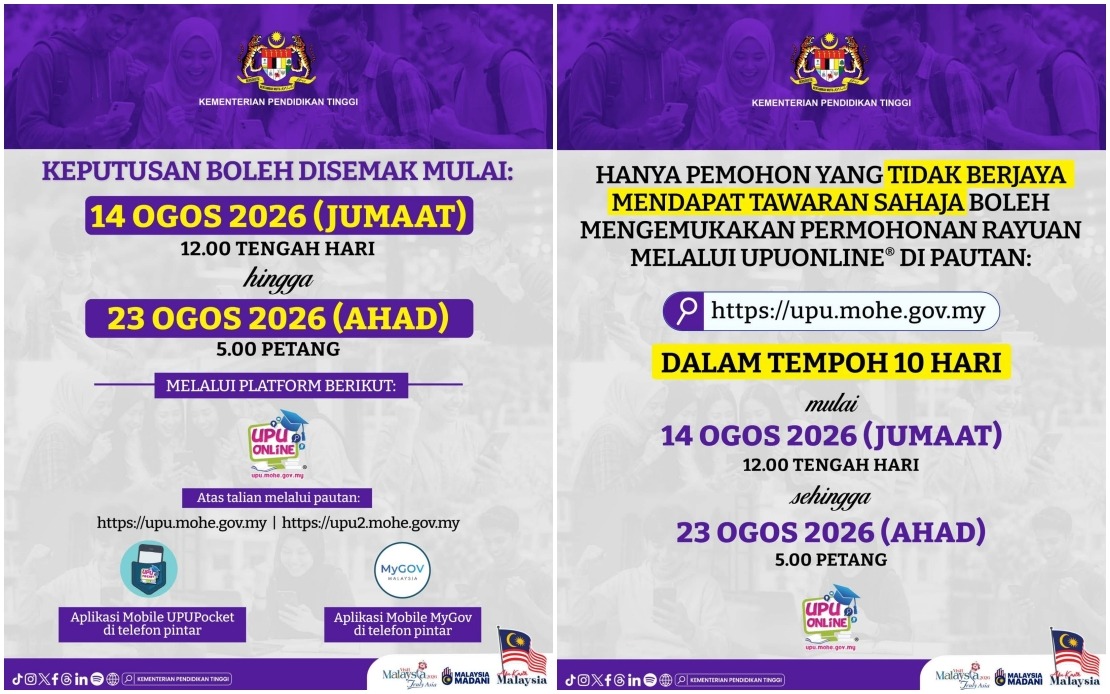
Malaysian students who completed their STPM or equivalent qualifications will finally receive their public university placement outcomes on August 14, marking a crucial milestone in the university admissions cycle for the 2026/2027 academic session. The Ministry of Higher Education will unveil the results through its online UPUOnline® system, ending months of anticipation for thousands of prospective undergraduates across the country who have been awaiting their fate since submitting applications earlier in the year.
Applicants can access their individual results starting from noon on August 14 through multiple digital channels designed to accommodate Malaysia's diverse population. The official UPUOnline website at https://upu.mohe.gov.my and the backup portal at https://upu2.mohe.gov.my will both be operational, alongside the mobile applications UPUPocket and Mobile MyGov, which allow students to check results directly from their smartphones. This multi-platform approach reflects the government's commitment to ensuring equitable access to critical information regardless of applicants' technological infrastructure or location, whether they reside in urban centres or more remote areas of Malaysia and East Malaysia.
The results window extends until 5 pm on August 23, providing a ten-day buffer for students to review their placements, compare offers across institutions, and plan their next steps accordingly. This extended timeline recognises that not all applicants may be able to access results immediately on release day, and families often need time to discuss options collectively before making binding decisions about their children's educational futures.
Once results are published, the confirmation phase begins immediately, with each public university managing acceptances and rejections through their respective institutional websites from August 15 onwards. Successful candidates will receive official offer letters from their allocated universities, but only after they have actively confirmed their willingness to accept the placement during the designated period. This two-way confirmation system ensures institutional commitment from students, reducing the likelihood of last-minute withdrawals that could disrupt enrolment planning.
For the unsuccessful applicants—a reality that affects a significant portion of each intake cycle—the system offers a structured pathway rather than leaving them without options. Those who fail to secure an initial placement may submit an appeal application between August 14 and 23, again through the UPUOnline portal. However, the Ministry of Higher Education has been transparent that such appeals will only succeed if vacancies remain within specific programmes after all initial placements and subsequent student registrations are finalised. This approach balances compassion with administrative realism, acknowledging that some students may be reconsidered if capacity permits, but making clear that successful appeals are not guaranteed.
Critically, the Ministry emphasises that offers made for the 2026/2027 academic session are final and binding. Once a student confirms acceptance of a placement, they forfeit any opportunity to request changes to either their chosen field of study or their designated university. This immutable nature of offers reflects institutional needs for firm enrolment figures to organise classroom resources, teaching staff allocation, and campus facilities. While the restriction may frustrate some applicants hoping to negotiate better options after seeing their initial results, it provides universities with essential planning certainty and prevents the cascading withdrawals that would destabilise intake schedules.
The August timeline arrives within the broader context of Malaysia's education system, where STPM remains the primary gateway for school-leavers seeking public university places. With limited capacity at premier institutions and intense competition for premium programmes in fields such as medicine, engineering, and business, the admission results carry enormous weight for young Malaysians. The stakes extend beyond individual students to their families, who often view university placement as a marker of educational achievement and a pathway toward economic mobility within Malaysia's competitive labour market.
For regional observers, Malaysia's structured, publicly managed admissions process contrasts with more decentralised systems elsewhere in Southeast Asia, where private university proliferation and varying quality standards create more fragmented pathways to higher education. The UPUOnline system represents an attempt to systematise fairness and transparency, though questions persist about whether the selection criteria—typically based on STPM results—adequately identify student potential across Malaysia's diverse socioeconomic and geographic demographics.
Prospective undergraduates should note that the confirmation deadline of August 23 is binding. Missing this window forfeits the placement offer automatically, so students and families must treat this date with absolute seriousness. For those with outstanding questions or technical difficulties accessing the portals, contacting their respective universities directly during the confirmation window remains advisable, as university admissions offices can provide individualised assistance that automated systems cannot replicate.
Looking ahead, the August 15-23 acceptance period will shape Malaysia's university intake for the coming academic year, influencing everything from campus demographics and programme-specific class sizes to residential college allocations and scholarship distributions. The ripple effects of this centralised admissions cycle will be felt across public universities nationwide as they welcome their newest cohort of students, each of whom represents both an educational opportunity and an institutional resource allocation decision made through the UPUOnline system's algorithmic matching process.

