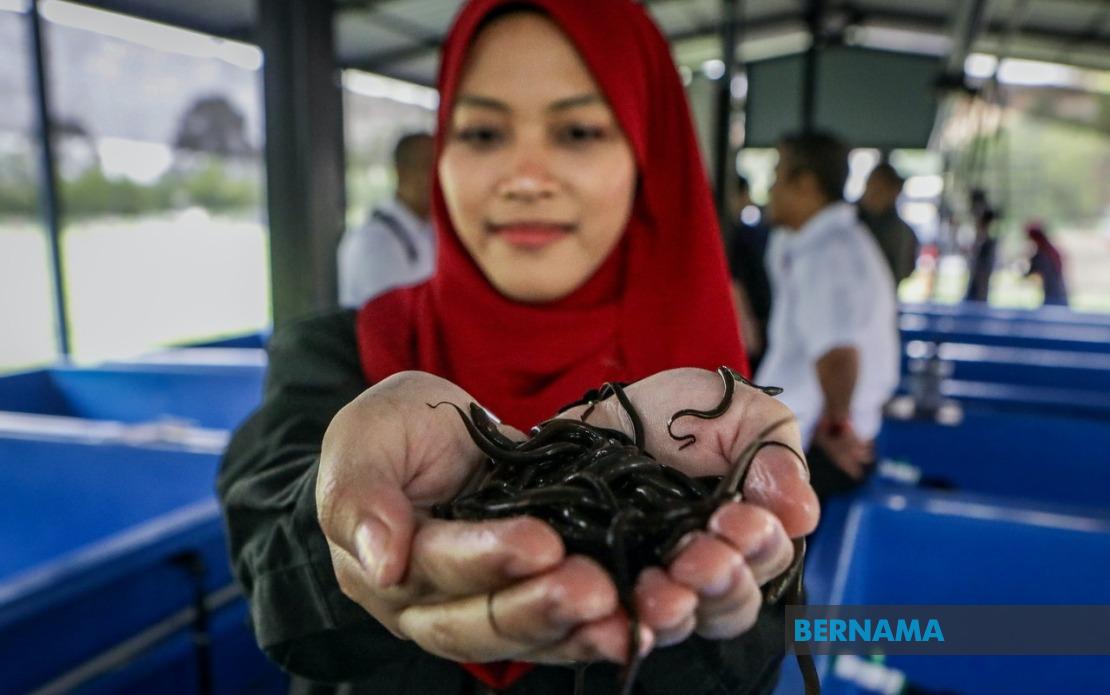
A vocational training institution in Arau has taken a hands-on approach to regional development by orchestrating a commercial eel farming initiative that doubles as a practical classroom for students while generating tangible economic benefits for five participating communities in Perlis. The Projek Penternakan Belut Komersial Geran Sejati MADANI, launched on July 1, represents a shift in how Technical and Vocational Education and Training (TVET) colleges can serve purposes beyond producing job-ready graduates—positioning themselves as catalysts for grassroots entrepreneurship and capacity building.
Politeknik Tuanku Syed Sirajuddin (PTSS) director Khairul Anuar Ishak underscored this expanded mission, framing the project as validation that TVET institutions possess both the expertise and institutional infrastructure to tackle community challenges directly. Rather than confining knowledge to classrooms, PTSS is channeling its aquaculture and business management capabilities into a structured six-month program where students gain experiential learning while communities acquire the skills and resources to operate profitable enterprises. This dual benefit model reflects a broader global trend where vocational education moves beyond employability toward inclusive economic development.
The project's architecture reveals sophisticated planning. Over the initial six-month implementation window, PTSS assumes full responsibility for site preparation, purchasing equipment and fingerlings, delivering comprehensive training modules, and establishing financial management systems. Only after this foundation-building phase does control transfer entirely to participating community groups, ensuring they possess both technical competence and administrative capacity to sustain operations independently. Each of the five communities receives 15,000 juvenile eels—a substantial initial cohort designed to achieve meaningful production volumes quickly.
Financial projections suggest compelling returns. Officials estimate that after five to six months of growth, each community should harvest approximately 5,000 kilograms of eels, providing a new revenue stream for families whose economic options may otherwise be limited. The RM500,000 government investment functions as initial capital injection rather than permanent subsidy, with the expectation that profitable operations will become self-financing. This contrasts with traditional poverty alleviation schemes that create dependency; instead, the model emphasizes building durable productive assets and entrepreneurial capability within target populations.
The involvement of the Prime Minister's Department's Implementation Coordination Unit (ICU JPM) signals that this initiative aligns with broader national development priorities. Azlan Abdul Samat, director of the Perlis Federal Development Office under ICU JPM, officiated the launch, indicating government endorsement of TVET-led community economic initiatives as part of Malaysia's regional development strategy. For Perlis, which historically ranks among Malaysia's less industrialized states, such programs carry particular significance in diversifying livelihoods beyond traditional agricultural dependence.
The contract farming methodology that PTSS has designed into the project creates market certainty for producers. Rather than requiring fledgling entrepreneurs to navigate wholesale or retail distribution independently—a barrier that often stalls small-scale aquaculture ventures—the arranged purchasing arrangements reduce commercial risk during these critical early months. This approach recognizes that technical skill alone cannot guarantee business success without reliable demand and pricing mechanisms.
From an educational standpoint, the project represents pedagogical innovation within Malaysian vocational training. Students encounter real-world complexity: monitoring water quality, managing disease prevention, tracking feed conversion ratios, maintaining breeding stock, and coordinating with community partners who depend on the venture's success. These variables cannot be fully replicated in controlled laboratory settings, making the project invaluable for developing graduates who understand agriculture not merely as biological science but as an integrated socioeconomic enterprise.
The emphasis on knowledge transfer rather than one-way assistance reflects contemporary development thinking. Rather than external agencies managing operations indefinitely, PTSS deliberately structures programs toward community self-management. This respects local agency and builds institutional confidence—communities learn to problem-solve independently rather than remaining dependent on government or educational institution support. For rural Perlis, where out-migration to urban centers has depleted human capital, such locally rooted economic initiatives can help retain younger residents by demonstrating viable income opportunities.
The collaboration model itself merits attention. By bringing together educational institutions, government agencies, industry partners, and communities under a coordinated framework, the project exemplifies the multi-stakeholder approach increasingly recognized as essential for sustainable development. PTSS contributes technical expertise and training capacity; government provides financing and regulatory support; industry partners potentially offer market linkages; and communities contribute land, labor, and local knowledge. This distribution of responsibilities and benefits creates broader ownership of outcomes.
For other Malaysian states considering similar initiatives, the Perlis eel farming project offers a replicable blueprint. Aquaculture, particularly in freshwater systems, suits many regions' environmental conditions and requires modest capital investment relative to industrial operations. The six-month implementation timeline proves realistic, and vocational institutions across Malaysia possess comparable pedagogical resources. However, success depends on rigorous attention to market research, ensuring community participants actually possess interest in aquaculture and that regional demand exists for the projected output volume.
The RM500,000 budget reflects genuine resource commitment. Unlike symbolic or pilot programs, this scale of investment can cover meaningful infrastructure, quality inputs, and comprehensive training rather than fragmented support. It signals that authorities recognize community economic development requires substantive financial backing alongside technical assistance. For participating communities, this level of resourcing can genuinely establish functioning enterprises rather than merely demonstrating concepts.
Looking ahead, the critical test arrives after the six-month handover period concludes. Community groups must then operate independently, solve problems as they arise, and navigate market fluctuations without institutional support. PTSS's responsibility includes ensuring communities receive sufficient post-launch mentoring and establishing mechanisms for addressing difficulties. Some ventures will inevitably encounter challenges—disease outbreaks, market price downturns, operational bottlenecks—and whether communities can navigate these determines whether the initial investment generates lasting economic transformation or remains a time-limited intervention.
Ultimately, Politeknik Tuanku Syed Sirajuddin's eel farming initiative exemplifies how Malaysian vocational institutions can evolve beyond conventional roles. By marrying educational objectives with community development outcomes, TVET colleges demonstrate relevance to immediate national priorities while maintaining pedagogical integrity. For rural regions like Perlis, such programs can reshape economic possibilities, offering pathways toward sustainable livelihoods that neither require urban migration nor depend on limited government employment opportunities.

