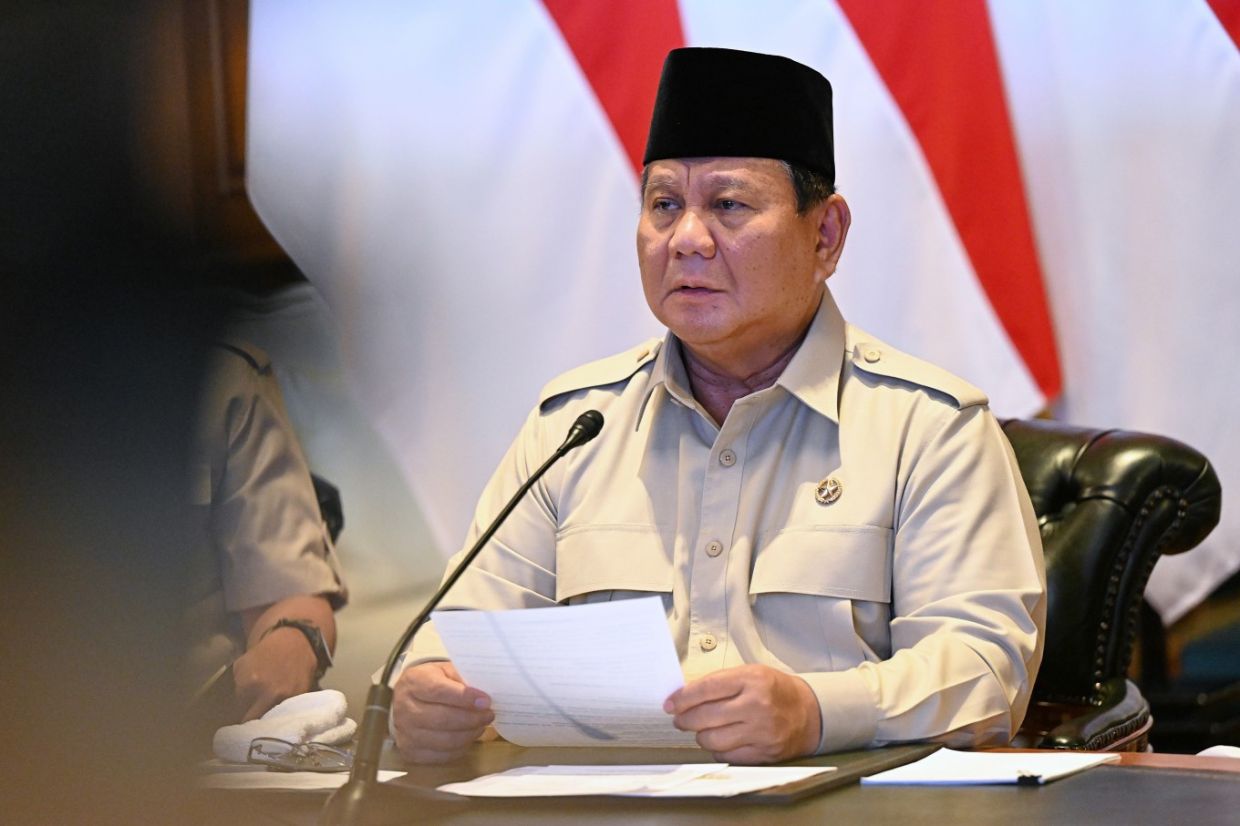
Indonesia's President Prabowo Subianto has experienced a dramatic reversal in public support, with his approval rating collapsing from 81.2 percent in November 2025 to 51.1 percent by July 2026, according to fresh data from Saiful Mujani Research and Consulting. The three-decade drop represents a decisive pivot from the kind of sustained political goodwill that has rarely extended beyond a president's first year in office. What made Prabowo's tenure exceptional was not merely the initial election victory, but the durability of public backing through much of 2025—a longevity that few modern leaders have managed to sustain.
The foundation of this extended goodwill rested primarily on aggressive social spending, particularly the free nutritious meal programme rolled out nationwide in January 2025. Unlike typical election victories that generate temporary euphoria before reality reasserts itself, Prabowo's administration deployed concrete welfare initiatives that provided tangible benefits to ordinary Indonesians. This approach kept him in the 70 to 80 percent approval range throughout 2025, a performance that contrasted sharply with his predecessor Joko Widodo's trajectory. Widodo did not achieve approval ratings in this range until late in his second term, when SMRC recorded his maximum rating of 81.7 percent in May 2023. Jokowi's first term, by contrast, opened with similar initial support but cratered rapidly to 41 percent following the politically damaging fuel subsidy hike.
The latest SMRC survey, conducted between July 5 and 19 involving 749 respondents, documents not merely a decline but a wholesale shift in public sentiment. Dissatisfaction surged from approximately 16 percent in November 2025 to 46.9 percent in the most recent poll—a striking inversion that leaves barely five percentage points between approval and disapproval. This pivot signals that the public has moved decisively from granting the benefit of the doubt to demanding concrete delivery on campaign commitments. Prabowo's core election pledges—namely reducing corruption and lifting gross domestic product growth from its current five percent to eight percent—now face direct scrutiny against measurable economic realities.
Those economic realities have deteriorated markedly. The rupiah has weakened substantially, the stock market remains sluggish, and questions have intensified regarding state spending sustainability and the independence of Bank Indonesia. Public perception of economic conditions has contracted sharply, with only 15.7 percent of respondents in July 2026 expressing positive views of the economy compared with considerably higher sentiment earlier in the year. Deni Irvani, SMRC's executive director, attributes the broad decline to worsening public perceptions across three crucial areas: the economy, the political environment, and law enforcement effectiveness. The erosion of confidence in these domains suggests that rhetorical appeals, however frequent or forceful, cannot indefinitely compensate for deteriorating lived experience.
Prabowo's communications strategy—rooted in high visibility through televised speeches and direct confrontation with critics and journalists—proved effective during the honeymoon period when underlying economic conditions remained sufficiently positive to support the president's narrative. His extensive media presence and willingness to engage adversaries directly generated momentum as long as day-to-day experiences aligned with official messaging. However, the July 2026 data suggest this communications ceiling has been reached. Citizens ultimately judge their leaders not by rhetorical force or screen time but by tangible metrics: the trajectory of prices, the exchange rate's stability, employment prospects, whether welfare programmes arrive as promised, and whether public services function. When these fundamentals deteriorate, even the most aggressive communications operation loses its persuasive power.
Critical context emerges when comparing Indonesia's situation to international precedent. Donald Trump's second term commenced in January 2025 with historically weak approval of 47 percent, whilst Barack Obama and Joe Biden both experienced steep early declines from their opening highs. None of these American leaders sustained the elevated approval plateau that Prabowo maintained through most of 2025. A 30-point drop across nine months remains dramatic, yet such declines need not prove catastrophic. Jokowi himself recovered from significantly worse early setbacks, demonstrating that a presidency need not be defined by its lowest point.
The credibility of these measurements deserves examination, particularly given that SMRC founder Saiful Mujani has become an openly critical voice regarding government policy. Gerindra Party officials have raised this point, questioning whether institutional bias might distort the polling. However, methodological soundness cannot be reliably assessed through examining a pollster's political positions. SMRC maintains a lengthy track record of rigorous survey work, including years when its findings reflected positively on the Jokowi administration. More significantly, the SMRC findings are not isolated. Indikator Politik Indonesia, operating independently, surveyed 4,250 respondents between July 14 and 24, discovering satisfaction of 49.5 percent—down from 68 percent in April 2026 and 81 percent in December 2025. This convergence between two distinct polling organizations tracking nearly identical downward trends substantially diminishes claims of systematic bias or methodological failure.
The administration's response indicates awareness of the severity of the situation. Officials at the Presidential Palace have convened the National Economic Council to devise approaches for improving economic policy performance—the domain where public satisfaction has contracted most severely. Prabowo's inner circle has simultaneously engaged pollsters from the successful 2024 presidential campaign for strategic consultation. These discussions have reportedly focused on enhancing public communication effectiveness and conducting comprehensive audits of programmes plagued by implementation difficulties, specifically the free nutritious meal initiative and the Red and White Cooperatives scheme. According to sources close to these consultations, one assessment suggests approval could recover if substantive improvements materialize within the president's immediate circle.
Governing during potential climate disruption presents additional complexity. Officials cite forecasts of an El Niño event and its anticipated consequences for agricultural productivity, household purchasing power, and food price inflation. The decision to maintain fuel prices unchanged reflects calculations that price increases would accelerate broader economic deterioration. This reflects genuine policy dilemmas: fuel subsidies create fiscal strain, yet price increases generate immediate political backlash. The government appears to be betting that stability in energy costs might provide breathing room for other interventions to take effect.
The expansion of social assistance programmes under consideration suggests an administration attempting to recapture momentum through intensified welfare spending rather than structural economic reform. Whether this represents genuine recognition of implementation failures or merely tactical repositioning remains unclear. The core challenge confronting Prabowo transcends communications strategy: ordinary Indonesians experiencing currency depreciation, price pressures, and uncertainty about programme delivery are unlikely to be swayed by presidential rhetoric alone. The fundamental question determining whether approval recovers centres on whether the economy, political stability, and public service delivery genuinely improve in the coming months.

