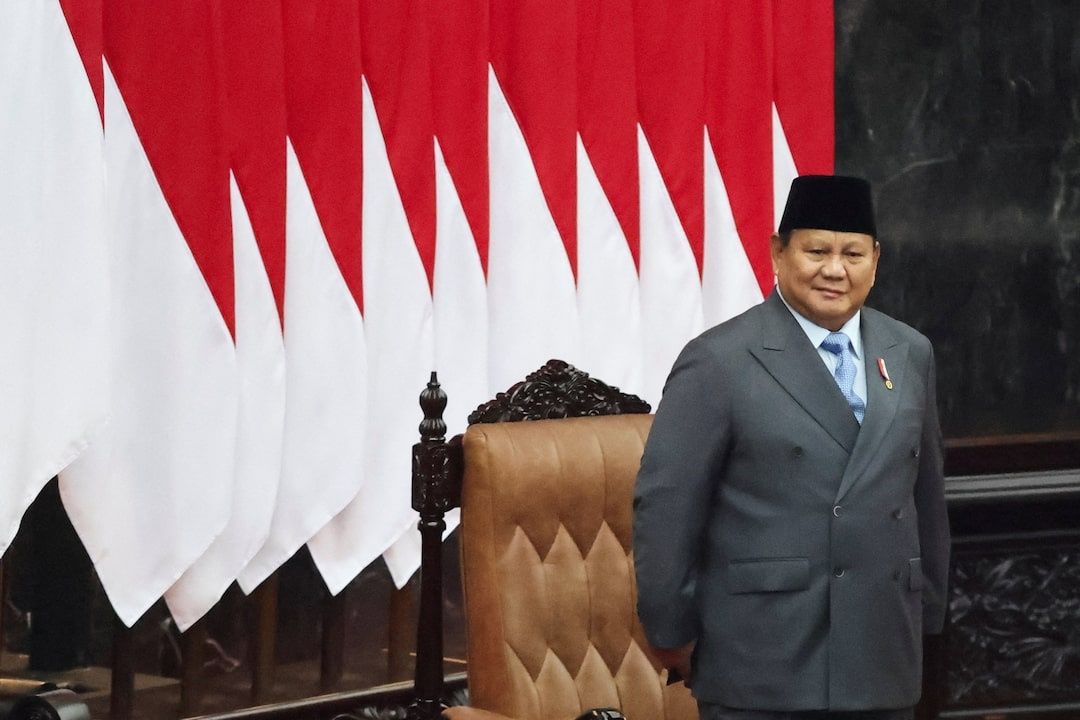
Indonesia's President Prabowo Subianto confronts a defining moment for his administration this Friday as he unveils the 2027 budget framework, a crucial test of his economic credibility at a time when public confidence in his leadership has eroded sharply and international investors grow increasingly wary of his policy direction. The former military officer, who rode a landslide electoral mandate to office last October with bold pledges to eradicate corruption, accelerate growth to 8 percent annually, and provide subsidised meals to millions of schoolchildren, now finds his ambitious agenda hemmed in by economic realities that threaten to undermine his political standing and market reputation.
Prabowo's political fortunes have shifted markedly during his opening months in power. Recent polling data reveals his approval rating has plummeted nearly 30 percentage points in just eight months, slipping to 51 percent as Indonesians grapple with deteriorating economic conditions and mounting frustration with the performance of law enforcement institutions. Concurrently, the rupiah has depreciated substantially whilst the nation's stock market has delivered disappointing returns, signalling investor anxiety about the government's policy trajectory and macroeconomic management. These interconnected challenges have created a difficult operating environment for a president who initially benefited from extraordinary goodwill and electoral enthusiasm.
The budget presentation itself will unfold across two phases on Friday. During a morning parliamentary address marking Indonesia's Independence Day, Prabowo will articulate his broader policy vision for the nation, before pivoting to detailed budget specifics in the afternoon session. This scheduling reflects the administration's awareness that the occasion demands not merely numerical tables but a coherent narrative addressing fundamental concerns about economic stewardship and the viability of signature programmes. Analysts and market participants will scrutinise both the fiscal architecture and the president's capacity to convince sceptics that his government has learnt from missteps and adjusted course accordingly.
A particularly acute vulnerability surrounds Prabowo's flagship free meals initiative, the centrepiece of his electoral campaign and a reflection of his claimed commitment to social equity. Implementation has been marred by budget constraints and troubling reports of mismanagement, raising uncomfortable questions about whether the administration can effectively execute even its flagship policies, let alone broader structural reforms. The reputational damage from these early stumbles reverberates beyond the programme itself, undercutting the president's broader credibility narrative about competent governance and corruption elimination.
Economists and financial institutions are viewing Friday's budget announcement as perhaps the most significant credibility checkpoint for international investors in recent years. Irman Faiz, an economist at Bank Danamon, underscores that the 2027 budget carries outsized significance because Indonesia's credibility has already been tested multiple times—markets have been forced repeatedly to digest policy surprises and strategic reversals that have gradually eroded investor tolerance for unpredictability. The fiscal deficit currently tracking around 2.8 percent of GDP in 2025 poses an additional constraint, as it edges perilously close to the constitutional ceiling of 3 percent, limiting the administration's flexibility for expansionary spending.
Central to investor concerns is the murky status of the Danantara Sumberdaya Indonesia initiative, a state-owned entity announced with considerable fanfare in May when Prabowo surprised markets by proposing centralised government control over all critical natural resource exports. The original announcement suggested the entity would assume direct operational control, sending shockwaves through commodity markets and triggering investor alarm about potential nationalisation disguised as policy reform. Subsequently, various government officials have walked back the proposal's scope, suggesting instead that Danantara Sumberdaya Indonesia would exercise supervisory rather than operational authority, yet genuine clarity remains elusive.
This ambiguity surrounding the commodity initiative encapsulates a broader challenge confronting Prabowo's government: the gap between ambitious announcements and practical implementation details, coupled with the inconsistency between different officials' public statements about policy direction. Yose Rizal Damuri, executive director of the Centre for Strategic and International Studies think tank, expects Friday's budget address to clarify the commodity agency's precise role—a point investors will scrutinise closely. Commodities traders and palm oil analysts globally are also watching intently, aware that clarification could significantly influence global agricultural and raw material markets, given Indonesia's substantial role in commodity production and export.
The rupiah depreciation and stock market underperformance reflect deeper concerns about macroeconomic stability and the sustainability of Prabowo's growth acceleration targets. When the president took office, achieving 8 percent annual growth from a baseline of 5 percent appeared feasible given initial investor enthusiasm and commodity price dynamics. However, subsequent months have revealed implementation challenges, policy inconsistency, and external headwinds that make the ambitious target considerably more daunting. Currency weakness itself creates inflationary pressures and erodes purchasing power, complicating the government's ability to finance social programmes whilst maintaining fiscal discipline.
Arya Fernandes, head of politics and social change at the Centre for Strategic and International Studies, argues that Prabowo faces an extraordinarily difficult task in Friday's address: he must simultaneously reassure investors about macroeconomic management, address rising public doubts concerning the economy's direction, and articulate credible plans for implementing priority programmes that have already encountered execution difficulties. This requires not simply announcing new spending plans but demonstrating that the administration understands what went wrong, how it will recalibrate, and why investors and citizens should place renewed confidence in its capacity to deliver results.
For Malaysia and the broader Southeast Asian region, Indonesia's fiscal and political trajectory carries spillover significance. As the region's largest economy and a key commodity producer, Indonesia's stability affects regional growth prospects, currency valuations, and investment flows. Market concerns about Indonesian policy unpredictability can trigger broader portfolio adjustments affecting the entire region. Moreover, the commodity export control proposals directly concern Malaysia's own resource industries and global commodity traders based in or operating from Malaysian financial centres. A chaotic resolution of these policy questions could unsettle regional economic confidence and complicate cross-border commercial relationships.
The contrast between Prabowo's overwhelming electoral mandate and his current political vulnerability underscores how rapidly initial goodwill can evaporate when economic conditions deteriorate and flagship programmes stumble. His government entered office with extraordinary latitude for ambitious reform, yet has managed instead to accumulate a series of credibility deficits through inconsistent messaging and implementation gaps. Friday's budget presentation represents an opportunity to reset expectations, provide genuine clarity on contentious policies, and demonstrate that despite early setbacks, the administration possesses both the competence and the commitment to deliver on its fundamental promises of sustainable growth and effective governance.

