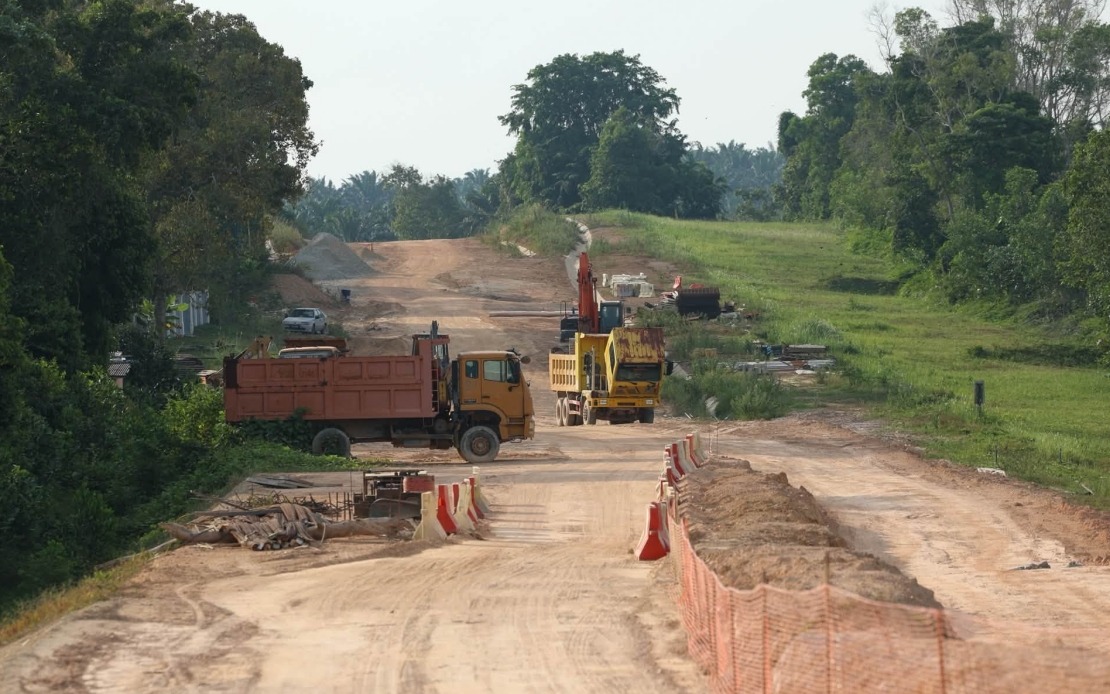
The 10-kilometre road linking Lukut to Kampung Sirusa through Kampung Paya and Kampung Bagan Pinang in Port Dickson is progressing at a faster pace than initially anticipated, with construction now standing at 60.57 per cent completion and the project 43 days ahead of its original timeline. The RM81.92 million undertaking, which carries a contractual completion date of August 10, 2027, represents a substantial infrastructure investment aimed at fundamentally reshaping Port Dickson's transport landscape and unlocking latent economic potential across the district.
Deputy Works Minister Datuk Seri Dr Ahmad Maslan conducted an inspection of the construction site to verify that work is progressing in accordance with agreed schedules, technical specifications and quality standards. The visit underscored the federal government's commitment to ensuring that large-scale infrastructure projects maintain momentum whilst adhering to rigorous oversight protocols. During the inspection, officials assessed on-ground conditions and addressed any logistical challenges that might impede the project's trajectory towards completion.
The works fall under the purview of the Ministry of Rural and Regional Development, with the State Public Works Department (JKR) serving as the implementing agency. Funding is drawn from the Federal Government's development allocation, reflecting Putrajaya's prioritisation of regional infrastructure in less densely developed areas. This governance structure seeks to balance central oversight with state-level execution capacity, a model increasingly common across Malaysia's infrastructure expansion programmes.
The project specification encompasses a comprehensive suite of civil engineering works built to Public Works Department R2 standards. The scope extends well beyond simple road surfacing; it includes slope stabilisation, comprehensive drainage networks, sewerage infrastructure, structural works and integration of utility conduits. This holistic approach ensures that the new corridor serves not merely as a transport artery but as foundational infrastructure supporting broader community development needs.
For Port Dickson residents, the implications are multifaceted. The enhanced accessibility between Lukut and Kampung Sirusa promises to compress journey times significantly whilst improving road quality and safety standards. Commuters travelling to economic centres, educational facilities, healthcare providers and tourist attractions will benefit from smoother traffic conditions and more direct routing. The psychological dimension of infrastructure development—community confidence that services and opportunities lie within reasonable reach—often proves as valuable as the tangible time savings.
The project functions as a catalyst for socioeconomic transformation across the district. Improved road connectivity historically correlates with accelerated commercial activity, as businesses find markets more accessible and supply chains more efficient. Port Dickson, already possessing tourism potential through its coastal positioning and recreational facilities, stands to attract enhanced investment as transport barriers diminish. Local entrepreneurs gain capacity to serve wider customer bases, whilst external investors view the district with increased interest once connectivity improves.
Employment generation represents another significant dimension. Infrastructure projects of this magnitude typically create construction jobs during implementation, whilst the improved accessibility subsequently facilitates new business ventures and expansions that generate sustained employment opportunities. The ripple effects extend across retail, hospitality, agriculture and light manufacturing sectors, all of which benefit from reduced transport costs and improved market access.
The ahead-of-schedule progress raises important questions about project management and execution capacity in Malaysia's public infrastructure sector. When projects consistently underperform schedule expectations, observers often attribute shortcomings to inadequate planning, resource constraints or technical difficulties. Conversely, accelerated progress suggests effective coordination between contractors, supervising engineers and government agencies, along with potentially favourable site conditions and weather circumstances. The 43-day advancement represents approximately nine per cent ahead of original projections, a meaningful margin that indicates either conservative initial scheduling or exceptionally competent execution.
For broader regional development strategies, this Port Dickson corridor exemplifies how targeted infrastructure investment can animate previously peripheral areas. Negeri Sembilan's Port Dickson district, whilst not among the nation's primary economic zones, possesses inherent advantages that improved connectivity can unlock. The new road essentially removes a constraint on development, allowing market forces and private enterprise to respond to newly expanded possibilities.
The project's completion within the contracted 2027 timeframe, potentially ahead of schedule, would represent a success story for Malaysia's infrastructure delivery. Such outcomes matter politically and administratively, building confidence among stakeholders and justifying continued public investment in similar initiatives. The works also demonstrate that large capital projects can progress effectively when institutional frameworks are sound, oversight is active and coordination between participating agencies functions adequately.
As construction continues across the coming months, Port Dickson residents and business stakeholders will witness tangible transformation of their district's physical infrastructure. The completed road will form part of a broader tapestry of connectivity improvements essential for Malaysia's development aspirations. Whether this particular project becomes a widely-cited exemplar of efficient public infrastructure delivery or simply another successful completion will depend partly on how outcomes are communicated and learned from across the government sector.

