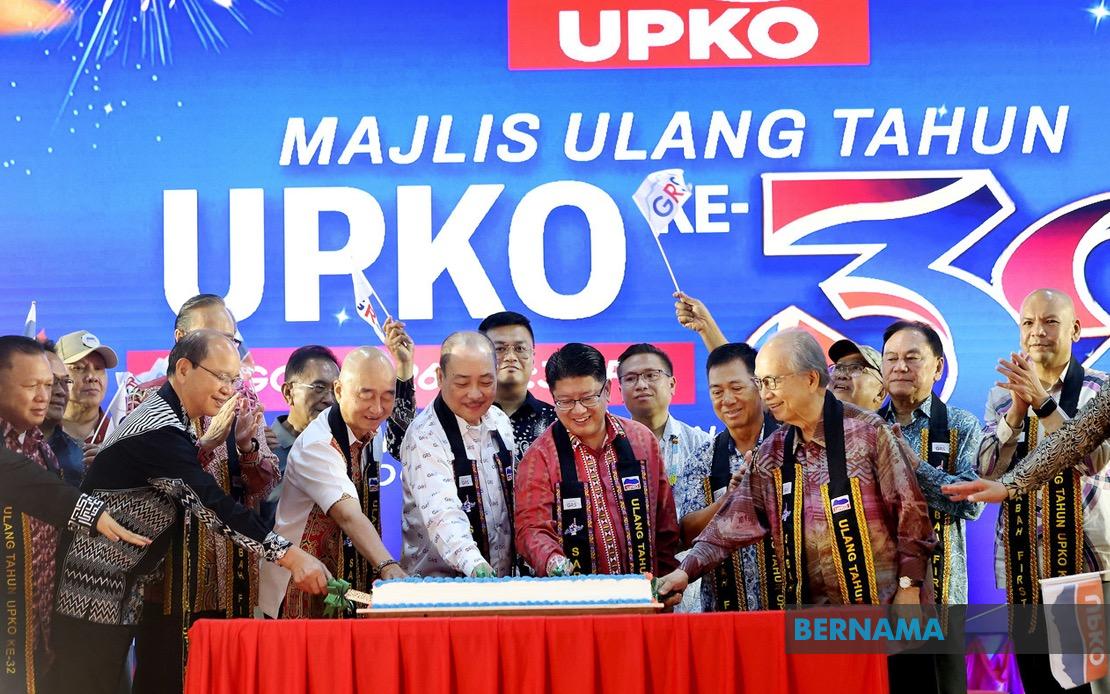
Sabah Chief Minister Datuk Seri Hajiji Noor has underscored the critical importance of political stability as a prerequisite for the state government to dedicate resources and attention toward development initiatives, economic advancement, and infrastructure expansion. Speaking at the 32nd United Progressive Kinabalu Organisation (UPKO) anniversary celebration and the opening of the party's 17th Triennial Delegates Conference in Kota Kinabalu, Hajiji articulated a vision in which a cohesive political landscape enables Sabah to concentrate on pressing developmental needs rather than managing internal political tensions.
The Sabah Chief Minister emphasised that the Gabungan Rakyat Sabah (GRS) coalition's strength lies in its ability to transcend the diverse ideological roots and organisational histories of its member parties. He acknowledged that whilst GRS component parties possess distinct backgrounds and political foundations, their participation in the coalition represents a conscious decision to prioritise collective governance and shared objectives over factional interests. This framing reflects an understanding that multi-party coalitions, particularly in a state context, require deliberate commitment to unity despite inherent differences.
Hajiji employed evocative language to describe GRS as a communal shelter where parties find common ground. He stated that GRS functions as a home that must be protected collectively, one that offers asylum for a unified mission centred on serving the people and advancing Sabah's interests. This metaphorical approach suggests that the coalition's coherence depends not merely on formal agreements but on a shared emotional and philosophical commitment to the state's wellbeing. By framing the coalition in terms of a common house, Hajiji sought to reinforce the notion that internal party differences are secondary to the overarching mission of Sabah's development.
The timing of these remarks is significant given recent structural changes within the GRS framework. In June of this year, the coalition formally accepted UPKO as a new member, expanding the coalition's composition to six constituent parties. This expansion represents a deliberate strategy to broaden the political base supporting the state government and consolidate regional influence. The inclusion of UPKO, led by Datuk Ewon Benedick who serves as Sabah Deputy Chief Minister III and Minister of Industrial Development, Entrepreneurship and Transportation, signals an effort to integrate diverse political constituencies and strengthen governance capacity.
With UPKO's entry, GRS now incorporates Parti Gagasan Rakyat Sabah, Parti Bersatu Sabah, Liberal Democratic Party, Parti Harapan Rakyat Sabah, and Parti Cinta Sabah alongside UPKO itself. This expanded coalition reflects a political strategy common in Malaysian state-level governance, where building broader coalitions provides greater legitimacy, resource access, and resilience against potential defections. For Sabah, where state politics has historically been characterised by shifting alliances and competing regional interests, the expansion of GRS demonstrates an attempt to consolidate a stable governing arrangement.
Hajiji called upon UPKO leaders and members to sustain cooperative efforts in realising what he termed the "Sabah First, Sabah United, Sabah Forward and Sabah Prosper" vision. These four pillars outline a developmental framework that places Sabah's interests at the centre, emphasises internal cohesion, indicates forward momentum, and targets prosperity. For Malaysian observers, this articulation reflects broader national discourse regarding federalism and state development, particularly relevant to Sabah given its constitutional status and historical economic grievances within the Malaysian federation.
The emphasis on political stability as a prerequisite for development carries particular resonance in the Malaysian context, where state-level governance has occasionally been disrupted by sudden political realignments or defections. Sabah's experience with political volatility in previous years—including instances of minority government situations—lends credibility to the Chief Minister's argument that stability enables more effective resource allocation toward long-term developmental objectives. Without the distraction of internal political management crises, a government can theoretically dedicate more attention to policy implementation, infrastructure development, and economic planning.
UPKO's integration into GRS also serves a symbolic and practical function within Sabah's political landscape. As a party with historical roots in the state's political establishment, UPKO's embrace of the GRS coalition signals acceptance of the current governing arrangement and potentially forestalls alternative political formations. This move effectively reduces the number of potential oppositional configurations and strengthens the governing coalition's parliamentary majority.
For Malaysian readers following Sabah's political trajectory, Hajiji's statements represent a conscious effort to establish the narrative that GRS's expanded composition provides the stability necessary for implementing the state government's developmental agenda. The Chief Minister's repeated invocation of unity and shared purpose reflects an understanding that perceptions of political cohesion directly influence public confidence, investor sentiment, and bureaucratic effectiveness. When a government appears divided or unstable, external stakeholders become hesitant to commit resources or support long-term initiatives.
The implications for Sabah extend beyond immediate political management. Regional development, infrastructure connectivity to Peninsular Malaysia and other East Malaysian states, and economic diversification all require sustained governmental focus and multi-year planning. By framing political stability as essential to these objectives, Hajiji positions the GRS coalition as indispensable to Sabah's advancement. This argument also carries weight for voters who prioritise tangible improvements in healthcare, education, transportation, and economic opportunities over factional political interests.
The coalition's expansion and the reaffirmation of unity principles also reflect broader regional dynamics within Malaysian politics. As national political alignments continue to evolve, state governments increasingly serve as repositories of political legitimacy and policy innovation. Sabah's GRS coalition, with its multiethnic and multiparty composition, represents a model of consensual governance that some observers argue aligns with Malaysia's constitutional design emphasising federalism and power-sharing among diverse communities.
Moving forward, the real test of GRS's stability will lie not in rhetorical affirmations but in the coalition's ability to manage competing interests, distribute resources equitably among component parties, and deliver measurable developmental outcomes. Political stability, whilst necessary, ultimately proves meaningful only when paired with tangible improvements in citizens' lives and fulfillment of governance promises.

