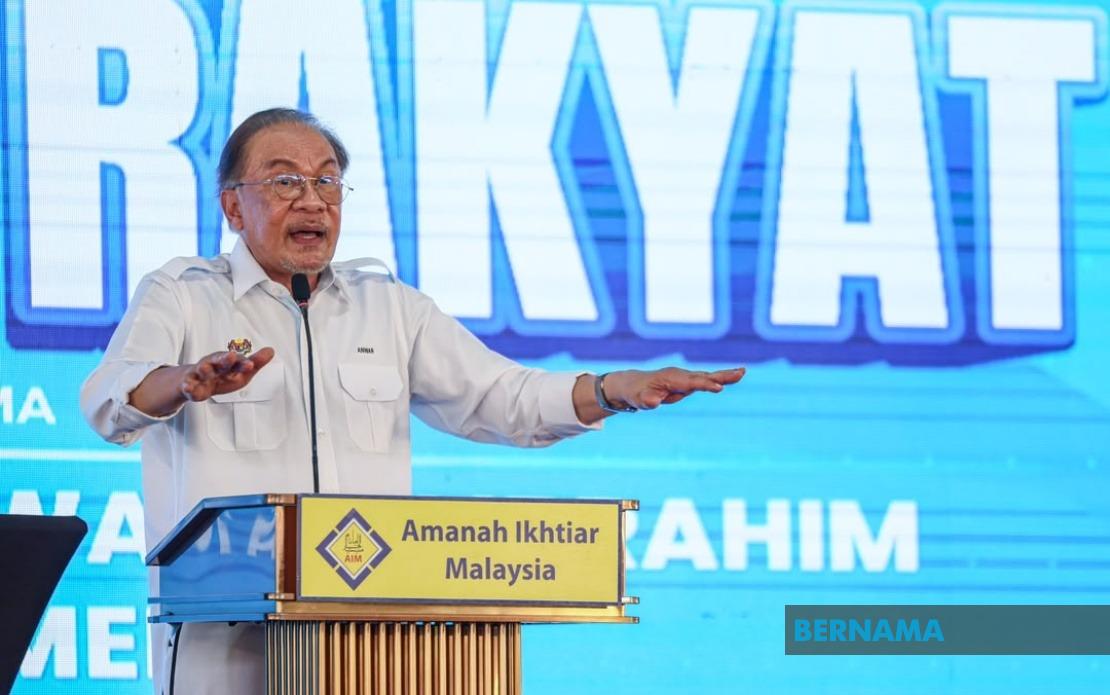
Prime Minister Datuk Seri Anwar Ibrahim has attributed opposition political coalitions to his administration's rigorous anti-corruption framework, arguing that those who previously benefited from lax governance now feel threatened. Speaking at a campaign event in Batu Pahat during the Johor state election campaign, Anwar suggested that his government's determination to hold officials accountable for embezzling public resources or exploiting their positions for personal advancement has made adversaries anxious about their prospects.
As both Prime Minister and Pakatan Harapan chairman, Anwar framed the MADANI Government's unwavering commitment to fiscal integrity as the underlying cause of mounting political pressure against his administration. He contended that rival factions recognise his government's vigilance in protecting state assets and maintaining transparent governance, prompting them to coordinate against what they view as an existential threat to their political dominance. This assertion reflects a broader narrative that Anwar has deployed to consolidate support, positioning anti-corruption efforts as a defining feature that distinguishes his leadership from predecessors.
Anwar emphasised that neither threats nor political manoeuvring would deter his administration from enforcing strict standards of conduct among elected representatives. He articulated his government's core philosophy as preventing leaders from exploiting their authority to acquire real estate, monopolise contracts, amass equity stakes, or accumulate illicit personal fortunes. This principled stance, he suggested, represents a fundamental departure from historical patterns of governance where officials routinely leveraged their positions for material benefit.
Drawing on his own experience as Prime Minister, Anwar highlighted his visits to Johor as evidence of personal adherence to these principles. He declared that despite numerous trips to the state, he had refrained from acquiring land, securing developmental contracts, or purchasing shares—actions he framed as commonplace among previous administrations. By contrasting his conduct with conventional practices, Anwar sought to reinforce the credibility of his anti-corruption rhetoric and establish a moral benchmark for other leaders within his coalition.
Anwar appealed to Johor voters to mandate Pakatan Harapan governance at the state level, arguing that alignment between federal and state administrations would accelerate development initiatives and welfare programmes more efficiently. He acknowledged that Johor, despite receiving billions of ringgit in development funding, continues facing significant infrastructure and social deficits. Housing affordability, road conditions, religious facilities, and support mechanisms for vulnerable populations remain inadequately addressed, he noted, suggesting that current state administration has underutilised resources or failed to prioritise equitable distribution of development benefits.
The Prime Minister articulated a vision of prosperity that extends beyond concentrated wealth accumulation within elite circles. He criticised the prevailing model where a narrow segment of the population accrues substantial gains while the broader populace experiences stagnation. This redistributive framing carries particular resonance in Johor, a state with significant resource endowments that nonetheless displays visible economic disparities. Anwar's emphasis on ensuring ordinary residents access affordable housing and essential services reflects an attempt to reframe electoral competition around material concerns rather than identity-based politics.
Anwar devoted particular attention to defending Pakatan Harapan's coalition with the Democratic Action Party, a partnership that remains contentious among certain Malay-Muslim constituencies concerned about religious representation. Over his three-and-a-half years in office, he asserted that DAP cabinet members have never obstructed programmes benefiting Malay or Islamic communities. This claim invites scrutiny among voters who fear that secular partners might dilute religious policy priorities. By invoking the historical record, Anwar attempted to neutralise anxieties about coalition governance compromising Islamic or Malay interests.
The Prime Minister took care to acknowledge the considerable enthusiasm generated among Pakatan Harapan supporters in the Senggarang constituency, where substantial crowds gathered despite intense heat. He interpreted this participation as evidence of grassroots backing for his administration's direction and policies. Such observations serve multiple purposes: they reinforce Anwar's narrative of widespread popular support, provide visual evidence for media documentation, and motivate campaign operatives by demonstrating volunteer commitment to the coalition's electoral prospects.
For Malaysian observers, Anwar's campaign messaging illuminates the central strategic terrain of contemporary politics. Rather than emphasising ethnic or religious cleavages that historically dominated electoral competition, his framing positions governance quality and systemic integrity as primary differentiation factors. This approach reflects broader global trends where anti-corruption platforms generate significant electoral appeal, particularly following periods of perceived institutional capture. The Johor contest provides a test case for whether such messaging resonates with voters or whether identity and factional considerations remain decisive.
The Johor state election will involve 172 candidates contesting 56 seats, with polling scheduled for July 11 and early voting on July 7. The electoral outcome will substantially indicate whether Anwar's anti-corruption framing successfully mobilises voter support or whether competing political narratives prove more persuasive. A strong Pakatan Harapan performance would validate his strategic emphasis on governance quality, while conversely, losses would suggest that other considerations—including long-established factional loyalties, identity-based concerns, and incumbent performance at state level—remain more consequential for electoral outcomes than federal-level anti-corruption positioning.
Anwar's assertions about coordinated opposition simultaneously reflect genuine political competition and serve his coalition's broader strategy of portraying rivals as defending discredited systems. Whether characterising such opposition as motivated by threatened corruption benefits constitutes accurate analysis or effective but oversimplified political rhetoric remains contested. Regardless, this framing has become central to how Anwar's administration communicates with constituents, particularly in contexts where development disparities and service delivery shortcomings create receptiveness to narratives blaming predecessor misgovernance for contemporary challenges.

