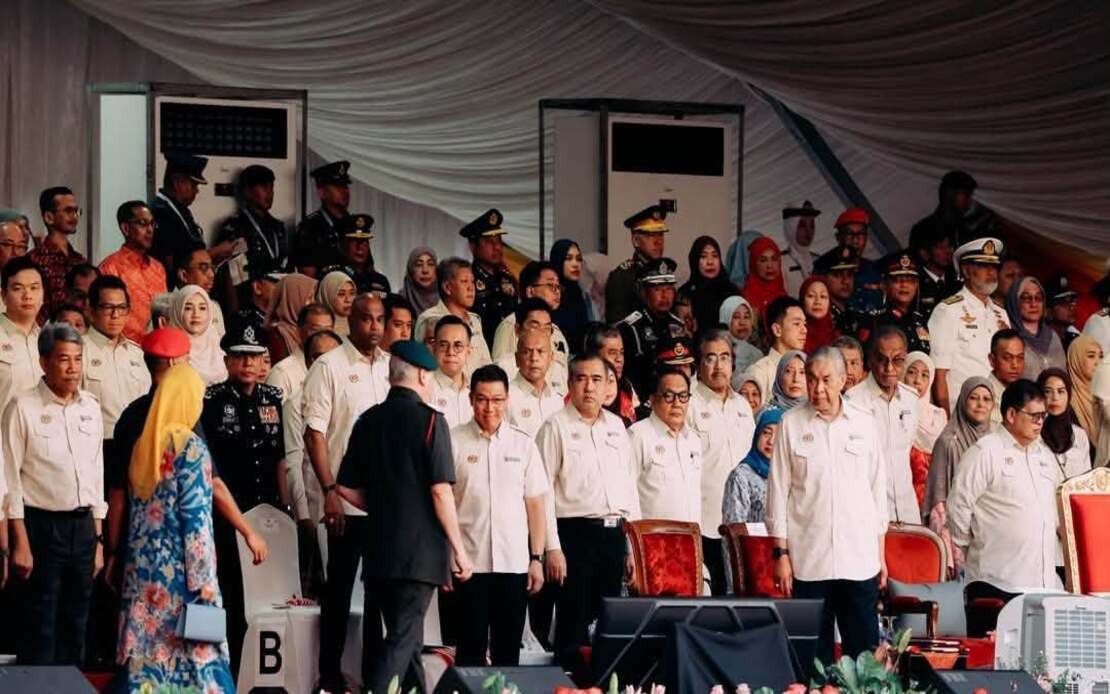
Datuk Armizan Mohd Ali, Malaysia's Domestic Trade and Cost of Living Minister, has underscored the critical importance of political maturity in sustaining the coalition government formed following the 15th General Election. Speaking on National Day, Armizan emphasized that the country's evolving political environment demands both leadership and citizenry to recognize that governmental stability directly influences how effectively development goals and public welfare are pursued. His comments reflect broader concerns about institutional continuity in Malaysia's multiparty political system and the challenges inherent in managing divergent interests within a broad coalition.
The shift in Malaysia's political landscape represents a fundamental departure from the decades-long single-party dominance that previously characterized the nation's governance model. Following GE15, the establishment of the Unity Government brought together multiple political factions with distinct ideological positions and electoral constituencies. This arrangement necessitates a fundamentally different approach to governance than previously practiced. Armizan's remarks suggest that Cabinet leadership has deliberately cultivated institutional protocols and professional standards to bridge these differences, despite the partisan tensions that continue to simmer at grassroots levels.
Central to Armizan's argument is the distinction between legitimate political competition and the governance imperative for stability. He noted that while party activists have engaged in robust public disagreement during recent months, senior Cabinet members have maintained constructive and professional interactions during official proceedings. This observation highlights a deliberate compartmentalization: permitting political debate within acceptable bounds while preserving institutional effectiveness in decision-making forums. Such an approach differs markedly from the confrontational political culture that characterized Malaysian politics during certain periods.
Armizan referenced the turbulent 2018-2022 period as a cautionary example of institutional dysfunction. During that four-year span, Malaysia experienced three changes of prime minister and corresponding reorganizations of the Cabinet structure. Each transition disrupted policy continuity, created uncertainty in long-term planning, and diverted leadership attention toward succession politics rather than substantive policy implementation. The frequency of these changes, Armizan suggested, fundamentally undermined Malaysia's capacity to execute sustained development strategies or build investor confidence. This historical reference implicitly argues that the current Coalition, despite its internal tensions, represents a preferable alternative to the instability that preceded it.
The minister articulated a framework for understanding political maturity that extends beyond traditional definitions of democratic participation. In his formulation, maturity involves consciously subordinating narrow partisan advantage to collective institutional interests when governance is at stake. This requires that political actors distinguish between platforms where competition is appropriate—electoral campaigns, parliamentary debates, and public advocacy—and forums where consensus-building becomes the operative principle. The Cabinet, in this taxonomy, falls into the latter category. This nuanced position acknowledges that vigorous political competition remains legitimate while arguing that transformation into government imposes different behavioral expectations.
Armizan's emphasis on balancing political rights with nation-building responsibilities addresses a fundamental tension in plural democracies. Coalition members retain legitimate interests in advancing their parties' positions and protecting their electoral appeal. Simultaneously, they have assumed fiduciary responsibilities toward the broader polity. Resolving this tension requires what Armizan describes as awareness—an intellectual recognition that both dimensions of their role must be honored, even when they pull in different directions. This framing rejects both unconditional subordination of party interests and unrestrained pursuit of partisan advantage, instead proposing a form of contingent cooperation.
For Malaysian and Southeast Asian readers, Armizan's message carries implications for democratic institution-building in plural societies. Malaysia's experience with coalition governance in the post-GE15 period offers a potential model for managing ideologically diverse political systems. The apparent success in maintaining Cabinet-level harmony despite grassroots tensions suggests that procedural disciplines and professional norms can, at least temporarily, contain partisan conflict. However, this arrangement remains fragile and dependent on continued elite commitment to cooperation. Any significant breakdown in this informal understanding could rapidly destabilize the current configuration.
The National Day context Armizan chose for these remarks deserves consideration. By framing political maturity as essential to the nation-building project commemorated on August 31, he connected institutional governance to national identity and collective purpose. This rhetorical move sought to elevate discussion beyond immediate partisan calculations toward abstract national interests. It suggested that supporting the Unity Government's stability should be understood not as partisan preference but as patriotic responsibility. Whether this framing resonates beyond elite circles or influences mass political behavior remains uncertain.
Armizan's characterization of Cabinet relationships as harmonious and constructive, despite public tensions between party activists, invites scrutiny regarding the sustainability of this arrangement. Cabinet unity is undoubtedly important, yet it represents only one component of coalition stability. Parliamentary support, public confidence, and grassroots party member satisfaction also matter considerably. The apparent disconnect between elite cooperation and activist-level conflict suggests that different levels of the political system may be experiencing the coalition differently. This disjuncture potentially harbors future instability if grassroots pressures eventually constrain elite flexibility.
The minister's broader point about governance effectiveness deserves emphasis for Malaysian readers assessing their political situation. Regardless of ideological preferences regarding coalition composition, the practical reality is that constant governmental turnover, policy reversals, and leadership uncertainty impose real costs on economic planning, investor confidence, and public service implementation. Whether the current arrangement offers superior practical outcomes compared to alternative configurations remains debatable, but Armizan's case that stability facilitates better governance outcomes has intuitive appeal.
Armizan concluded by characterizing National Month celebrations as opportunities to recommit to collective nation-building regardless of political differences. He positioned government, civil service, business, civil society, and citizens as partners in governance systems where each actor holds distinct responsibilities. This inclusive framing extends political maturity beyond elite leadership to suggest it represents a broader social value. Whether this aspirational vision translates into sustained public support for the Unity Government or whether accumulated disappointments eventually undermine commitment to cooperation remains an open question that will shape Malaysian politics in coming years.

