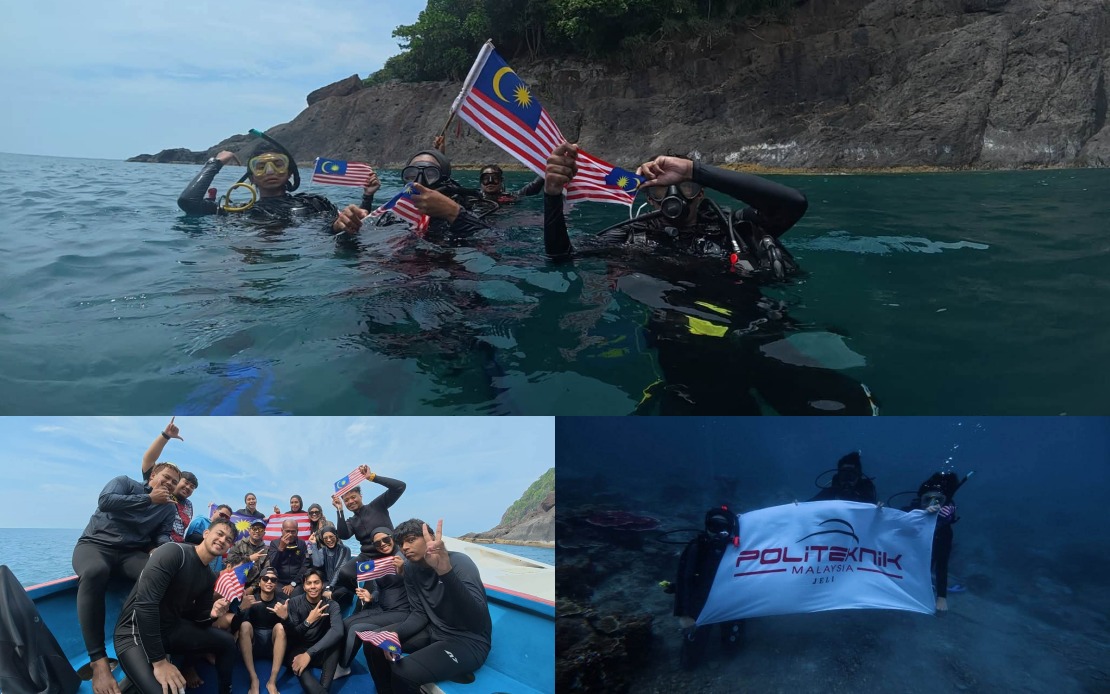
Politeknik Jeli Kelantan marked Malaysia's 69th National Day this year through an unconventional patriotic gesture that doubled as a significant educational milestone. Staff and students of the institution orchestrated the placement of the Jalur Gemilang 18 metres beneath the surface of the sea off Pulau Tenggol in Terengganu, merging National Day commemoration with hands-on maritime training.
The initiative served purposes extending well beyond symbolic nationalism. According to Mohd Adam Nashriq Bani Yamin, an Aquaculture lecturer at Politeknik Jeli Kelantan, the submerged flag demonstration functioned as both a meaningful tribute to the nation and a practical showcase of competencies being developed within the institution's programmes. The underwater placement required participants to apply technical expertise garnered through their academic pursuits, particularly within the aquaculture discipline where students must eventually operate in marine environments as part of their professional responsibilities.
The event formed part of a comprehensive scuba diving training and certification initiative conducted between August 27 and 30 at Dive Buddy Dungun. This programme brought together the institution's Aquaculture Technology Unit alongside the Department of Agrotechnology and Bio-Industry, creating a unified learning environment. Two lecturers and two fifth-semester students enrolled in the Diploma in Aquaculture Technology programme participated actively in the training component, gaining exposure to professional diving standards and underwater operational procedures.
Water safety constitutes a critical dimension of maritime occupational preparation that many terrestrial-focused educational programmes overlook. By incorporating scuba diving within the curriculum framework, Politeknik Jeli equipped participating students with competency in hazard recognition and emergency response protocols specific to aquatic environments. Such preparedness proves invaluable when graduates transition into professional roles requiring sustained water-based activities, where rapid decision-making under pressure could prove lifesaving.
The diving certification achieved through this initiative carried international credentials. Instructed by Dr Nabila Talib from Dive Buddy Malaysia, participants pursued PADI (Professional Association of Diving Instructors) qualifications spanning both the Open Water Diver certification and Divemaster levels. These designations represent globally recognised standards acknowledged across the marine industries, positioning graduates favourably within international employment markets whilst simultaneously validating the technical calibre of instruction delivered at the institution.
The specific choice to display both the national flag and the Politeknik Jeli flag at identical depths expressed institutional identity whilst affirming patriotic commitment. This layered symbolic gesture communicated that educational excellence and national pride operate in concert rather than isolation—a messaging approach particularly relevant within Malaysia's educational sector, where institutional prestige frequently intertwines with broader national development aspirations.
Marine aquaculture and marine biotechnology fields represent growth sectors within Southeast Asia's blue economy, yet they remain constrained by workforce capacity limitations. Graduates equipped with practical underwater competencies alongside academic credentials address this supply-demand imbalance more effectively than traditionally classroom-focused cohorts. The diving skills acquired during such programmes enable direct application to marine farming administration, underwater infrastructure assessment, and ecosystem monitoring activities increasingly demanded by expanding aquaculture operations.
The conservation dimension of marine expertise warrants particular emphasis within Malaysia's context. Coral reef degradation, fish stock depletion, and coastal ecosystem fragmentation demand interventions requiring underwater technical capability combined with scientific understanding. Politeknik Jeli's approach of embedding environmental stewardship within practical diving training creates graduates capable of contributing to marine conservation objectives whilst simultaneously pursuing commercial aquaculture interests—an integration increasingly necessary as regulatory frameworks tighten across the region.
Industry-aligned competency development distinguishes contemporary polytechnic education from purely theoretical institutional models. By structuring National Day observance around genuine skill acquisition rather than ceremonial activities, Politeknik Jeli demonstrated how civic engagement and workforce preparation need not represent competing institutional priorities. Employers increasingly recognise that technical certifications combined with foundational discipline knowledge indicate graduate readiness better than academic qualifications alone.
For Malaysian educational institutions navigating the complexities of balancing patriotic obligations with vocational relevance, this underwater flag initiative offers an instructive template. It illustrates how creative programming can simultaneously address multiple institutional objectives—fulfilling National Day recognition requirements whilst advancing student capability development and institutional reputation. Such integrated approaches become increasingly important as regional competition for aquaculture talent intensifies, with neighbouring countries similarly investing in maritime human capital development.
The broader implications extend beyond Politeknik Jeli's specific context. Malaysia's commitment to developing blue economy sectors depends substantially upon tertiary institutions successfully transitioning from theoretical instruction toward hands-on competency cultivation. Events like this underwater flag display, whilst symbolically meaningful, ultimately gain significance through their demonstration that educational institutions can embed patriotic expression within authentic professional development pathways rather than treating them as competing obligations.

