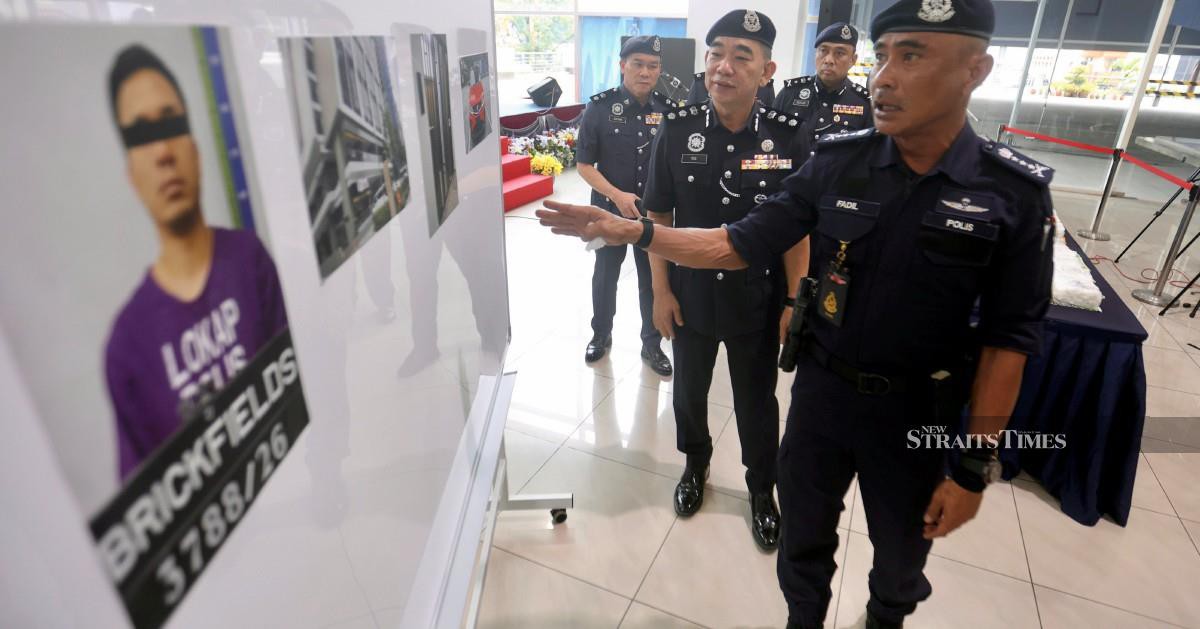
Police have dismantled what appears to be a significant drug distribution operation in the Brickfields area of Kuala Lumpur, recovering nearly 80 kilograms of methamphetamine and 30 kilograms of ecstasy in a coordinated enforcement action. The total value of seized drugs and related assets has been assessed at RM8.3 million, marking one of the more substantial narcotics seizures in the capital's recent law enforcement record. A foreign national has been taken into custody as investigations into the operation continue, with authorities working to establish the full scope of the trafficking network.
The Brickfields neighbourhood, a densely populated commercial and residential area in central Kuala Lumpur with a longstanding reputation as a transit point for various illicit activities, has periodically been the focus of intensive drug enforcement operations. The scale of this particular seizure underscores the persistent challenge facing law enforcement agencies in containing the supply chains that feed methamphetamine and ecstasy consumption throughout the Klang Valley and beyond. Both substances have remained priority targets for Malaysian authorities given their widespread abuse among young adults and the criminal networks that profit from their distribution.
Methamphetamine, commonly known as meth or crystal meth, continues to present a growing challenge across Southeast Asia, with Malaysia experiencing sustained demand despite concerted interdiction efforts. The drug's potency and relatively low cost compared to other stimulants have made it particularly attractive to certain consumer demographics, driving traffickers to maintain consistent supply flows through major urban centres. The 80-kilogram seizure represents a substantial quantity that would have served multiple downstream distribution points, suggesting the operation may have functioned as either a major wholesale point or a consolidation centre for multiple smaller suppliers.
Ecstasy, or MDMA, has similarly maintained a presence within Malaysia's drug market, particularly in nightlife settings and at social gatherings frequented by younger demographics. The 30-kilogram seizure indicates these substances were being stockpiled in significant quantities, consistent with professional-scale trafficking operations rather than small-scale dealing. The fact that both drugs were recovered in the same location suggests the operation may have catered to diverse consumer preferences or served as a central hub distributing multiple product lines to various street-level retailers.
The arrest of a foreign national points toward the international dimension of drug trafficking in Malaysia, where organised criminal syndicates frequently employ non-citizens as couriers, warehouse operatives, or mid-level organisers. Foreign traffickers often face greater challenges in establishing the networks and cultural familiarity required for retail distribution, making them more suitable for intermediary roles within larger organisations. The circumstances of the arrest may provide investigative leads extending into international trafficking routes and the regional suppliers who feed the Malaysian market.
Brickfields has long occupied a complex position within Kuala Lumpur's geography, serving as both a legitimate commercial and residential neighbourhood and simultaneously as a hub for various marginal activities. Its proximity to key transportation arteries, its relatively affordable commercial real estate, and its demographic composition—including significant migrant worker populations—have historically made it attractive to criminal operators seeking relative anonymity and access to transportation networks. Police operations targeting the area reflect broader enforcement strategies that concentrate resources on known trafficking hubs, though such operations must balance enforcement needs against the considerable collateral impact on legitimate residents and businesses.
The RM8.3 million valuation encompasses both the wholesale cost of the seized narcotics and the estimated value of any assets recovered during the operation, which may have included vehicles, cash, equipment, or property. This combined figure provides a more complete picture of the criminal enterprise's scale than drug quantities alone, though it reflects wholesale rather than street-level values. The distinction matters for understanding the operational capacity and profit margins of the organisation disrupted by this enforcement action.
Malaysian law enforcement agencies have been intensifying coordination between federal and state-level forces to address trafficking patterns that increasingly exploit geographic advantages and cross-border vulnerabilities. The drug seizure in Brickfields demonstrates the continued utility of traditional enforcement tactics focused on identified trafficking locations, complementing efforts to disrupt supply chains at ports, airports, and land borders. The effectiveness of such operations depends partly on sustained intelligence gathering and partly on the willingness of communities to report suspicious activities, though the latter remains inconsistently forthcoming in areas with significant floating or migrant populations.
The broader implications of this seizure extend beyond Brickfields itself. The recovery of such substantial quantities suggests demand within the local market remains robust enough to justify the risks traffickers accept in maintaining supply operations. Authorities continue emphasising that street-level consumption reflects deeper issues around addiction, mental health, and social integration, factors that enforcement alone cannot address. Rehabilitation and prevention initiatives remain underfunded relative to enforcement spending, a pattern observed across the region despite evidence from international research suggesting treatment and prevention warrant greater investment.
The investigation proceeding from this arrest and seizure will likely follow established patterns, with investigators attempting to establish the supply chain above the arrested individual and the distribution network below. The foreigner's identity, nationality, and prior criminal history will factor into determining whether this represents an isolated operation or part of a larger syndicate. Cooperation between Malaysian authorities and relevant foreign governments may prove necessary if the trafficking route extends across international boundaries, a likelihood given the quantities involved and the increasingly sophisticated nature of regional drug distribution networks.
The police operation signals continued commitment to major drug enforcement in Kuala Lumpur's central areas, though persistent trafficking suggests that supply-side interventions, while necessary, remain insufficient to meaningfully reduce availability. The perpetual renewal of enforcement targets and the recurring discovery of substantial drug caches point toward a market characterised by multiple independent operators and syndicate-driven supply chains that continuously reorganise following disruptions. Meaningful impact on drug availability may ultimately require complementary demand-reduction strategies addressing root causes of consumption.

