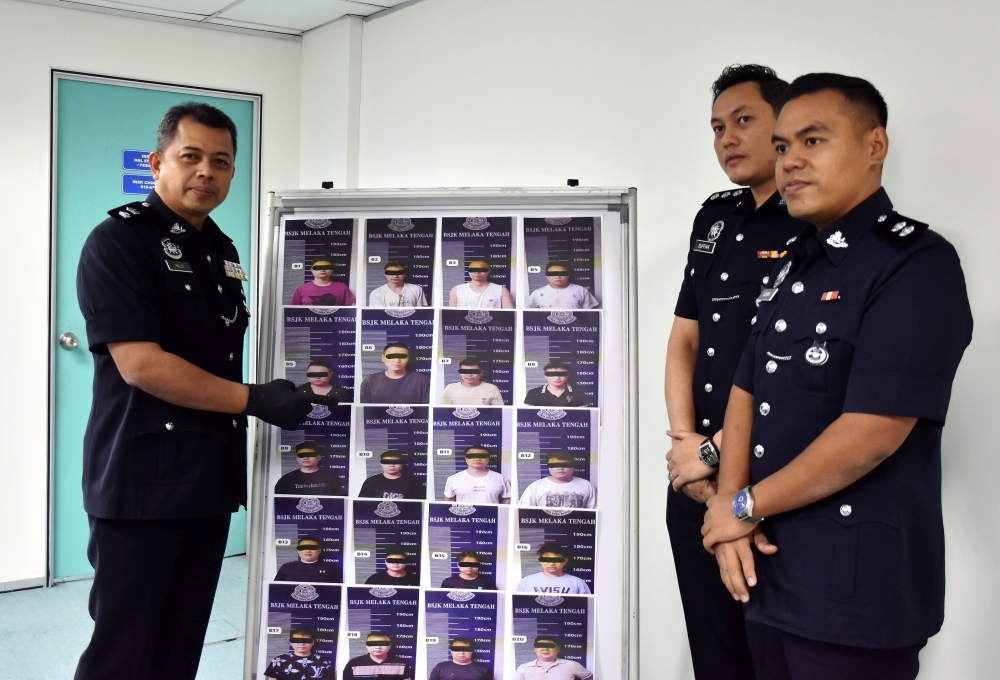
Police have successfully broken up an international investment fraud syndicate operating from Melaka, resulting in the apprehension of 21 Chinese nationals implicated in a sprawling scheme that offered fake investment opportunities to unsuspecting victims. The operation represents a significant law enforcement success against transnational organised crime, highlighting the growing menace of cross-border financial fraud targeting Southeast Asian investors seeking returns in cryptocurrency and other speculative ventures.
The investigation, which culminated in coordinated enforcement action in Melaka, uncovered a network that deliberately misrepresented non-existent or worthless investment products to lure victims into depositing substantial sums of money. Authorities identified multiple victims who had lost considerable amounts by transferring funds to bank accounts controlled by the syndicate members, operating under the guise of legitimate financial enterprises. The scale of the operation suggests a well-organised structure with distinct roles, ranging from recruitment specialists to those managing financial transactions and fabricating supporting documentation.
This enforcement action underscores a troubling trend across Southeast Asia where criminal syndicates exploit the region's growing appetite for alternative investment vehicles and digital financial products. Scammers have increasingly moved beyond traditional pyramid schemes to sophisticated operations involving cryptocurrency wallets, fake trading platforms, and fraudulent wealth management services that appear credible through professionally designed websites and forged credentials. The participation of foreign nationals indicates these operations often involve international collaboration, with foreign operatives managing back-office functions while local accomplices handle victim acquisition.
The modus operandi typically employed by such syndicates involves elaborate grooming tactics wherein potential victims are initially contacted through social media platforms or dating applications, establishing trust relationships before investment pitches are introduced. Victims are shown fabricated screenshots of account balances and returns, creating an illusion of profitability that encourages larger subsequent investments. Once substantial funds have been transferred, the perpetrators sever contact, leaving victims with worthless digital assets or empty accounts and no recourse for recovery.
Malaysia has become a significant operational hub for such transnational fraud networks, partly owing to its developed financial infrastructure, banking accessibility, and large population of middle-class savers seeking investment opportunities. The country's position as a regional financial centre and its relatively easy access to international banking services make it attractive for syndicates seeking to launder proceeds or receive victim transfers before converting funds to untraceable cryptocurrency. Additionally, the linguistic and cultural proximity between Malaysia and China facilitates recruitment of Chinese nationals who can effectively target Mandarin and Cantonese-speaking communities throughout the region.
The enforcement success reflects enhanced cooperation between Malaysian law enforcement agencies and cross-border intelligence sharing mechanisms. Investigations into investment fraud typically require tracking complex financial flows, identifying multiple layers of money laundering, and coordinating with banks to freeze suspicious accounts before funds disappear. The arrest of 21 individuals simultaneously indicates authorities had conducted thorough groundwork, identifying the full network structure before moving to apprehend all members simultaneously, thereby preventing dispersal or destruction of evidence.
For Malaysian victims of such schemes, the path to recovering lost funds remains fraught with difficulty. While police are empowered to freeze identified assets, international legal frameworks for asset recovery are notoriously cumbersome and time-consuming. Many victims never recover their investments, particularly when perpetrators have already converted funds to cryptocurrency or transferred proceeds across multiple jurisdictions. This reality underscores the importance of consumer awareness and prevention through financial literacy initiatives.
The incident carries broader implications for Southeast Asia's broader financial integrity and consumer protection landscape. As digital finance penetrates deeper into everyday commerce across the region, the sophistication of fraud schemes has escalated proportionally. Regulators and law enforcement agencies must balance facilitating fintech innovation with robust safeguards protecting retail investors from predatory schemes. The challenge is particularly acute given the involvement of transnational criminal networks with substantial resources and technical capabilities to continuously adapt their methodologies to evade detection.
Authorities are now investigating the full extent of the syndicate's operations, seeking to identify all victims and recover additional assets. Financial intelligence units are tracing fund flows through banking channels to determine where proceeds were ultimately directed and whether accomplices remain at large in Malaysia or elsewhere. The investigation also aims to uncover whether the arrested individuals operated independently or formed part of a larger international organised crime structure with operations across multiple countries.
This enforcement action serves as a reminder to Malaysian investors to exercise heightened vigilance when presented with unusually lucrative investment opportunities, particularly those involving digital assets or requiring rapid decision-making. Legitimate financial institutions employ standardised verification procedures, clearly disclose risks, and provide regulated platforms for transactions. Any investment proposition featuring pressure tactics, promises of guaranteed returns, or requests to conduct transactions through informal channels warrants immediate suspicion. Victims or individuals targeted by such schemes are encouraged to report details to the police Commercial Crime Investigation Department or the financial sector regulator for appropriate action.

