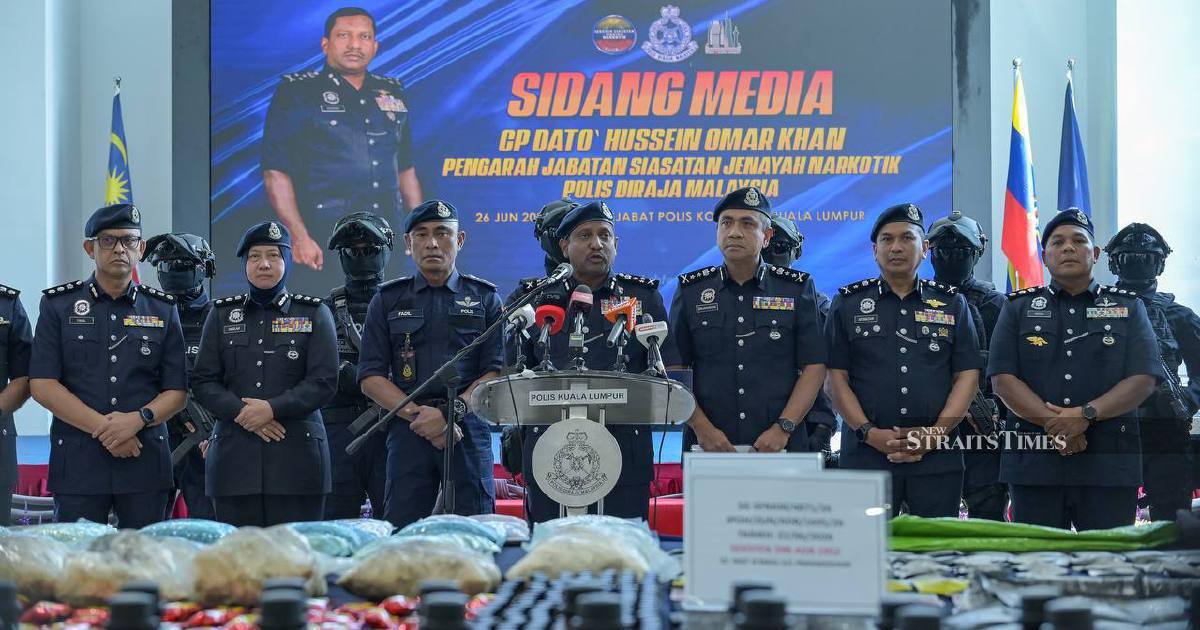
Law enforcement authorities in Kuala Lumpur have delivered a significant blow to organised drug trafficking operations following a carefully coordinated three-pronged enforcement action on June 20. The combined raids across Cheras locations resulted in the seizure of drugs valued at approximately RM135.63 million and the apprehension of seven individuals suspected of involvement in large-scale narcotics distribution. The operation underscores the persistent threat posed by trafficking networks seeking to introduce substantial quantities of illicit substances into Malaysian communities.
The scope of the confiscated material suggests sophisticated smuggling and distribution arrangements. Authorities have indicated that the intercepted consignment represented an intentional effort to inundate the domestic market with drugs, a strategy commonly employed by transnational criminal syndicates operating across Southeast Asia. The sheer monetary value of the seized contraband indicates that the suspects possessed significant financial resources and established supply chain networks capable of handling bulk quantities of controlled substances.
Cheras, a densely populated area in southern Kuala Lumpur, has witnessed increasing law enforcement attention regarding drug-related activities in recent years. The location's accessibility and proximity to various transportation routes make it an attractive logistics hub for criminal enterprises moving contraband throughout the Klang Valley and beyond. The selection of this site by the trafficking network reflects broader patterns observed by authorities concerning the concentration of distribution networks in urban centres with high population density and multiple exit corridors.
The arrest of seven suspects provides investigative leads that may unravel broader connections within regional drug trafficking hierarchies. Police typically employ detailed interrogation of detained individuals to map out supply sources, downstream distributors, money laundering arrangements, and financial beneficiaries of such operations. The information gleaned from questioning could potentially reveal links to international syndicates operating across borders, particularly given the substantial quantities involved, which often point to transnational sourcing.
The RM135.63 million valuation reflects the street-level potential of the seized drugs rather than wholesale acquisition costs, demonstrating how dramatically criminal organisations profit through the distribution chain. A drug trafficking network's ability to generate such enormous margins depends on maintaining supply lines from source countries—typically in the Golden Triangle region of Southeast Asia—through transit points and into consumer markets. Each stage of this pipeline involves multiple actors, corruption of officials, and sophisticated money movement techniques.
This operation reveals the intensity of demand for illicit substances within Malaysia and the region more broadly. Despite sustained law enforcement efforts, traffickers continue to invest heavily in smuggling operations, suggesting that potential profits far exceed perceived risks. The constancy of supply attempts indicates that previous seizures and arrests have failed to fundamentally disrupt the economics of drug trafficking, pointing to the need for more comprehensive intervention strategies addressing both supply reduction and demand management.
The prevention of market flooding carries significant public health implications for Malaysian communities. When traffickers successfully introduce large quantities of drugs, particularly synthetic narcotics like methamphetamine or fentanyl, addiction rates rise sharply, straining healthcare systems and driving increases in drug-related crime. The arrested individuals' apparent objective to saturate the market suggests a deliberate strategy to create mass dependency and establish long-term revenue streams from an expanded user base across multiple socioeconomic strata.
Coordination among multiple police units across different divisions was necessary to execute the three simultaneous raids effectively, preventing suspects from receiving advance warning and destroying evidence. Such tactical synchronisation represents a maturing approach to organised crime enforcement in Malaysia, reflecting lessons learned from previous operations where premature disclosure of raid locations compromised seizures. The success of this operation demonstrates that intelligence-gathering capabilities and inter-agency communication have improved substantially within law enforcement agencies.
The June 20 operation fits within the broader Southeast Asian context of transnational drug trafficking, where Myanmar remains the primary source of synthetic drugs destined for Malaysian markets. The region's porous borders, limited customs capacity in some jurisdictions, and corruption among officials at transportation checkpoints enable criminal organisations to move contraband efficiently. Malaysia's position as a major consumption market and transit point makes it a lucrative target for traffickers seeking to diversify their distribution networks across the region.
Investigations stemming from this seizure will likely focus on identifying the ultimate suppliers, financial controllers, and retail-level distributors connected to the arrested suspects. Understanding how proceeds were laundered through banking systems or informal remittance channels could reveal vulnerabilities in Malaysia's anti-money laundering frameworks. The case may also prompt authorities to examine whether any corrupt officials facilitated the trafficking operation, a persistent challenge in combating organised crime throughout Southeast Asia.

