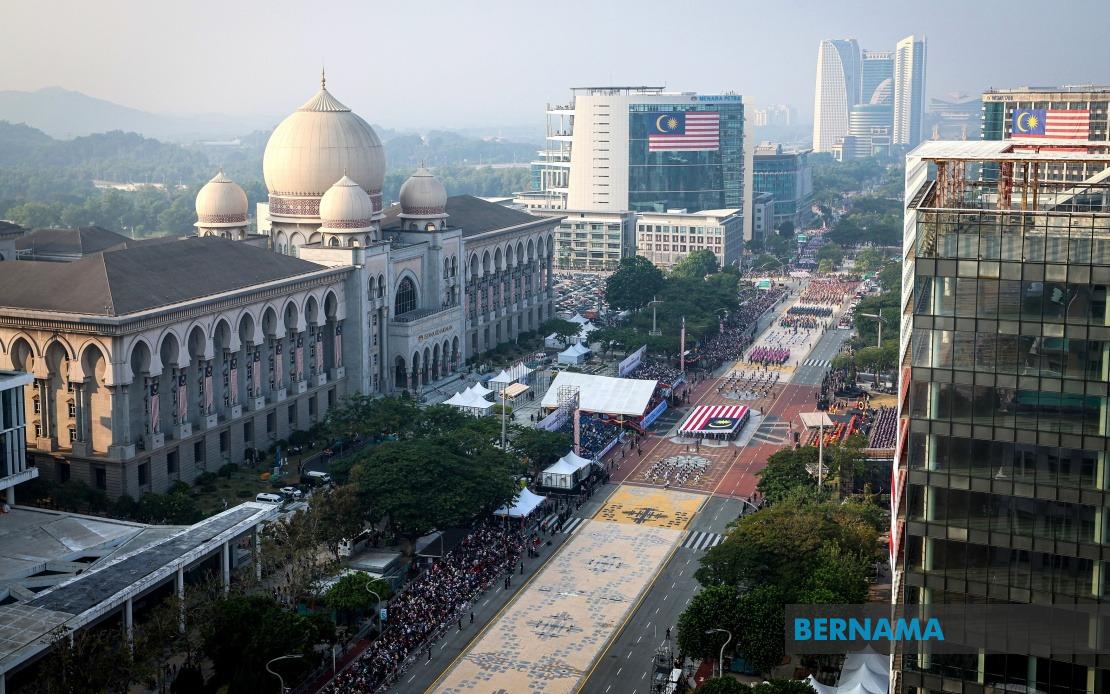
The Royal Malaysia Police (PDRM) will position 2,354 personnel across Dataran Putrajaya for the nation's 69th National Day commemoration scheduled for August 31, marking a significant security undertaking for one of Malaysia's most prominent civic occasions. The comprehensive deployment reflects the scale of coordination required to manage a celebration that organisers project will draw more than 80,000 spectators to the administrative capital's flagship venue.
Putrajaya district police chief Assistant Commissioner Aidi Sham Mohamed outlined the operational framework during a press briefing following the full-scale rehearsal held earlier this week. The assigned officers will assume dual responsibilities encompassing static security positions at key junctures and mobile traffic management units positioned to regulate vehicle flow throughout the precinct and surrounding thoroughfares. This layered approach seeks to balance unrestricted public access with operational safety protocols that have become standard practice for major national gatherings.
The occasion carries particular significance as it represents the continuation of Malaysia's National Day tradition under the "Malaysia MADANI: Kesejahteraan Dinikmati" theme, emphasising shared prosperity and collective wellbeing. Communications Minister Datuk Seri Fahmi Fadzil confirmed that the event would proceed according to established protocols, with no substantial deviations from customary celebration formats, though the police deployment scale indicates heightened attention to crowd management and security fundamentals.
For Malaysian citizens and international visitors planning attendance, authorities have issued comprehensive behavioural guidelines designed to facilitate smooth operations while maintaining personal safety standards. Aidi Sham advised attendees to arrive substantially ahead of scheduled programming commencement, thereby dispersing arrival flows and reducing pressure points during peak entry periods. This staggered arrival strategy has proven effective at previous large-scale national events where concentrated entry windows create bottlenecks and operational challenges.
Parking regulations constitute a major focus of the advisory framework, with police explicitly cautioning against unauthorised vehicle placement in prohibited zones throughout Dataran Putrajaya and contiguous areas. Beyond mere traffic flow considerations, such violations substantially compromise emergency vehicle access routes and create congestion that compromises the ceremonial experience for other attendees. Authorities similarly emphasised compliance with traffic direction from on-site personnel, recognising that individual driving decisions collectively determine whether vehicular movement remains fluid throughout the event duration.
Personal security consciousness has received deliberate emphasis in official communications, with particular attention directed toward child supervision and asset protection. The high attendance density anticipated—exceeding 80,000 visitors—creates environments where vigilance regarding children's whereabouts and valuables security becomes substantially more demanding than routine daily circumstances. Police guidance reflected this reality by explicitly reminding families to implement heightened monitoring protocols and practical precautions against opportunistic loss or separation incidents.
Weapons prohibition represents perhaps the most unambiguous security directive issued to prospective attendees. Authorities categorically proscribed bringing any dangerous implements to the celebration venue, reflecting standard counterterrorism and public safety protocols adopted by law enforcement agencies across democratic nations hosting large-scale public assemblies. The blanket prohibition acknowledges that Dataran Putrajaya, as a government administrative centre, warrants exceptional security vigilance and that weapons presence—regardless of stated intent—fundamentally contradicts the peaceable character that National Day celebrations are intended to embody.
The 2,354-officer deployment represents substantial resource commitment reflecting Putrajaya district's policing priorities during this high-profile event. The personnel distribution must accomplish multiple simultaneous functions: managing pedestrian flow throughout the venue, monitoring peripheral areas for security threats, maintaining traffic order on connecting roadways, responding to medical emergencies or incidents, and establishing visible police presence that both deters inappropriate behaviour and reassures attendees regarding their physical safety. Coordinating such diverse operational elements across such personnel numbers demands intricate planning and real-time communication infrastructure.
Malaysia's National Day commemoration at Dataran Putrajaya has become a defining civic ritual that brings together citizens from disparate backgrounds to collectively affirm national identity and shared political community. The 69th iteration occurring in 2026 continues this tradition while reflecting contemporary security consciousness and crowd management expertise refined through decades of similar public gatherings. The extensive police preparation, while prominent in formal security briefings, operates ideally as background infrastructure enabling rather than dominating attendee experience—a calibration that requires substantial professional competence from deployed personnel.
Regional observers note that Malaysia's approach to securing major national celebrations balances democratic openness with practical security requirements, representing a model relevant across Southeast Asia where nations similarly navigate tensions between accessibility and protective necessity. The August 31 commemoration, with its projected 80,000-plus attendance and over 2,300 deployed security personnel, exemplifies how established democracies maintain vibrant public civic life while implementing professional security frameworks. For Malaysian attendees, compliance with outlined guidelines—early arrival, parking discipline, weapons prohibition, and heightened personal vigilance—directly enables the police force to focus resources on genuine security threats rather than managing preventable infractions, ultimately benefiting all celebrants through enhanced operational efficiency and collective safety.

