A 70-year-old woman fighting gallbladder cancer faces an anguish familiar to many terminally ill patients: separation from her beloved companion. When Ewa Lutka-Krawczyk learned of her dire prognosis, her foremost concern was not her own survival but the welfare of Gaja, a shelter dog she had welcomed into her home three years earlier. In a poignant request, she asked her physician whether she might have a few more years of life, not for herself, but so that Gaja would not be abandoned. Yet her condition deteriorated rapidly, forcing her admission to a palliative ward at a Warsaw hospital, where Gaja remained at home, struggling to eat without her owner.
This deeply personal narrative has catalysed a significant policy shift in Poland. Proposed legislation now working through parliament would establish a formal legal right for patients in hospices and palliative care facilities to receive visits from their own pets. While such visits occur informally at many Polish medical institutions, no comprehensive legal framework currently guarantees this practice. The bill, introduced by a lawmaker from Prime Minister Donald Tusk's centrist party, represents an attempt to codify what supporters argue should be a basic entitlement for those facing their final days.
Dr Tomasz Dzierzanowski, director of the Palliative Medicine Clinic at the Medical University of Warsaw where Lutka-Krawczyk receives treatment, has emerged as the driving force behind this initiative. His advocacy reflects a broader philosophical position: that the emotional and spiritual wellbeing of dying patients deserves the same institutional attention as their physical needs. In his view, the presence of a cherished animal can alleviate suffering in ways that medical interventions alone cannot achieve, particularly during a historical moment when isolation has become endemic among the terminally ill.
Dzierzanowski characterises contemporary society as experiencing "an epidemic of loneliness," a condition he observes acutely within palliative care settings. Many elderly patients have outlived their social circles, their friendships eroded by time and circumstance. Simultaneously, younger patients often find themselves isolated despite living in an age of digital connectivity, having failed to cultivate the deep interpersonal bonds that sustained previous generations. In response to this reality, Dzierzanowski articulates a commitment to ensuring no patient dies without companionship—though he acknowledges that such company ideally originates from other human beings.
The catalyst for Dzierzanowski's campaign originated in a particularly moving encounter with a cancer patient named Waldemar. Though gravely ill, Waldemar's primary anxiety centred not on his own mortality but on the fate of his two cats. Recognising the psychological torment this separation inflicted, Dzierzanowski arranged for the animals to be brought into the ward. The reunification proved transformative. Waldemar's tears of joy, combined with the visible emotional response of his cats and the profound reaction of surrounding staff and patients who witnessed the encounter, convinced Dzierzanowski that institutional policy must address this gap. "It made me realise that this issue finally needed to be addressed," he reflected.
Lutka-Krawczyk herself embodies both the problem and the potential solution outlined in the proposed legislation. Her condition precludes her from returning home to Gaja, yet the promise of the dog's visit to her hospital bed has kindled hope. This prospect—which Dzierzanowski's clinic already facilitates where circumstances permit—represents a fundamental reorientation of how institutions approach the care of dying patients. Katarzyna Piekarska, the lawmaker steering the legislation through parliament's health committee, frames the reform as necessary formalisation of existing practice. "In reality, animals in hospitals are already there anyway," she observed. "That's why it needs to be regulated in the law."
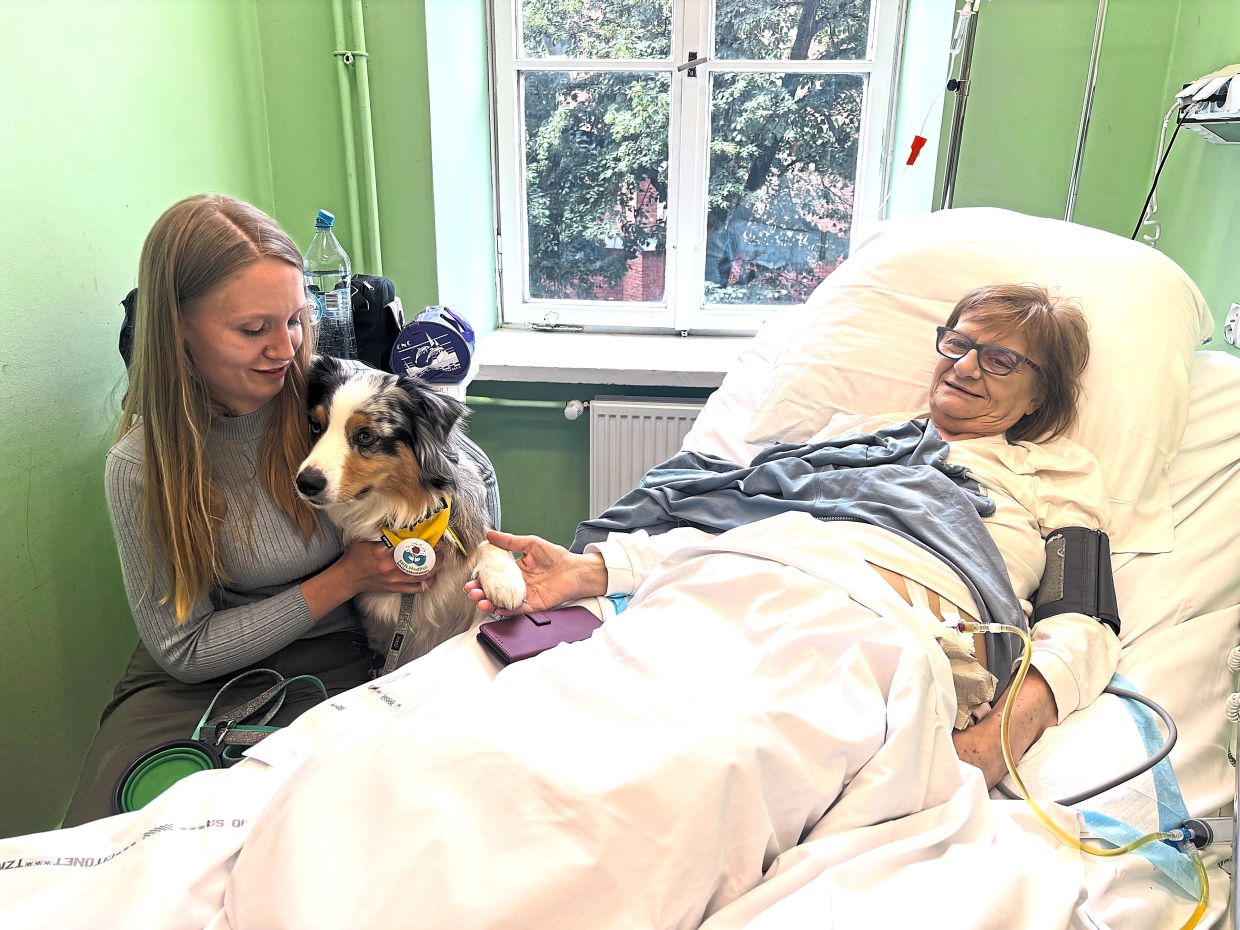
Beyond individual patient pets, Dzierzanowski has incorporated animal-assisted therapy into his palliative program. During recent ward rounds, Kluska, an Australian shepherd whose name translates as "dumpling," circulated through the facility with her handler, Malgorzata Brzozowska. The therapy dog's presence elicited visible responses from patients previously withdrawn or subdued. Lutka-Krawczyk brightened noticeably, grasping Kluska's paw and smiling—a moment of connection that transcended her medical condition. Another patient, Wojciech Zelik, a 58-year-old man hospitalised with a tumour, rallied sufficiently to sit up and observe Kluska performing tricks, his comments about the dog's soft fur reflecting a momentary respite from his awareness of his predicament.
The benefits of animal companionship extend throughout the hospital ecosystem, not merely to patients themselves. Brzozowska, a medical student conducting the therapy dog sessions, notes that visits relieve stress among nursing staff, kitchen workers, and others who labour daily within the emotionally demanding palliative care environment. These professionals, habitually focused on the terminal decline of their charges, found visible solace in brief interactions with the visiting animal, with even the kitchen staff contributing ham to Kluska's visits. Such moments provide momentary psychological relief in an occupation characterised by cumulative grief.
Most significantly, Brzozowska emphasises that the therapeutic value intensifies substantially when patients interact with their own animals rather than therapy dogs. The calming effect operates bidirectionally: patients experience reduced anxiety and distress, their families find comfort in witnessing their loved one's joy, and the animals themselves exhibit measurably lower stress levels. Brzozowska's interpretation of the animals' behaviour suggests a profound awareness on their part. "The dog isn't as stressed," she observed. "We interpret this as meaning that he simply knows what's happening, that he knows where the owner, who was always there before, has disappeared to." This reciprocal emotional understanding underscores why Poland's legislative effort carries significance beyond mere administrative convenience.
For Malaysia and other Southeast Asian nations grappling with rapidly ageing populations and rising palliative care demands, Poland's experience offers instructive lessons. The region faces similar demographic trends that intensify loneliness among elderly terminal patients, compounded in many cases by migration patterns that physically separate adult children from elderly parents. Institutional frameworks that acknowledge the therapeutic legitimacy of pet companionship in end-of-life care could represent a culturally appropriate, cost-effective complement to conventional medical interventions. The Polish model suggests that legalising such practices need not burden healthcare systems substantially; rather, it formalises and encourages practices already occurring informally.
The legislation's progress through parliament remains uncertain, yet the momentum generated by Dzierzanowski's advocacy and Lutka-Krawczyk's personal story has established pets' roles in palliative care as a serious policy consideration in Poland. The movement reflects a broader recognition that terminal care encompasses not merely the extension of biological life but the preservation of the human connections and sources of meaning that make that life worth living. For Lutka-Krawczyk, awaiting Gaja's visit while a draining tube addresses her physical deterioration, the law may ultimately represent something simpler: the assurance that in her final period, she need not be separated from the one being most central to her existence.

