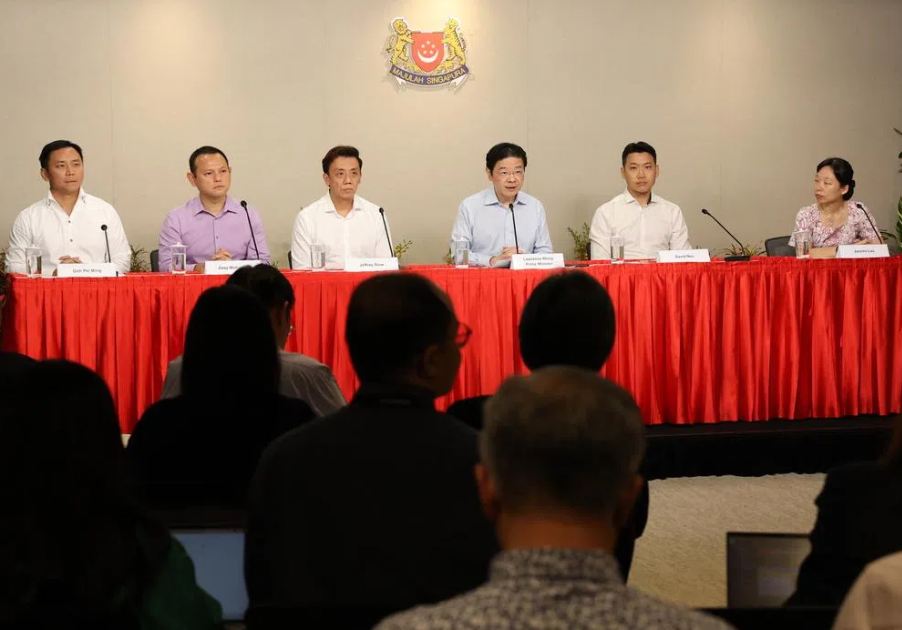
Prime Minister Lawrence Wong has announced a significant restructuring of Singapore's Cabinet that underscores the government's commitment to blending youth with experience. The reshuffle, effective progressively from July 27, elevates several members elected in the 2025 general election to expanded roles while maintaining continuity through senior leaders. This marks another step in Singapore's deliberate transition strategy, as the government navigates political changes including two unexpected resignations this year.
At the heart of the shuffle are Jeffrey Siow and David Neo, both first-time politicians who are being promoted to full minister status. Siow, who has been acting as Transport Minister since May 2025, and Neo, serving as acting Culture, Community and Youth Minister, will retain their current portfolios following their elevation. Their promotions reflect what Wong described as their successful performance in acting roles and their readiness to assume greater responsibilities within the Cabinet structure.
Sim Ann, another member of the GE2025 cohort, moves into the combined role of Second Minister for Foreign Affairs and Home Affairs, broadening her portfolio and signalling the government's confidence in her capability to handle sensitive portfolios. Meanwhile, Jasmin Lau steps into the Manpower Ministry as acting minister, replacing Tan See Leng, who transitions to become Minister for Trade and Industry with a focus on Energy and Industry. This movement of personnel reflects deliberate positioning of politicians according to their demonstrated strengths and development trajectories.
The reshuffle also brings Ng Chee Meng, the labour chief, back into Cabinet as Minister in the Prime Minister's Office, while K. Shanmugam assumes the position of Senior Minister. Two backbench MPs with prior civil service experience, Foo Cexiang and Shawn Loh, will become ministers of state, further deepening the bench of first-term lawmakers stepping into ministerial responsibility. For Malaysia and the broader region, these changes demonstrate how Singapore maintains institutional continuity while executing planned succession strategies.
Wong's reshuffle cannot be separated from the context of political disruptions that have prompted the changes. Acting Minister-in-charge of Muslim Affairs Faishal Ibrahim resigned on July 20 following what he termed a "lapse of judgment" in managing personal interactions, while Senior Minister of State Koh Poh Koon stepped down in June citing family reasons. Rather than viewing these as setbacks, Wong framed the reshuffle as an opportunity to strengthen the government's leadership pipeline and demonstrate institutional resilience.
Wong addressed the question of timing directly, explaining that while Cabinet composition is reviewed annually, unexpected resignations necessitated accelerating certain decisions. He emphasised that building a strong pipeline requires not just developing future ministers but also cultivating capable backbenchers and mid-level office-holders. This multi-tiered approach differs from sudden leadership overhauls and reflects Singapore's long-term institutional planning philosophy, which other Southeast Asian governments monitor closely as a model for stability.
The appointment of Shanmugam as Senior Minister alongside Lee Hsien Loong signals an intentional strategy to retain institutional memory and provide mentorship to younger leaders. Wong explained that as the government progresses through its leadership transition, these seasoned figures increasingly serve advisory roles, guiding and developing the next generation. This structure allows experienced hands to remain influential while creating space for newer politicians to assume executive responsibility, a delicate balance that Wong suggested was essential for maintaining Singapore's governance standards.
Wong notably declined to appoint a second deputy prime minister alongside the incumbent Gan Kim Yong, maintaining the existing structure despite questions about whether additional senior positions might facilitate smoother succession planning. He defended this decision by pointing to the current arrangement's strength and the presence of three coordinating ministers overseeing different government portfolios. Shanmugam retains his role as Coordinating Minister for National Security, while Chan Chun Sing and Ong Ye Kung, appointed in May 2025, oversee other governmental areas. This distributed senior leadership model differs from concentrating authority and reflects Singapore's institutional preference for oversight mechanisms.
On his continuation as Finance Minister since 2021, Wong characterised his search for a successor as an ongoing process rather than an urgent matter. He acknowledged that political development occurs at different speeds, with some individuals progressing to larger roles earlier than others. This pragmatic stance reflects an understanding that forced advancement creates governance risks, while premature retention of key positions by senior figures limits generational transition. For Southeast Asian observers, Wong's emphasis on matching individual readiness to responsibility offers a counterpoint to both sudden transitions and stalled succession planning.
The broader pattern reveals Singapore's approach to leadership renewal as systematically staged rather than revolutionary. Wong stressed that veteran and experienced leadership continues alongside team refreshment, describing this as "the Singapore way of leadership renewal." The latest changes represent a continuation of this incremental process rather than a decisive break with past arrangements. For regional governments watching Singapore's political management, the strategy demonstrates how institutional structures can accommodate generational change while preserving governance continuity and decision-making quality. The next phases of Singapore's transition will likely continue this measured approach, with performance and demonstrated capability serving as key criteria for advancement.

