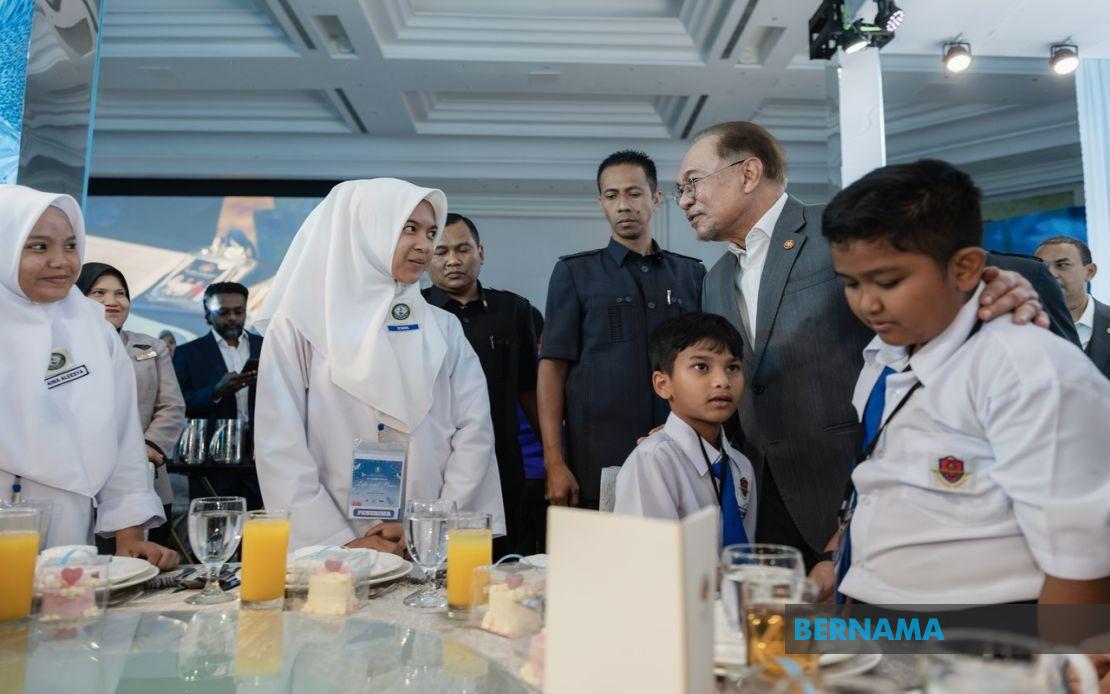
Prime Minister Datuk Seri Anwar Ibrahim has underscored a fundamental principle in education that extends beyond classroom performance: the equal importance of cultivating character and moral values in Malaysia's youth. Speaking at a gathering of 700 pupils from 47 schools across Kuala Lumpur and Putrajaya, he articulated a vision of schooling that embraces intellectual development alongside ethical formation, warning that intelligence divorced from compassion creates individuals ill-equipped to contribute meaningfully to society.
The occasion, which formed part of the "Celebration of Life and Peace" event organised by the ERM Foundation, provided Anwar with a platform to address young Malaysians directly about their responsibilities as future citizens. His message resonated beyond the immediate audience, touching on a persistent concern in Malaysian education discourse: the need to balance academic rigour with social-emotional development. The event itself was designed to honour the foundation's founder, Xin'er, by celebrating the birthdays of children from selected schools, creating an intimate setting where the Prime Minister could communicate personal values to the younger generation.
Anwar's framing of the purpose of education—"to learn, to become good, to become knowledgeable"—reflects a holistic understanding of schooling that has deep roots in Malaysian educational philosophy. He articulated a straightforward proposition: intellectual capability without moral foundation ultimately serves no constructive purpose. A student who excels academically but engages in bullying or disrespectful behaviour toward peers and educators contradicts the fundamental aims of the educational system. This articulation represents a deliberate pushback against any tendency to prioritise grades and examination results at the expense of character development, a tension that remains relevant in competitive education systems across Southeast Asia.
The specific invocation of bullying as a behavioural concern reflects current anxieties about student conduct in Malaysian schools. School bullying—whether physical, verbal, or increasingly, cybernetic in nature—represents a growing challenge for educators and policymakers. By invoking the issue in his remarks, Anwar positioned anti-bullying attitudes as integral to being a "good" person, not merely as a disciplinary concern. This reframing suggests that schools must view the cultivation of respectful peer relationships and inclusive school environments as educational objectives in their own right, rather than peripheral matters of conduct management.
Anwar's direct appeal to the children themselves—asking them to commit to studying diligently, respecting teachers, and honouring their parents—shifts responsibility partially from institutions to individual choice. He framed these commitments as promises made to him personally, creating an emotional and relational dimension to the behavioural expectations. This approach acknowledges that young people are capable of moral reasoning and personal commitment, rather than treating them as passive recipients of rules and discipline. The intergenerational framing, with Anwar jocularly referring to himself as "this grandpa," also humanised the Prime Minister and made his message feel like advice from an elder concerned with their welfare rather than a top-down directive.
The presence of Datuk Seri Dr Wan Azizah Wan Ismail, Anwar's wife, reinforced the emphasis on family values and parental involvement in character development. Her attendance underscored that these are not merely political pronouncements but reflections of family priorities. Similarly, the involvement of 700 students and representation from 47 schools indicated a coordinated effort to reach a significant cross-section of Kuala Lumpur and Putrajaya's student population, suggesting that this message about integrated character and academic development was meant to resonate widely rather than serve as an isolated intervention.
Xin'er's remarks complemented Anwar's message by emphasising the emotional and psychological dimensions of childhood development. Her articulation of creating birthday celebrations that combined festivity with deeper meaning—celebrating those children who might otherwise lack such opportunities due to illness or hardship—expanded the conversation beyond individual moral conduct to encompass collective responsibility for vulnerable children. She positioned the event as creating space for all children to experience peace, love, and happiness, essentials that exist alongside but distinct from material gifts or academic achievement.
The practical provisions offered at the event—RM500 cash assistance to each child, special catering, and entertainment—reflected a commitment to meeting immediate welfare needs while delivering the message about values and character. This combination of material support and moral messaging creates a holistic intervention model: the State acknowledges and addresses material vulnerabilities while simultaneously investing in the intangible dimensions of healthy development. For Malaysian policymakers, this suggests an approach to youth development that does not treat welfare and values education as separate domains but rather as mutually reinforcing components of comprehensive child development.
The event's naming as a "Celebration of Life and Peace" carries deliberate symbolic weight. Peace, particularly at the individual and interpersonal level, flows from respect, kindness, and the rejection of harmful behaviours like bullying. By anchoring this celebration in concepts of peace and life, organisers positioned character development and anti-bullying efforts not as bureaucratic requirements but as prerequisites for the kind of social harmony that enables all children to flourish. This framing resonates with broader regional conversations about education's role in social cohesion and stability.
For Malaysia's education sector, Anwar's emphasis represents a reinforcement of policy direction emphasising whole-child development. The message affirms that schools are not merely credentialling institutions preparing students for examinations and economic competition, but formative environments where young people acquire the values, habits, and relational skills necessary for ethical citizenship. In a regional context where education systems frequently face criticism for emphasising examination performance over critical thinking and moral development, the Prime Minister's public commitment to this broader vision carries institutional weight.
The underlying challenge articulated through Anwar's remarks concerns the persistent tension between academic measurement and character assessment. While schools can readily quantify examination results and academic rankings, evaluating the success of moral and character development remains more elusive. Malaysian educators and administrators must grapple with how to create school cultures, curricula, and assessment systems that take seriously the integration of intellectual and moral development—ensuring that children emerge not only with qualifications but with the wisdom and kindness to use them well.

