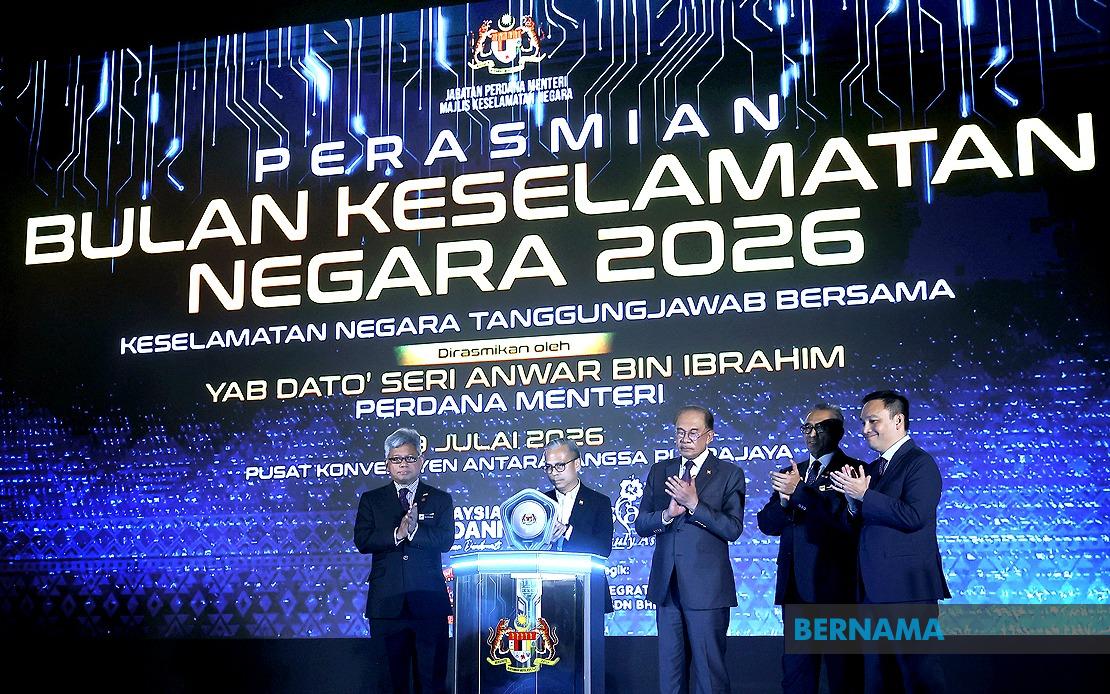
Prime Minister Datuk Seri Anwar Ibrahim has sounded an alarm about the nation's tendency to dwell on divisive identity-based politics at a time when Malaysia confronts far more pressing security challenges. Speaking at the launch of National Security Month 2026 in Putrajaya, Anwar expressed frustration with what he characterised as an outdated preoccupation with race, religion, and regional sentiment—matters that, while historically significant to Malaysian discourse, increasingly distract from the complex threats emerging across technological and digital frontiers.
The Prime Minister's remarks reflected a broader strategic concern shared among senior government officials present at the event, including Communications Minister Datuk Fahmi Fadzil, Chief Secretary to the Government Tan Sri Shamsul Azri Abu Bakar, and National Security Council director-general Datuk Raja Nurshirwan Zainal Abidin. Anwar noted that parliamentary debates frequently circle back to familiar grievances and identity-based narratives that, while generating political heat, consume valuable time and energy that ought to be directed toward understanding and countering emerging vulnerabilities.
The timing of Anwar's intervention carries particular significance for Malaysia's regional standing. Southeast Asia has become increasingly exposed to transnational security risks, from cyber-attacks targeting critical infrastructure to digital warfare tactics exploited by state and non-state actors. By framing the debate as one of national priorities rather than merely exhorting unity, Anwar positioned Malaysia's capacity to move beyond traditional divisions as essential to its survival and prosperity in an unpredictable geopolitical environment.
Anwar, who holds concurrent responsibility as Finance Minister, emphasised that governing institutions must transition from reactive postures to genuinely anticipatory frameworks. His critique extended beyond mere political grandstanding; he articulated a vision wherein every government department, agency, and ministry operates with heightened awareness of emerging technological dimensions of security. This represents a philosophical shift from treating security as a specialised function delegated to defence and intelligence bodies, toward embedding security consciousness across the entire bureaucratic apparatus.
The warning against divisive sentiment also carries implicit recognition of how identity-based politics can be weaponised in hybrid warfare scenarios. Adversaries—whether hostile foreign powers or extremist networks—often exploit existing fault lines and communal tensions to amplify social fragmentation and undermine state cohesion. By normalising political discourse around race and religion during periods of heightened external threat, Malaysia inadvertently creates vulnerabilities that sophisticated actors can manipulate through disinformation campaigns and coordinated digital operations targeting specific communities.
For Malaysian readers and policymakers, this framing introduces a pragmatic recalibration of national discourse. Rather than suggesting that traditional concerns are invalid or unimportant, Anwar proposed a hierarchy of urgency: acknowledging that while historical grievances and identity questions deserve sustained attention through appropriate institutional channels, the immediate security landscape demands concentrated focus and resource allocation. This approach resonates with comparable assessments in neighbouring economies confronting parallel challenges.
The emphasis on rapid institutional adaptation to technological change underscores Malaysia's vulnerability as a developing nation with substantial digital infrastructure but evolving cybersecurity capabilities. State actors and criminal syndicates increasingly target financial systems, telecommunications networks, and government databases. Bureaucratic complacency or political distraction during critical transitions in security threats could expose Malaysia to significant economic and social damage. Anwar's directive essentially calls for accelerated organisational learning across the civil service, a transformation that requires both intellectual flexibility and political will.
Anwar's remarks also implicitly acknowledge that identity-based political mobilisation, while electorally potent, increasingly appears parochial when measured against transnational security realities. Voters and leaders alike must weigh the utility of reinforcing communal boundaries at a moment when the threats most likely to affect Malaysians—technological disruption, climate-related instability, pandemics, cross-border organised crime—transcend traditional identity categories. This observation does not deny the importance of managing intercommunal relations, but rather suggests that security exigencies demand a different calibration of political emphasis.
The National Security Council's prominence in organising this month-long programme signals institutional commitment to elevating security awareness beyond specialist circles. Yet implementation will test whether Malaysia's political establishment can genuinely subordinate divisive identity narratives to collective security imperatives, or whether such calls for unity remain rhetorical flourishes that dissolve once electoral cycles activate. The gap between Anwar's exhortations and subsequent parliamentary conduct will reveal much about the government's capacity to manage both national cohesion and emerging threats simultaneously.
For Malaysia and its Southeast Asian neighbours, the fundamental challenge remains translating high-level strategic clarity into sustained institutional behaviour. Anwar's intervention demonstrates that the imperative is intellectually recognised at the apex of government. Whether that recognition translates into budgetary reorientation, personnel training, inter-agency coordination, and genuine deprioritisation of divisive rhetoric represents the crucial test of whether Malaysia can navigate an era of multiplying security complexities without surrendering the social stability that underpins prosperity.

