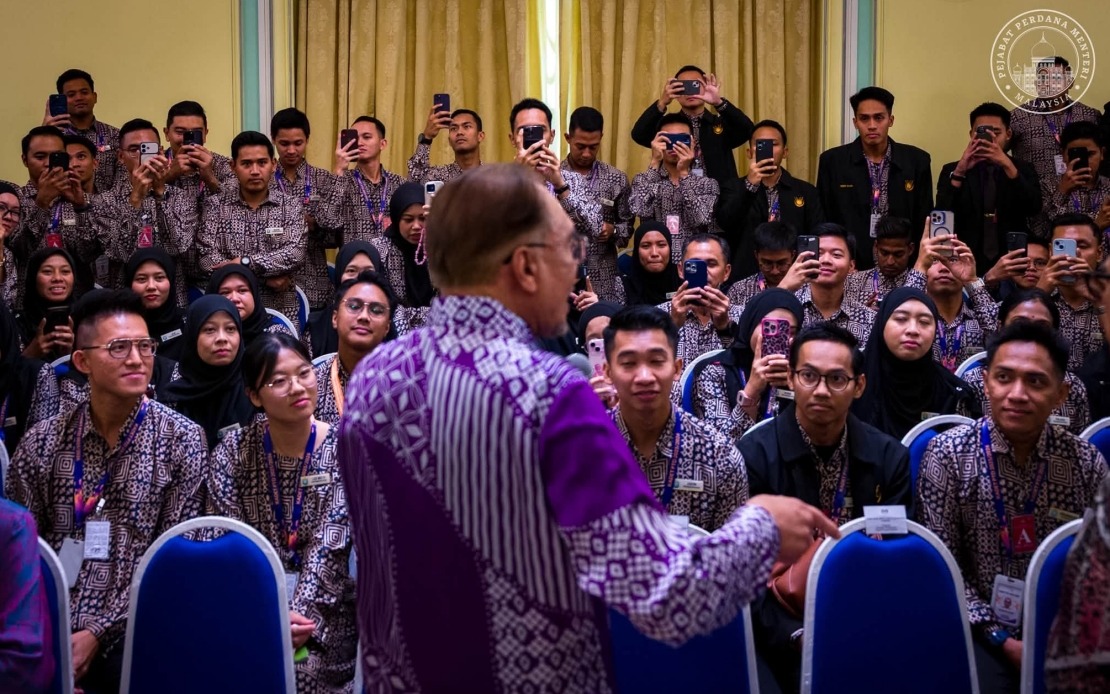
Prime Minister Datuk Seri Anwar Ibrahim has called on Malaysia's civil service to balance institutional modernisation with steadfast moral principles, framing both as essential to achieving a more equitable and prosperous nation. During an engagement with Administrative and Diplomatic Service (PTD) officer cadets pursuing postgraduate qualifications in public management at his Putrajaya office on July 16, Anwar underscored that public servants bear a special responsibility to marry adaptability with integrity—qualities he characterised as inseparable from effective governance.
The Prime Minister's remarks arrive at a juncture when Malaysia's bureaucracy faces mounting pressure to demonstrate responsive policymaking while restoring public confidence. The tension between preserving institutional stability and driving necessary change represents a persistent challenge across Southeast Asia, where civil services inherited colonial administrative structures yet must serve increasingly diverse and demanding populations. Anwar's emphasis on this duality suggests the government recognises that reform without ethical moorings risks legitimacy, while ethical rigidity without reform courts irrelevance.
Anwar's message to the PTD cadets, conveyed via social media, centred on a specific proposition: that national development rests fundamentally on the calibre and principled character of those stewarding public institutions. This framing positions civil servants not merely as implementers of policy but as custodians of the nation's trajectory. For Malaysia, where concerns about governance standards and service delivery efficiency have periodically surfaced, such messaging implicitly acknowledges that restoring faith in government machinery requires both structural competence and demonstrated commitment to the public good.
The Administrative and Diplomatic Service represents the apex of Malaysia's civil service hierarchy, cultivating senior administrators who shape policy across federal and state governments. These cadets, upon completion of their training, will occupy positions influencing resource allocation, regulatory frameworks, and institutional direction. The choice to address this cohort directly underscores that reform ambitions cannot succeed without buy-in from the administrative elite tasked with translating leadership priorities into operational reality.
Anwar's insistence on placing national and public interests above institutional or personal considerations reflects broader Southeast Asian governance debates. Throughout the region, questions about whether civil services function primarily to serve citizens or to entrench bureaucratic power structures persistently emerge. By explicitly articulating a people-centred approach, Malaysia's Prime Minister signals that his administration expects public servants to demonstrate genuine commitment to public welfare rather than administrative convenience or parochial institutional interests.
The emphasis on efficiency within this ethical framework carries particular weight for Malaysia's development trajectory. Regional competitors including Singapore, South Korea, and Vietnam have achieved rapid advancement partly through cultivating highly capable, results-oriented civil services operating within clear ethical parameters. Malaysian policymakers appear cognisant that merely adopting similar administrative structures without embedding genuine commitment to integrity risks creating technocratic systems that generate policy without legitimacy or effectiveness.
Anwar's invocation of good governance as foundational to progressive and just development aligns with international governance standards yet tailors them to Malaysia's specific context. Malaysian civil servants have encountered reputational challenges in recent years, including allegations of inconsistent service delivery, opaqueness in certain administrative processes, and varying standards across federal and state systems. A sustained emphasis on governance quality from the Prime Minister's office signals intent to address these perceptions through institutional culture-building rather than structural overhaul alone.
The postgraduate qualification pursued by the PTD cadets—specifically in public management—reflects recognition that modern governance demands sophisticated analytical and administrative capacity. These officers will manage budgets in the billions of ringgit, oversee complex policy implementation, and interface with international counterparts. Anwar's message essentially frames their training not merely as technical preparation but as induction into a profession bound by ethical obligations transcending administrative convenience or political expediency.
For Malaysian citizens and businesses reliant on civil service efficiency and fairness, this articulation matters considerably. Inconsistent application of regulations, delayed processing, or discretionary decision-making rooted in personal interest rather than policy principle inflicts real costs on economic activity and public welfare. By addressing this cohort directly on integrity, Anwar creates accountability expectations extending beyond formal regulations into institutional culture and individual conscience.
The broader implications for Malaysia's development agenda warrant consideration. Southeast Asian nations competing for foreign investment, talent retention, and regional leadership prominence benefit substantially from reputations for administrative integrity and competence. Singapore's sustained prosperity rests partly on widespread confidence in civil service neutrality and capability. As Malaysia pursues advanced economy status and seeks to attract high-value industries, the health of its governance institutions becomes a differentiating factor in regional competition.
Anwar's message also implicitly addresses generational transition within Malaysia's bureaucracy. Younger civil servants entering the system now have witnessed both governance failures and reforms. They will shape institutional norms for decades. Establishing clear expectations around integrity and change-orientation at this stage influences institutional culture far more effectively than directive management of individual cases later.
The challenge ahead involves translating these aspirational statements into sustained institutional practice. Civil servants throughout Southeast Asia often encounter pressures and constraints limiting their capacity to act on such principles—inadequate resources, competing directives, political interference, or systematic inefficiencies inherited from previous administrations. Anwar's exhortations carry force only if accompanied by systemic reforms removing structural obstacles to principled performance.
Ultimately, the Prime Minister's engagement with PTD cadets represents an attempt to rebuild social contract foundations between government and governed. Effective governance systems succeed when public servants genuinely internalise commitments to public service and when citizens believe those commitments are real. Malaysia's trajectory will depend substantially on whether articulated principles of integrity and reform-mindedness translate into observable improvements in how ordinary Malaysians experience government institutions.

