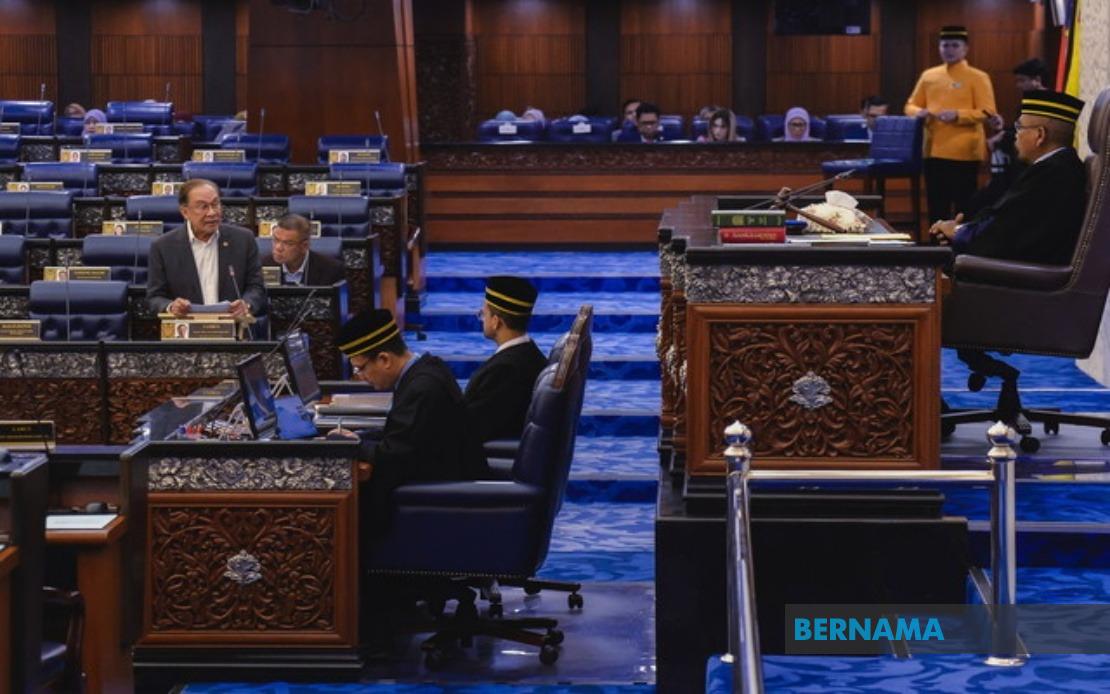
Prime Minister Datuk Seri Anwar Ibrahim has underscored the legal prohibition against announcing new government projects or introducing fresh policies during election campaign periods, clarifying the boundaries that govern how federal and state authorities must conduct themselves as voting approaches. Speaking during Minister's Question Time in the Dewan Rakyat, Anwar addressed concerns about the upcoming state elections in Johor, Melaka and Negeri Sembilan, making explicit that this constraint represents a firm and unvarying position adopted by his administration.
The restriction draws its legal authority from Section 24B of the Election Offences Act 1954, which establishes the framework within which campaign activities must operate. Anwar explained that once nomination day is formally declared, political campaigning enters an active phase, yet this freedom to contest does not extend to announcing or pledging new infrastructure, development projects or policy initiatives that would benefit the state in question. This distinction is critical for understanding the scope of electoral regulation in Malaysia, as it prevents the incumbent government from leveraging the machinery of state to gain competitive advantage through spending announcements timed to coincide with voting campaigns.
The Prime Minister was particularly emphatic that government structures at all levels must refrain from utilising their administrative apparatus to publicise fresh projects during the campaign window. His remarks encompassed federal agencies, state governments and municipal authorities, signalling that the prohibition applies uniformly across the administrative hierarchy. This comprehensive approach reflects an effort to ensure that taxpayer-funded resources and public platforms are not weaponised to influence electoral outcomes, a concern that resonates across Southeast Asia where governments sometimes face accusations of deploying state resources to favour ruling coalitions.
Anwar's response came in answer to a parliamentary question from Datuk Seri Dr Shahidan Kassim, the Perikatan Nasional member for Arau, who sought clarification on whether the ban remains operative and what mechanisms exist to verify compliance. The fact that such a question was tabled suggests ongoing uncertainty among lawmakers about how strictly these rules are enforced, or whether loopholes permit creative announcements that technically skirt the regulation. By publicly reiterating the government's commitment, Anwar appears to be signalling that enforcement will remain firm, though questions about monitoring mechanisms were not fully elaborated.
Crucially, the Prime Minister drew a distinction between entirely new projects and those that have already received formal approval or budgetary allocation in preceding financial years. Under this interpretation, government bodies may continue to promote or progress schemes that were previously greenlit and funded, even if the campaign period overlaps with their implementation or public unveiling. This caveat is significant because it permits the government to deliver on existing commitments without facing accusations of electoral manipulation, though it also creates a grey area where the timing of announcements regarding pre-approved work might still generate controversy if perceived as strategically positioned to influence voters.
The context of these elections is important for understanding why such clarifications matter. Johor, Melaka and Negeri Sembilan have varying political compositions, with some areas controlled by opposition coalitions or representing competitive terrain. In such environments, clear rules about what government bodies can announce help prevent perceptions of unfair advantage, which can undermine public confidence in electoral integrity. Malaysia's election framework, like that of many democracies, seeks to establish a level playing field where parties compete on policy platforms and candidates' merits rather than on the government's ability to deliver last-minute spending pledges.
Enforcement of such rules, however, presents practical challenges. Distinguishing between a legitimate announcement of previously approved work and an improper disclosure of new commitments requires judgment calls that may be contested. Different agencies might interpret the boundaries differently, and without a single arbiter making real-time determinations, inconsistencies can arise. The Prime Minister's reiteration suggests that the government intends to take compliance seriously, yet the mechanics of how violations will be identified and addressed remain somewhat opaque from the parliamentary exchange.
Regionally, Malaysia's approach reflects broader principles observed in other Southeast Asian democracies, though implementation varies. Thailand, Indonesia and the Philippines have grappled with similar issues, recognising that restricting government announcements during campaigns is necessary to maintain electoral fairness. However, enforcement effectiveness differs markedly, with some jurisdictions relying on electoral commissions to monitor activity whilst others depend on opposition parties and civil society to flag alleged breaches. Malaysia's Electoral Commission plays a role in overseeing these regulations, though its autonomy and resources remain subjects of debate.
For Malaysian businesses, investors and civil society organisations, understanding these rules is practical. Companies seeking government contracts or partnerships, as well as ngos advocating for policy changes, must be mindful that election periods impose a temporary freeze on new government initiatives. This can affect project timelines and funding announcements, requiring stakeholders to plan accordingly around campaign schedules. The rules also shape political strategy, as parties must build their campaigns primarily around existing platforms and delivered results rather than promising fresh commitments that cannot be announced until the campaign concludes.
The Prime Minister's emphasis on consistency in interpreting and applying these rules also signals a commitment to institutional integrity. By publicly restating the policy during parliamentary question time, he places the government on record, making future deviations more difficult to justify and creating accountability expectations. This transparency can strengthen public trust in electoral processes, though only if enforcement proves equally transparent and consistent. The onus falls on administrative bodies to ensure that enthusiasm for electoral success does not override the legal framework designed to protect democratic fairness, a balance that requires sustained institutional discipline across multiple agencies.
Looking ahead to the Johor, Melaka and Negeri Sembilan state elections, these guidelines will shape how government actors communicate with voters. Opposition parties will likely monitor announcements closely to identify any apparent breaches, potentially escalating disputes to the electoral commission or the courts. The clarity Anwar has provided may help reduce such disputes by establishing unambiguous boundaries, though the grey areas surrounding pre-approved projects suggest that controversy is not entirely foreseeable. Overall, the Prime Minister's restatement reflects a broader commitment to electoral integrity, even as the practical implementation of these rules continues to evolve.

