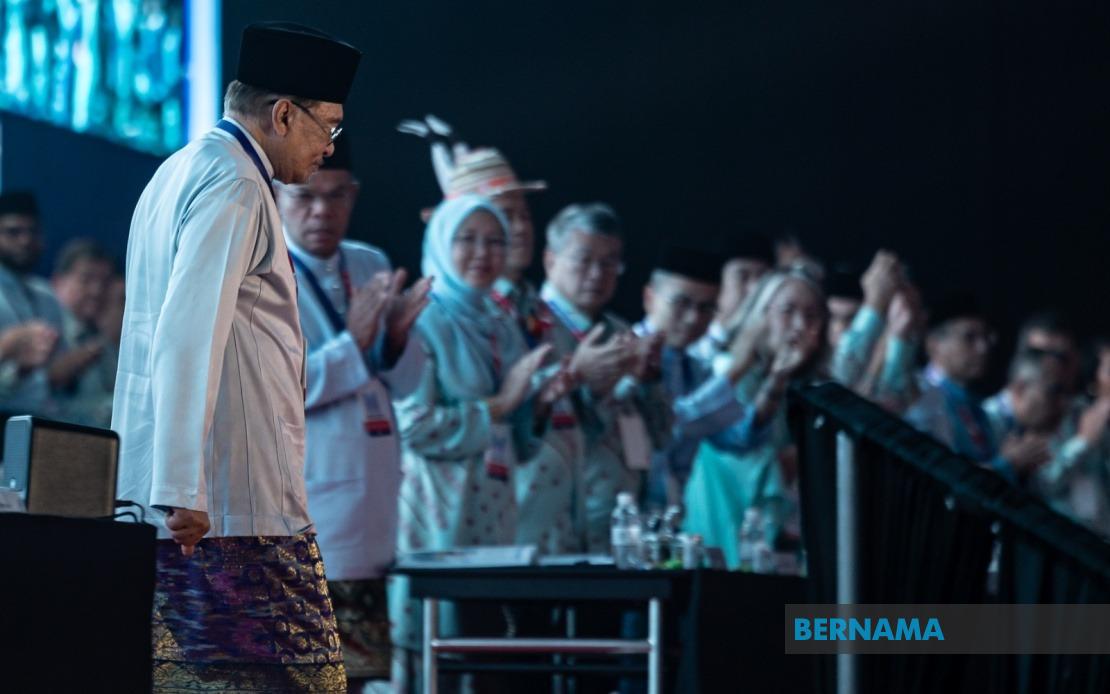
Prime Minister Datuk Seri Anwar Ibrahim moved swiftly on Thursday to counter accusations that the MADANI administration treats some Malaysian states unequally, declaring instead that federal spending across the country has expanded meaningfully across his tenure. Addressing delegates at the 2026 PKR National Congress in Melaka, Anwar presented a series of budget figures to substantiate claims that no region has been neglected, framing differential allocations as reflections of varying developmental priorities rather than political bias.
The Prime Minister's comments arrive amid periodic tensions between the federal government and state administrations over resource distribution, a perennial issue in Malaysian federalism where states often compete for investment and infrastructure funding. Anwar's remarks suggest the government remains mindful of regional sensitivities and is keen to demonstrate equitable treatment across the peninsula, Sabah, and Sarawak. Such messaging is particularly relevant in competitive political terrain where opposition figures frequently allege marginalisation of non-aligned states.
Central to Anwar's defence was the transformation in Sabah's financial position under his administration. The Prime Minister highlighted that federal expenditure directed towards the state has surged by 35 per cent since 2022, climbing from RM13 billion to RM17.6 billion by 2026. This trajectory, Anwar suggested, undermines claims of deliberate neglect, particularly as previous state governments had not publicly complained about allocations during earlier administrations. The rhetorical move thus positions the current government as actively improving Sabah's position rather than maintaining historical patterns of underfunding.
Sarawak's budget allocation presents an even steeper growth curve, with federal funding increasing by nearly half in the equivalent period. Anwar noted that the state's allocation rose from RM10.2 billion in 2022 to RM15.1 billion, representing a 48 per cent increase. Such growth rates exceed national average budgetary expansion and underline the federal government's substantial financial commitment to Malaysia's largest state by land area. For Sarawak, historically conscious of its constitutional position and resource autonomy, such increases represent tangible acknowledgment of its standing within the federation.
Beyond the bordering states, Anwar referenced improvements affecting multiple peninsular regions. Terengganu's allocation expanded from RM6 billion in 2022 to RM8.1 billion in the current fiscal year, reflecting a 35 per cent jump. Johor, Malaysia's second-largest economy and a crucial political battleground, saw its budget climb from RM10.2 billion to RM14.6 billion by 2026—a 43 per cent increase that signals federal commitment to supporting the southern powerhouse. Anwar also mentioned that Kedah, Kelantan, and Perlis had benefited from similar upward trajectories, though without providing specific figures.
The Prime Minister's enumeration of multiple states across different regions suggests a deliberate strategy to present a comprehensive picture of budgetary equity. By naming Sabah and Sarawak—geographically and politically distinct from Peninsular Malaysia—alongside Terengganu and Johor, Anwar attempted to demonstrate that no major region has been systematically excluded from resource growth. The emphasis on Johor is particularly noteworthy, as the state represents a significant economic engine and has been subject to political competition between coalitions.
Understanding the context of Malaysian federalism illuminates the significance of Anwar's defence. State governments, whether aligned with or opposed to the federal administration, frequently dispute allocation formulas and argue that their territories receive insufficient resources relative to needs and economic contributions. The MADANI government, comprising multiple political parties with different state-level fortunes, faces pressure to demonstrate fairness across its coalition partners while managing expectations from non-aligned states. Budget increases serve as concrete evidence of federal goodwill that can be brandished in political communications.
For Malaysian observers and regional analysts, such budget trajectories carry implications beyond numerical accounting. Infrastructure investment, development projects, and public service expansion funded through these allocations shape economic opportunity and quality of life across states. States receiving larger increases may accelerate construction of roads, hospitals, and educational facilities, influencing migration patterns and business location decisions. The visibility of such projects becomes political capital, with both federal and state governments claiming credit for improvements.
The timing of Anwar's statements at a PKR congress reflects the governing coalition's need to maintain internal cohesion and prevent component parties from defecting over perceptions of unequal treatment. PKR operates across multiple states with varying political influence, and reassurance of consistent federal support helps bind party leadership to the coalition. Simultaneously, the Prime Minister's remarks serve as implicit messaging to states controlled by opposition parties, suggesting that cooperation with the federal government brings tangible benefits.
However, the defence also masks underlying complexities in how Malaysian allocations function. Federal budget figures represent total government spending in states rather than direct transfers to state governments, which instead receive revenue from shared taxes and specific grants. The distinction matters because federal spending encompasses defence installations, federal development projects, and federal employee salaries, which may not directly benefit state administrations or address their identified priorities. States and the federal government sometimes disagree on whether spending patterns align with regional developmental needs.
Moving forward, the Prime Minister's commitment to sustained budget growth across regions will face scrutiny as economic conditions evolve and national expenditure constraints potentially tighten. Public memory of budget announcements typically extends only as far as visible project completion, and delays or cancellations can rapidly erode political capital gained through allocation rhetoric. States will continue monitoring their relative position within the federal budget framework, particularly as the 2026 election cycle approaches and political competition intensifies.
Anwar's intervention demonstrates the enduring salience of fiscal federalism in Malaysian political discourse. By centralising the budget narrative around equity and growth, the Prime Minister attempts to preempt criticism while building a record of developmental commitment. Whether such efforts successfully mollify state-level concerns or merely defer deeper debates about resource distribution will become clearer as actual project implementation proceeds across the federation.

