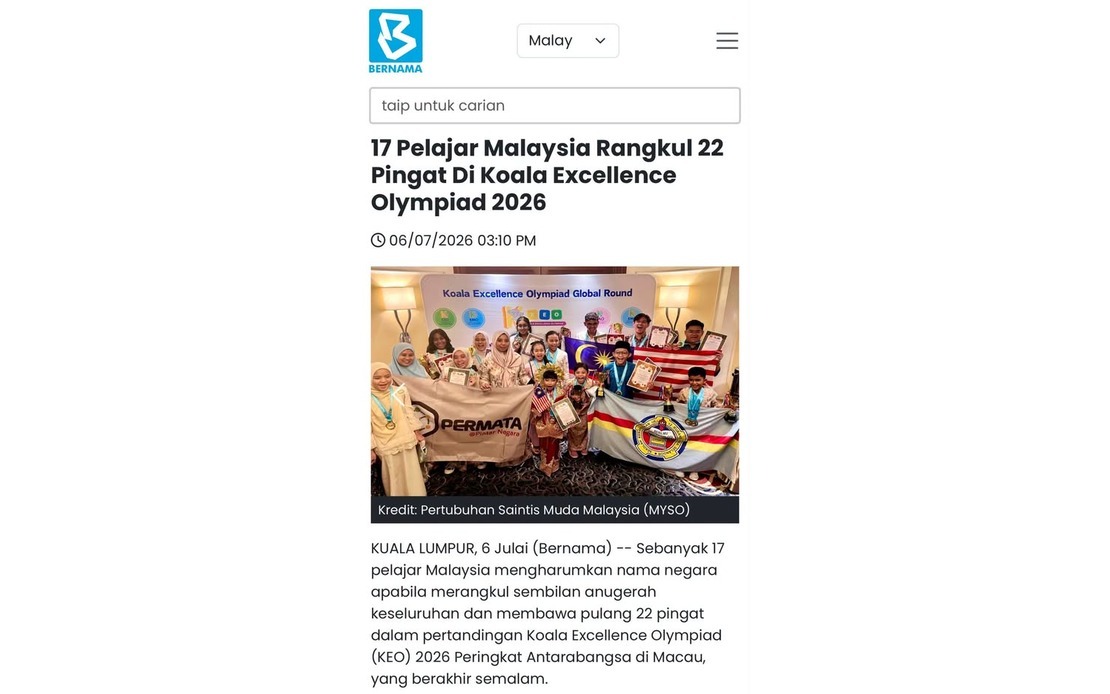
Prime Minister Datuk Seri Anwar Ibrahim has publicly recognised the exceptional accomplishments of 17 Malaysian students who competed at the 2026 Koala Excellence Olympiad (KEO) Global Finals held in Macau. The students collectively brought home an impressive haul comprising nine overall awards and 22 medals, underscoring Malaysia's growing presence in international academic competitions across diverse disciplines.
Anwar took to social media to express his pride in the contingent's performance, urging the young competitors to maintain their commitment to excellence and continue building on their success. His message reflected the government's ongoing emphasis on nurturing talented youth and positioning Malaysia as a competitive player in the global education arena, particularly in rigorous academic contests that test proficiency across multiple fields.
The Malaysian delegation's medal tally consisted of five gold, six silver, and eleven bronze medals, according to Aidah Misran, the coordinator of the Malaysia Young Scientists Organisation (MYSO) and head of the Malaysian contingent sent to Macau for the competition. This breakdown demonstrates strong performance across multiple categories, with particular strength in achieving top-tier recognition, as evidenced by the substantial number of gold medals secured.
The KEO represents a significant platform for young scholars to demonstrate their academic prowess on an international stage. Developed by a consortium of Australian educational experts and graduates, the competition spans four core disciplines: English, Mathematics, Science, and Arts. This multidisciplinary approach ensures that participating students must exhibit well-rounded intellectual capabilities rather than specialising narrowly in a single subject area.
The competition itself was organised collaboratively by KEO and the Miss Man International Group, with MYSO serving as the coordinating body within Malaysia. This partnership model has proven effective in recruiting and preparing competitive teams, drawing together some of the nation's brightest young minds from various schools and educational backgrounds. The involvement of MYSO, an established organisation dedicated to fostering scientific talent among youth, lends credibility and rigour to Malaysia's selection and preparation processes.
International academic olympiads and competitions have become increasingly important in Malaysia's educational landscape, serving as both a measure of academic achievement and a platform for cultural exchange. Events such as the KEO Finals allow Malaysian students to benchmark their capabilities against peers from other countries while gaining exposure to different educational perspectives and methodologies. The presence of contingents from multiple nations also facilitates networking opportunities that may lead to future academic collaborations and partnerships.
The success registered at the KEO 2026 finals carries implications beyond the immediate recognition of individual students. Strong performance in international academic competitions often translates into enhanced institutional and national prestige, potentially attracting greater investment in science and mathematics education at primary and secondary levels. Such victories also serve as inspirational benchmarks for younger students contemplating their own academic trajectories and career aspirations in fields requiring strong foundational knowledge.
The breadth of disciplines covered by the competition—spanning humanities through science—reflects a holistic approach to academic excellence that aligns with global educational trends emphasising interdisciplinary knowledge and critical thinking. By excelling across English, Mathematics, Science, and Arts, Malaysian students demonstrated that excellence need not be confined to STEM fields alone, a message that may encourage greater participation from students with diverse intellectual interests and academic strengths.
For Malaysian educators and policymakers, such outcomes underscore the effectiveness of targeted talent identification and nurturing programmes. The consistent production of medal-winning students at prestigious international competitions suggests that existing frameworks for identifying gifted youth and providing them with appropriate developmental opportunities are functioning effectively, though ongoing refinement and increased investment may enhance performance further.
The timing of such achievements, publicly acknowledged by the nation's chief executive, also serves a motivational function for the broader student population. Recognition from the highest levels of government legitimises the pursuit of academic excellence and signals that national leaders view international competition success as a worthy endeavour deserving celebration and support. This institutional validation can encourage greater numbers of ambitious students to dedicate themselves to rigorous academic preparation and competition participation.

