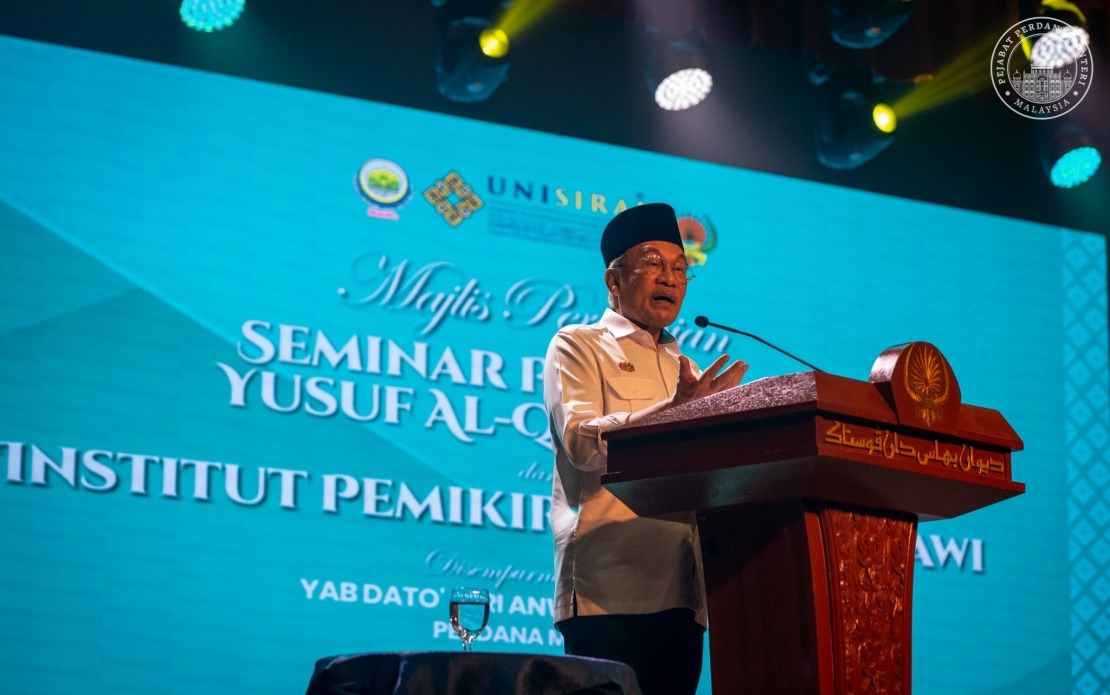
Prime Minister Datuk Seri Anwar Ibrahim has pledged RM2 million in financial support from the MADANI Government to establish and strengthen the Al-Qaradawi Thought Institute, positioning the facility as a centre for rigorous examination of the late Islamic scholar's philosophical contributions and their application to modern challenges. The announcement came during the formal opening of both the Yusuf Al-Qaradawi Thought Seminar and the institute itself at Wisma Dewan Bahasa dan Pustaka in Kuala Lumpur on July 21, underscoring the government's emphasis on intellectual discourse within Islamic frameworks.
The Prime Minister's personal reflection on his relationship with the prominent Islamic thinker reveals the depth of Al-Qaradawi's influence on Malaysia's contemporary political leadership. Anwar acknowledged his indebtedness not merely to the scholar's theoretical work but to the emotional and intellectual support garnered across decades of interaction, framing the financial commitment as a gesture rooted in genuine regard rather than ceremonial obligation. His comments posted on X demonstrated how this relationship transcended the typical scholar-student dynamic, evolving into a mentorship that shaped Anwar's own understanding of progressive Islamic thought.
The historical context Anwar provided illuminates why this investment matters for Southeast Asia's religious landscape. During the 1980s Islamic resurgence, a period marked by heightened ideological tensions and competing visions of how Islam should manifest in contemporary societies, Al-Qaradawi emerged as a moderating voice. His counsel to the Malaysian Islamic Youth Movement (ABIM), where Anwar held prominent positions, specifically urged the organisation to embrace wasatiyyah—the principle of moderation and balance—rather than succumb to more rigid interpretive frameworks. This guidance proved consequential in steering Malaysia's Islamic movement toward intellectual pluralism at a critical juncture.
Understanding Al-Qaradawi's role as what Anwar termed a 'zeitgeist'—a mover of the times and agent of change—provides crucial perspective for contemporary Malaysian policymakers grappling with similar tensions. The scholar exemplified how Islamic thought could remain theologically grounded while remaining open to dialogue, reform, and adaptation. His writings and pronouncements demonstrated that fidelity to Islamic principles need not require isolation from broader intellectual currents or rejection of differing perspectives. For a diverse, multicultural nation like Malaysia, this philosophical approach carries particular resonance as the country navigates questions of religious identity, social cohesion, and inclusive governance.
The establishment of the Al-Qaradawi Thought Institute addresses a gap in Malaysia's institutional landscape by creating a dedicated space for systematic research into Islamic jurisprudence and contemporary applications. Such institutions serve multiple functions simultaneously: they preserve intellectual heritage, foster new scholarship, and provide platforms for examining historical figures whose contributions might otherwise fade from active academic discourse. The institute's focus on developing and strengthening research capacity suggests an investment in generating original analysis rather than simply archiving existing materials, potentially positioning it as a resource for scholars across Southeast Asia seeking rigorous engagement with Islamic thought.
Anwar's repeated emphasis on Al-Qaradawi's commitment to openness and reception of differing viewpoints stands in deliberate contrast to more doctrinaire approaches to Islamic scholarship. By highlighting this aspect during a government-sponsored event, the Prime Minister signals official recognition of intellectual diversity as compatible with, rather than threatening to, Islamic identity. This positioning becomes significant in regional contexts where religious discourse sometimes bifurcates into competing camps with limited cross-pollination. The RM2 million commitment thus carries symbolic weight beyond its material dimensions, representing a governmental endorsement of particular intellectual traditions within Islam.
For Malaysian readers engaged with broader Southeast Asian developments, this initiative reflects ongoing conversations about Islam's relationship to modernity, governance, and pluralism. Countries across the region—from Indonesia to Brunei to Thailand's Muslim-majority provinces—grapple with similar questions about balancing traditional religious values with contemporary demands for adaptation and inclusivity. The Al-Qaradawi Thought Institute becomes a potential reference point and research hub for scholars exploring how Islamic intellectual traditions have addressed these challenges historically and might inform current debates.
The funding allocation, while modest by government standards, demonstrates prioritisation of research infrastructure for Islamic scholarship. This contrasts with potential alternative allocations and suggests deliberate policy choices about which intellectual traditions merit institutional support. The decision to establish this institute during a period of intense global polarisation around religious identity and interpretation further underscores its significance. By investing in scholarship examining a figure known for advocating moderation and dialogue, the government stakes a position in contested debates about Islam's contemporary trajectory.
Anwar's personal narrative of intellectual formation through interaction with Al-Qaradawi also illustrates how individual relationships between thinkers shape national policy trajectories. The Prime Minister's willingness to publicly acknowledge his debt to a foreign scholar, and to materially support research perpetuating that scholar's intellectual legacy, demonstrates the practical consequences of ideological mentorship. For younger Malaysian intellectuals and policymakers, this model suggests possibilities for transcontinental scholarly networks that enrich local contexts without compromising cultural specificity.
Looking forward, the institute's success will depend on its ability to attract high-calibre researchers, facilitate genuine intellectual discourse rather than hagiography, and produce scholarship with relevance beyond niche academic circles. The RM2 million injection provides necessary initial resources, yet sustainability requires building an ecosystem of partnerships, generating publishable research, and establishing the institute as an indispensable reference for understanding contemporary Islamic thought. Should the institution fulfil this potential, it could influence how Malaysia and the broader region conceptualise the relationship between religious scholarship, modernity, and pluralistic governance.

