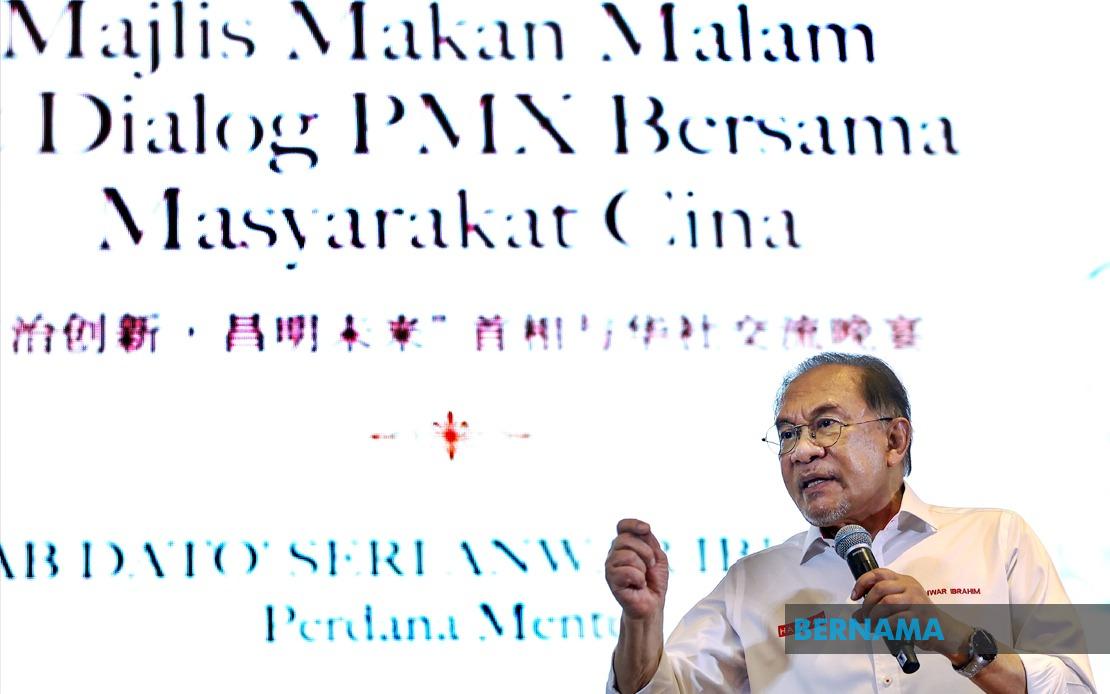
Prime Minister Datuk Seri Anwar Ibrahim has doubled down on his commitment to transform Malaysia into a prosperous nation underpinned by inclusive governance, using an engagement with the Chinese community in Johor Bahru to articulate a leadership philosophy rooted in serving every citizen regardless of ethnic or religious background. Speaking at a community dinner on July 4, Anwar outlined what he described as his personal mission at this stage of his political career: establishing a political and administrative legacy characterized by fairness, transparency, and unwavering dedication to the wellbeing of all segments of Malaysian society.
The Prime Minister's remarks came at a moment when Malaysia continues to grapple with deep-seated concerns about political stability, economic inequality, and public trust in governance. By explicitly addressing the Chinese community—a significant economic and demographic force within the country—Anwar sought to reinforce the message that his administration operates on the principle of genuine representation rather than narrow factional interests. This calculated outreach reflects an understanding that Malaysia's prosperity depends fundamentally on the voluntary cooperation and confidence of all its diverse populations, and that any perception of favoritism or exclusion threatens both social cohesion and economic competitiveness.
Anwar's emphasis on intergenerational responsibility reveals a maturing approach to his role. Rather than fixating on immediate policy victories or electoral gains, he positioned himself as a custodian of Malaysia's institutional health, concerned with the kind of nation his successors will inherit. This framing carries particular weight given Malaysia's recent political turbulence, including government changes and public anxieties about institutional integrity. By anchoring his leadership philosophy to principles of fairness and cleanliness—language deliberately chosen to evoke both moral integrity and administrative competence—Anwar attempted to address a widespread appetite for renewed credibility at the highest levels of government.
The inclusive character of Anwar's message merits closer examination. Rather than appealing exclusively to his core Pakatan Harapan base, he constructed a narrative that transcends party affiliation and speaks directly to Malaysian citizenship. His insistence that "every single citizen in this country is important" and that as Prime Minister he "must serve everybody" represents an ideological positioning that rejects zero-sum politics. In the Southeast Asian context, where polarization along ethnic and religious lines has destabilized nations across the region, this commitment to cross-community governance carries strategic importance beyond domestic symbolism.
Anwar's personal reflection on his age and legacy appears deliberately designed to distinguish his tenure from earlier patterns of Malaysian politics. By contemplating how he wishes to be remembered—not for accumulating power or wealth, but for demonstrating genuine care for his people—he invoked a different standard of political accountability than what many Malaysians have historically witnessed. The statement carries an implicit critique of previous administrations, while simultaneously setting expectations for his own conduct. This backward-looking perspective, when combined with forward-looking governance commitments, creates a narrative bridge between past disappointments and future possibilities.
The specific assertion that his goal is for Malaysians to eventually say "Anwar loved the people, and the people loved him back" reveals something important about his conception of political authority. Rather than relying on coercive state power or technocratic expertise alone, Anwar appealed to affective bonds—the emotional connection between leader and citizen. In a nation where trust in institutions has been periodically strained, this emotional dimension cannot be dismissed as merely sentimental. The psychological contract between government and governed matters profoundly for policy implementation, tax compliance, and broader civic participation.
The presence of Parti Keadilan Rakyat vice president and Selangor Menteri Besar Datuk Seri Amirudin Shari at the event provided institutional reinforcement to Anwar's message, signaling that his commitment to clean, fair governance extends across different administrative levels. Amirudin's participation suggested cohesion within the ruling coalition and alignment between federal and state-level leadership on fundamental governance principles. For Malaysian observers concerned about coordination between different tiers of government, this visibility mattered as much as Anwar's spoken words.
The significance of Anwar's vision for Malaysia cannot be divorced from the regional context. Southeast Asia faces mounting pressures from global economic competition, geopolitical tensions, and social fragmentation. Nations that can harness the talents and loyalties of all their citizens while maintaining institutional integrity gain measurable advantages. Malaysia's ethnic and religious diversity, often framed as a challenge, becomes a competitive asset when channeled through genuinely inclusive governance. Anwar's emphasis on serving all communities simultaneously addresses both internal Malaysian concerns and broader regional competitiveness.
Moving forward, the critical question concerns the translation of these principles into concrete policy and administrative action. The gap between aspirational rhetoric and institutional reality often determines whether such statements catalyze genuine change or fade into forgotten campaign language. For Malaysian citizens and international observers alike, the credibility of Anwar's legacy commitment will ultimately depend on measurable outcomes: the composition of appointed officials, the distribution of development resources, the handling of sensitive communal issues, and the demonstration of genuine accountability mechanisms. These practical tests will reveal whether his articulated philosophy represents authentic governance reorientation or rhetorical repositioning.

