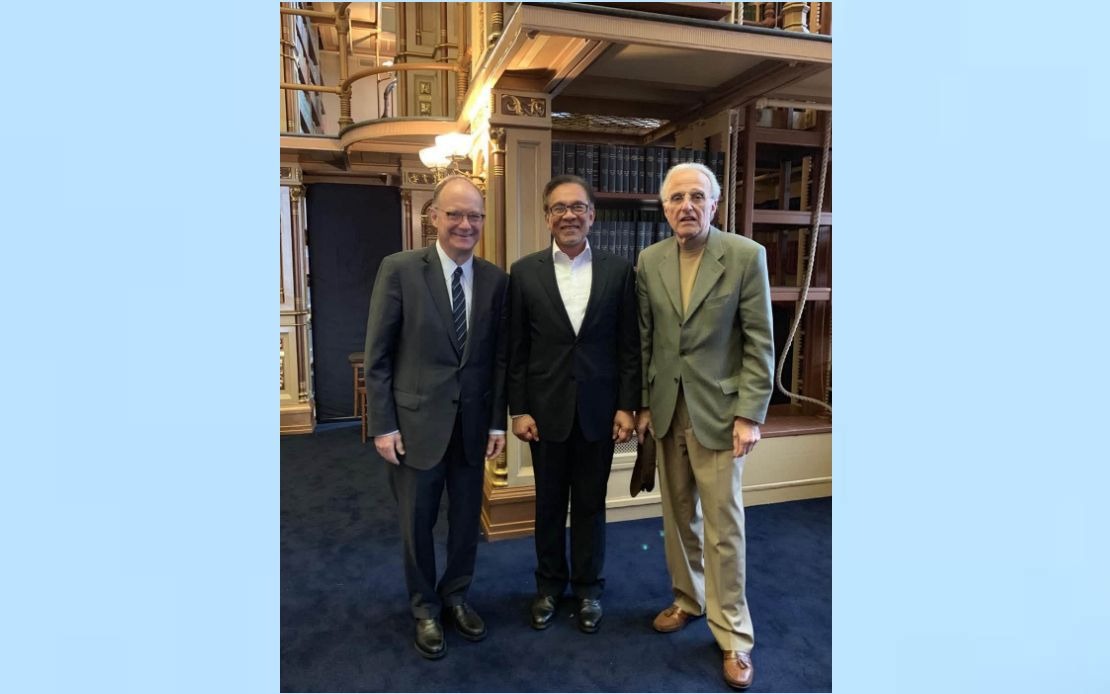
Prime Minister Datuk Seri Anwar Ibrahim has expressed profound grief over the death of Professor John L. Esposito, the internationally acclaimed Islamic scholar whose life work fundamentally reshaped how the Western world understands Islam and Muslim societies. In a heartfelt Facebook tribute, Anwar reflected on the loss of a towering intellectual figure who dedicated his career to fostering dialogue and dispelling misconceptions between civilisations that he refused to view as inevitably antagonistic.
The Prime Minister's personal connection to Esposito runs exceptionally deep, spanning more than fifty years since their initial encounter during the early 1970s. This relationship provided Anwar with sustained intellectual companionship and counsel during pivotal moments of his own political and scholarly journey. By publicly honouring this bond, Anwar underscores the value Malaysia places on cross-cultural scholarship and the importance of building understanding rather than perpetuating division in an increasingly complex geopolitical landscape.
Esposito's most enduring legacy, according to Anwar, lies in his systematic effort to establish rigorous academic foundations for Western comprehension of Islamic thought and practice. Rather than accepting oversimplified narratives or caricatures, Esposito invested decades in presenting Islam as a multifaceted civilisational force worthy of serious scholarly examination. His methodology transformed Islamic studies from a peripheral academic discipline into a central concern for policymakers, educators, and informed citizens grappling with questions of religious identity and international relations.
Among Esposito's most significant institutional contributions was his founding of Georgetown University's Centre for Muslim-Christian Understanding, a groundbreaking initiative that formally institutionalised interfaith scholarship at one of America's most influential universities. This centre became a crucible for developing nuanced understanding of theological commonalities and historical points of intersection between two of the world's largest faith traditions. Through this platform, Esposito supervised generations of scholars and facilitated dialogues that extended far beyond academic circles into diplomatic and policy spheres.
Esposito's scholarly output was remarkably prolific and deliberately accessible. His co-authored work "Makers of Contemporary Islam" provided historical context for understanding modern Islamic movements and thinkers, while his standalone volumes including "What Everyone Needs to Know About Islam" and "Who Speaks for Islam?" brought sophisticated academic analysis to general readers. These books proved particularly valuable in the post-9/11 environment, when Western publics desperately needed reliable information to counter sensationalism and fear-driven discourse surrounding Islam and Muslims. Esposito's capacity to maintain scholarly rigour while writing for broader audiences distinguished him from many academics confined to narrow specialist audiences.
Anwar employed a metaphor that captures Esposito's philosophical orientation, observing that the scholar "built bridges where others were content to build civilisational barriers." This formulation reflects a conscious rejection of the "clash of civilisations" thesis that gained considerable currency in international relations scholarship. Instead, Esposito exemplified an approach grounded in the conviction that sustained intellectual engagement, historical understanding, and good faith dialogue could overcome prejudice and foster peaceful coexistence even amid real disagreements and competing interests.
The Prime Minister's characterisation of Esposito as exceptionally generous in private conversation while remaining intellectually rigorous in published work reveals dimensions of the scholar's character often absent from academic obituaries. This duality suggests someone who refused to compartmentalise his intellectual commitments from his personal relationships, bringing the same commitment to understanding and fairness to individual interactions as to his scholarly publications. Such consistency of character contributed substantially to Esposito's influence among policymakers and leaders who valued both his ideas and his integrity.
For Malaysia particularly, Esposito's passing represents the loss of a Western intellectual voice whose work legitimised and elevated Muslim perspectives in global discourse. In a region where Muslim-majority nations navigate complex relationships with Western powers, having respected Western scholars who engage Islam sympathetically rather than defensively or dismissively holds considerable geopolitical significance. Esposito's scholarship provided intellectual ammunition for those arguing against essentialist religious determinism and demonstrated that Western academia could produce work genuinely respectful of Islamic civilisation.
Anwar's decision to formally commemorate Esposito reflects broader commitment by Malaysia's political leadership to positioning the nation as a centre for interfaith dialogue and religious understanding. By publicly celebrating a Western scholar's contributions to Muslim-Christian understanding, the Prime Minister signals that Malaysia values intellectual exchange across religious and cultural boundaries. This positioning distinguishes Malaysia's approach from more isolationist or confrontational models of Islamic governance that view Western engagement suspiciously.
The Prime Minister extended formal condolences to Esposito's widow Jean and to his extended family, colleagues, and former students, acknowledging the ripple effects of his loss across multiple communities. Anwar concluded by expressing hope that Esposito's scholarly legacy and the dialogical traditions he spent a lifetime cultivating would continue bearing fruit in future generations. This closing sentiment reframes death not as conclusion but as transition, with influence extending posthumously through intellectual descendants and institutional legacies that Esposito established.
Esposito's death marks a significant moment for reflection on the state of Islamic studies and Muslim-Western relations in contemporary scholarship. As polarisation intensifies in multiple regions and religious identity becomes increasingly politicised, the model of rigorous, sympathetic scholarship that Esposito embodied appears more rather than less necessary. His work demonstrated that understanding Islam need not involve abandoning critical analysis, just as respect for Muslim societies need not preclude examining internal debates and disagreements within Islamic traditions. These balanced approaches, increasingly rare in polarised contemporary discourse, constitute perhaps Esposito's most valuable bequest to future scholars and policymakers.

