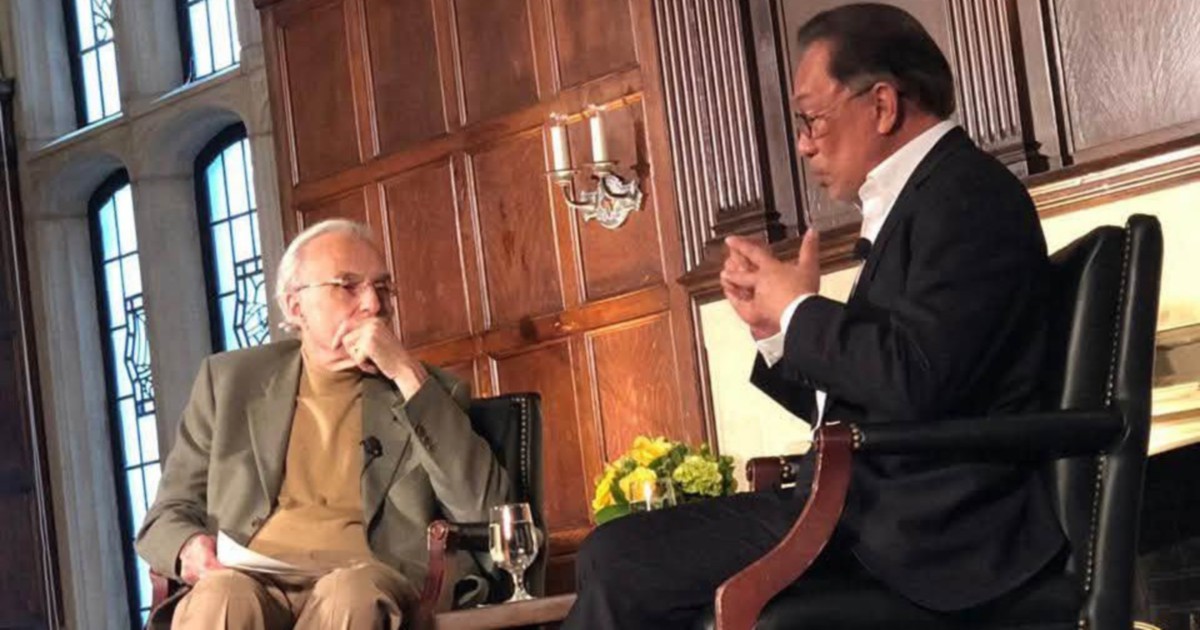
Prime Minister Datuk Seri Anwar Ibrahim has conveyed his deepest sympathies following the passing of Professor John L. Esposito, whose academic contributions to the study of Islam have earned him recognition as among the world's most influential scholars in the field.
Esposito's intellectual legacy extends across decades of groundbreaking research that reshaped Western understanding of Islamic civilization, theology, and contemporary Muslim societies. His work bridged cultural and geographical divides at a time when academic discourse on Islam faced increasing polarisation, particularly following major geopolitical events that strained interfaith relations globally. Through his prolific writing and institutional leadership, he championed nuanced perspectives that moved beyond stereotypical portrayals of Islamic traditions and Muslim communities.
The Georgetown University professor emerged as a pivotal figure in Islamic studies from the 1970s onwards, establishing himself as a rigorous scholar while simultaneously serving as a public intellectual who addressed urgent questions about Islam's role in modern geopolitics. His publications reached far beyond academic circles, influencing policymakers, journalists, and educated publics seeking informed analysis rather than sensationalism. This dual role—rigorous scholar and accessible communicator—distinguished his contributions from much of contemporary discourse.
For Malaysia and the broader Southeast Asian region, Esposito's scholarly output carried particular relevance. His examinations of Islam's interaction with state formation, democracy, and pluralism provided frameworks through which scholars and policymakers across the region could evaluate their own experiences. Southeast Asia's religiously diverse nations, where Muslim-majority populations coexist with significant Hindu, Buddhist, and Christian communities, found in his work validation of the theoretical possibility that Islamic governance and democratic institutions need not exist in perpetual conflict.
Esposito's institutional work proved equally consequential. His leadership at Georgetown University's Prince Alwaleed Bin Talal Center for Muslim-Christian Understanding reflected his conviction that advancing knowledge about Islam required sustained institutional support and cross-disciplinary engagement. The centre became a hub for scholars, policymakers, and civil society representatives grappling with questions of religious identity in pluralistic societies—challenges directly resonant with Malaysia's own national project of managing religious and ethnic diversity within a constitutionally Islamic but multifaith framework.
Throughout his career, Esposito maintained a commitment to empirical research and historical contextualisation that earned respect even from scholars who disagreed with his interpretations. Rather than dismissing Islam as inherently incompatible with democracy or human rights, he examined specific historical cases and contemporary movements with scholarly rigour, demonstrating how theology and politics intersect across diverse Muslim-majority societies. This methodology encouraged younger generations of scholars to move beyond ideological certainty toward evidence-based analysis.
His books, which numbered over fifty, became standard texts in universities worldwide. Works examining Islamic movements, the politics of Islamic law, or the relationship between Islam and democracy provided readers—from undergraduates to policymakers—with conceptual tools for understanding complex social phenomena. For Malaysian academics and thinkers engaging with questions about Islam's relationship to constitutional governance and minority rights, his systematic analysis of how different Muslim societies have navigated these tensions offered both historical examples and theoretical frameworks.
Esposito's passing represents a significant loss to global intellectual discourse at a moment when informed, nuanced scholarship on Islam remains urgently needed. Rising geopolitical tensions, the proliferation of social media commentary devoid of historical depth, and persistent misunderstandings between Muslim and non-Muslim communities create ongoing demand for the kind of careful, evidence-based analysis he championed. His death removes from public discourse a voice that commanded respect across ideological boundaries.
For Southeast Asia specifically, Esposito's legacy underscores the importance of sustained scholarly engagement with questions of religious pluralism, constitutional design, and the relationship between Islamic principles and democratic governance. Malaysia's own ongoing negotiations over the scope of Islamic law, the accommodation of minority rights, and the balance between religious authority and secular governance gain historical and comparative perspective from his body of work.
Anwar Ibrahim's public expression of condolences reflects the respect Esposito commanded among Muslim intellectuals and leaders internationally. His passing marks the conclusion of a remarkable scholarly career that helped establish Islamic studies as a rigorous, intellectually serious field of inquiry and demonstrated that understanding Islam required engagement with its theological depths, historical complexities, and contemporary diversity rather than reductive generalisations.

