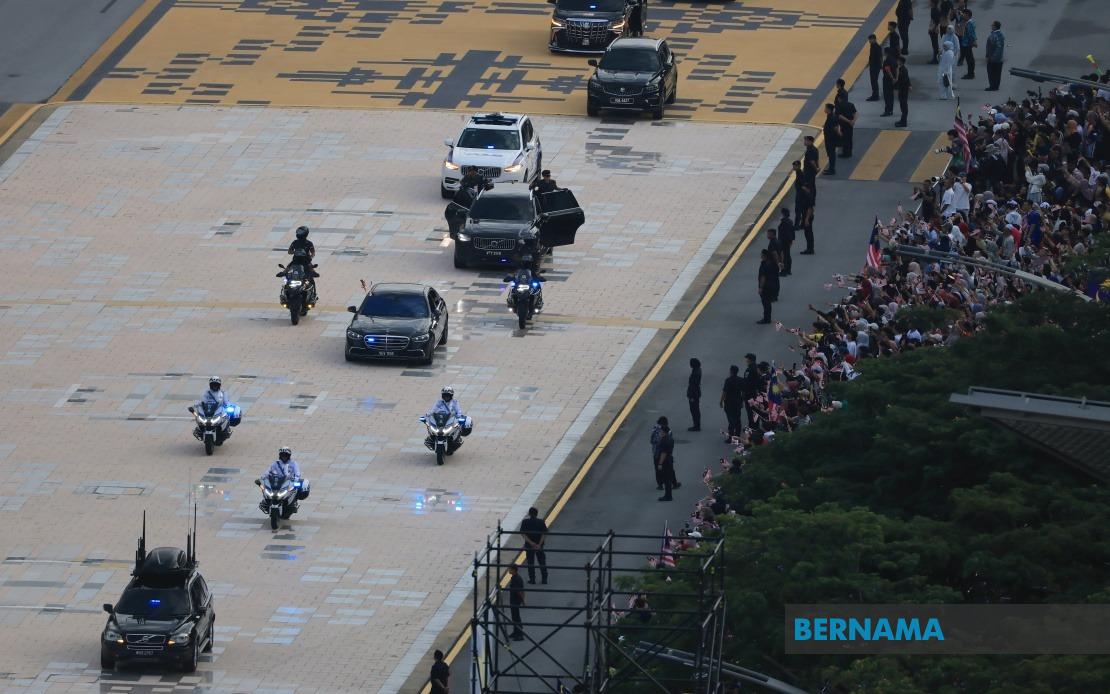
Prime Minister Datuk Seri Anwar Ibrahim, accompanied by his wife Datuk Seri Dr Wan Azizah Wan Ismail, presided over the nation's 69th National Day celebrations at Dataran Putrajaya on August 31, leading the most senior gathering of Malaysia's political leadership in a show of national unity. The Prime Minister and Finance Minister arrived at the ceremonial stage shortly before 8 a.m., as the traditional Hormat Perdana anthem resonated across the federal administrative capital, setting the tone for a day of remembrance and patriotic observance.
The pageantry at Dataran Putrajaya reflected the significance of the occasion, with the Malaysian Government marshalling unprecedented resources to demonstrate national cohesion and progress. Deputy Prime Minister Datuk Seri Dr Ahmad Zahid Hamidi arrived moments earlier, establishing the executive hierarchy at the celebration's heart. The presence of multiple Cabinet-level officials underscored the administration's commitment to the annual commemoration, with each senior minister positioning themselves prominently within the ceremonial framework.
The Cabinet representation extended across the full spectrum of government portfolios, with Communications Minister Datuk Seri Fahmi Fadzil attending in his dual capacity as chairman overseeing the broader National Day and Malaysia Day observances scheduled for 2026. Home Minister Datuk Seri Saifuddin Nasution Ismail and Defence Minister Datuk Seri Mohamed Khaled Nordin rounded out the visible security and administrative apparatus, their participation reinforcing the State's stewardship of national affairs during an occasion steeped in constitutional significance.
The celebration adopted the thematic banner "Malaysia MADANI: Kesejahteraan Dinikmati," reflecting the administration's broader developmental philosophy emphasizing prosperity and well-being for all citizens. This overarching concept shaped the day's programming and messaging, positioning the commemoration not merely as historical reflection but as a platform for articulating contemporary national aspirations and the Government's policy direction moving forward.
The scale of participation demonstrated the logistical complexity underlying such national ceremonies. Organisers mobilised nearly 11,000 individual participants drawn from 76 distinct contingents, representing Malaysia's mosaic of communities, institutions, and organisations. The inclusion of 22 marching bands added musical dimension to the procession, while 11 specially decorated vehicles processed through Putrajaya's ceremonial boulevards, each element choreographed to convey messages about national identity and achievement.
The assets deployed for the event extended far beyond traditional parade elements, encompassing the full depth of Malaysia's security and civilian infrastructure. Military and civilian authorities coordinated the deployment of 328 vehicles, vessels, and aircraft—drawing upon land, maritime, and aerial capabilities to demonstrate national defence and organisational readiness. The symbolic inclusion of 112 working animals acknowledged Malaysia's connection to traditional elements of national heritage, while 22 electric vehicles showcased the administration's commitment to sustainable development and environmental consciousness.
The attendance of deputy ministers, government dignitaries, and foreign diplomatic representatives broadened the celebration's diplomatic dimensions. The presence of international delegates at a National Day ceremony carries particular weight in Southeast Asia's diplomatic calendar, signalling Malaysia's standing within regional and global hierarchies while offering visiting dignitaries insight into how the nation marks its foundational historical moment. Such participation strengthens bilateral relationships and positions Malaysia as a nation confidently presenting itself to the world.
For Malaysian readers and regional observers, the prominence of Finance Minister Anwar Ibrahim in leading the commemoration reflects broader developments within the country's political trajectory. His dual portfolios as Prime Minister and Finance Minister represent significant concentration of economic and executive authority, a structural choice that carries implications for policy implementation and governmental coherence. The visible participation of the entire senior Cabinet alongside the Prime Minister suggests efforts to project unified leadership and government stability.
The scale and sophistication of the 69th National Day observance at Putrajaya demonstrate how Malaysia's Government utilises commemorative occasions to reinforce national narratives and political messaging. The theme of MADANI prosperity, coupled with the technological and organisational elements on display, attempts to connect historical achievement with contemporary development aspirations. For citizens and observers throughout Southeast Asia, such ceremonies offer windows into how Malaysia constructs and projects its identity during moments of national reflection and renewal.

