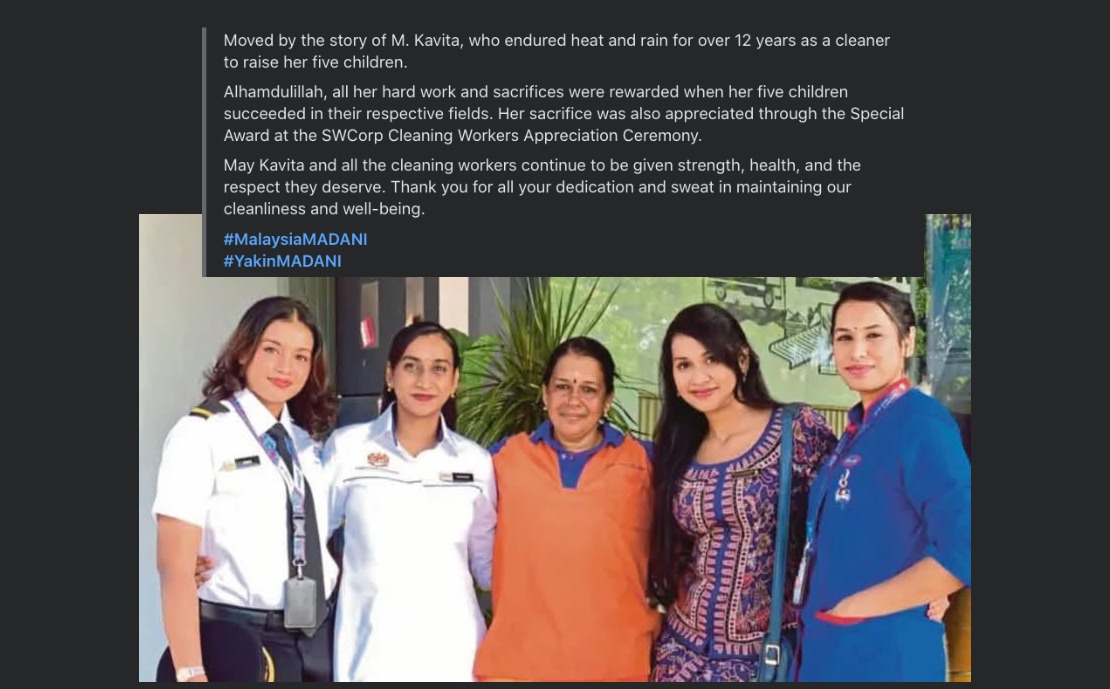
Prime Minister Datuk Seri Anwar Ibrahim has publicly honoured the contributions of M. Kavita, a dedicated sanitation worker whose more than 12 years of labour in challenging weather conditions to support her five children has become a compelling symbol of parental sacrifice and determination. Through a social media post, Anwar reflected on how Kavita's unwavering commitment to her family had ultimately borne fruit, with all five of her offspring now established in respected professions.
The recognition comes at a time when Malaysia's essential workers, often invisible in daily urban life, are increasingly being brought into the national conversation about dignity, respect, and social contribution. Kavita's story resonates across Malaysian society because it encapsulates values of perseverance and self-sacrifice that remain deeply rooted in the nation's cultural fabric. Her journey from humble circumstances to raising a accomplished generation speaks to possibilities that exist even within economic constraints and demanding labour conditions.
In his tribute, Anwar extended his gratitude beyond Kavita alone, addressing the broader community of sanitation and cleaning workers whose labour maintains public health and environmental standards throughout the country. He emphasised that these workers merit not merely economic compensation but genuine societal respect and recognition of their indispensable role. The Prime Minister's words acknowledged a systemic gap in how Malaysia values those in lower-income service sectors, suggesting a deliberate effort to elevate their status in public consciousness.
Kavita's extraordinary achievement was brought to international attention when her four daughters orchestrated a surprise birthday celebration at her workplace during her 50th birthday last month. The emotional climax of the gathering occurred when her daughters revealed themselves dressed in their professional uniforms, representing their diverse career paths: one working as a pilot, another as cabin crew, and a third as a staff nurse. This symbolic display of professional achievement was not merely sentimental but represented tangible upward mobility across multiple sectors of the Malaysian economy.
The emotional response from Kavita, captured in descriptions of her tears of joy, transcended the personal moment to illuminate broader themes about the relationship between parental sacrifice and generational advancement. Her reaction underscored how recognition from family, combined with public acknowledgment, can validate years of labour that often goes unheralded. The viral spread of her story across social media platforms demonstrates that Malaysians remain deeply moved by narratives of resilience and family-centred values.
Formal recognition of Kavita's contributions extended beyond the Prime Minister's words when she received a Special Award at SWCorp's Cleaning Workers' Day Appreciation ceremony. This institutional recognition, combined with political acknowledgment, signals a shift toward more comprehensive appreciation of essential service workers. SWCorp Malaysia, the national solid waste management corporation, used the occasion to spotlight an individual whose personal achievements exemplify the potential within its own workforce.
Kavita's employment with SWM Environment in Seremban placed her among thousands of Malaysian workers engaged in sanitation services across the nation's municipalities and urban centres. Her tenure of more than 12 years reflects long-term commitment despite the physical and often unglamorous nature of street sweeping work. The duration of her employment, combined with her successful child-rearing, suggests resilience tested across economic cycles and changing work conditions.
For Malaysian policymakers and social observers, Kavita's narrative offers practical insight into how essential workers manage dual responsibilities of income generation and family development. Her success in raising children who entered professional sectors including aviation and healthcare indicates that economic barriers, while significant, need not determine generational outcomes when combined with parental determination and children's educational engagement. This has implications for social mobility discussions and education policy across Southeast Asia.
The story also reflects changing demographics in Malaysian service sectors, where many workers come from backgrounds of limited educational opportunity but demonstrate agency in directing their children's educational trajectories. Kavita's achievement represents countless unnamed workers whose sacrifices remain unrecognised, yet who similarly invest in their children's futures through modest wages earned in demanding conditions. Her public recognition, therefore, carries symbolic weight extending far beyond her individual circumstances.
Anwar's tribute arrives amid broader conversations about worker dignity and respect across Malaysia and the wider Southeast Asian region. As nations develop economically, the tendency exists to overlook those who perform essential but lower-status labour. By explicitly recognising Kavita and her peers, Anwar positioned the government as acknowledging this demographic segment as integral to national functioning and deserving of dignity.
The intersection of personal achievement and public recognition in Kavita's story offers a template for how Malaysia might celebrate its unsung workers. Her children's professional successes represent not exceptional circumstances but achievable outcomes when family support, educational access, and individual aspiration converge. The visibility given to such narratives can inspire others in similar circumstances while signalling governmental commitment to valuing all contributors to Malaysian society.

