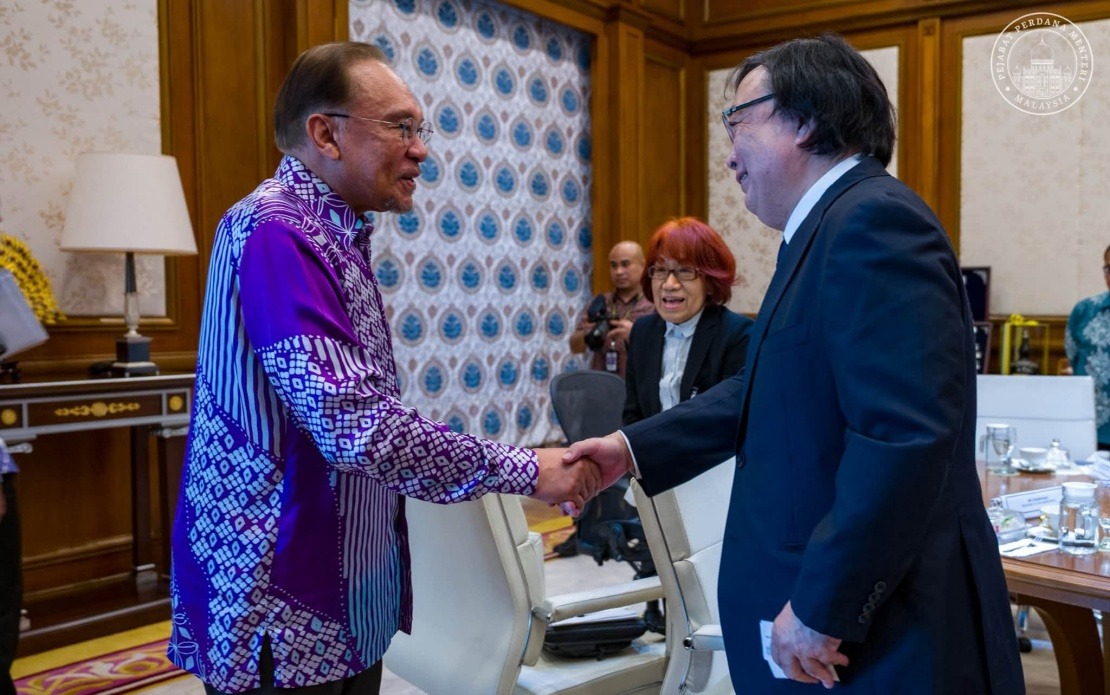
Prime Minister Datuk Seri Anwar Ibrahim received Genron NPO President Yasushi Kudo at an official meeting in Kuala Lumpur on July 23, focusing on expanding the Asia Leaders Roundtable as a mechanism for strategic dialogue across Asia. The encounter underscored Malaysia's commitment to multilateral engagement on pressing regional and global issues, while simultaneously reinforcing bilateral relations with Japan.
The Genron NPO, a Japanese independent think tank, plays a significant role in facilitating high-level dialogues and policy discussions among Asian leaders and intellectuals. The organization's leadership visiting Malaysia reflects growing interest in deepening cross-border exchanges on matters affecting the region's stability and economic development. Through such platforms, nations are able to articulate policy positions and explore collaborative responses to shared challenges in a non-governmental setting that often permits greater candour than formal diplomatic channels.
Anwar expressed appreciation for Japan's receptiveness during his official visit to the country in June, highlighting the warm reception and assistance provided by the Japanese government. This personal diplomatic engagement serves multiple purposes: it strengthens personal relationships between senior officials, signals mutual respect between capitals, and creates momentum for ongoing policy coordination. Malaysia's recent high-level visit to Tokyo demonstrates the priority both nations place on their bilateral relationship and suggests active consultation on matters of shared strategic interest.
The Prime Minister emphasized that Malaysia regards its Comprehensive Strategic Partnership with Japan as among its most consequential international relationships, spanning both security and economic dimensions. This partnership encompasses defence cooperation, trade and investment flows, technological collaboration, and people-to-people exchanges. For Malaysia, Japan represents not merely a traditional ally but a gateway to advanced manufacturing and technological transfer that supports the nation's economic modernization objectives. The relationship also provides strategic reassurance in an increasingly complex regional security environment.
Anwar conveyed his appreciation for an invitation to participate in the Tokyo Conference 2027, an event that signals his anticipated continued prominence in regional policy discussions. The Prime Minister's acceptance of such invitations reflects Malaysia's aspirations to position itself as a thoughtful voice in Asian strategic conversations. Additionally, Anwar acknowledged his earlier contribution to the 2026 conference through a video message, demonstrating consistent engagement with the Genron NPO's dialogue mechanisms even when scheduling constraints prevent physical attendance.
The Asia Leaders Roundtable represents an important institutional mechanism for addressing transnational challenges that transcend individual national borders. Issues such as maritime security, climate change, supply chain resilience, and digital governance require coordinated regional thinking. By strengthening this platform, Malaysia signals its willingness to contribute to solutions that benefit the broader Asian community. For Japan, engagement through the Genron NPO allows its diplomatic influence to extend beyond formal governmental channels into the realm of intellectual and policy leadership.
From Malaysia's perspective, deepening cooperation with Japanese think tanks and policy forums offers several strategic advantages. Access to Japanese research capabilities and policy expertise supports Malaysia's own analytical capacity on complex international issues. The country can also leverage such forums to articulate its perspective on regional development, economic partnerships, and security challenges. For a middle-power nation like Malaysia, participation in elite dialogue networks enhances its voice in discussions about Asia's future trajectory.
The meeting also reflects broader patterns of Malaysia's diplomatic strategy under Anwar's leadership. The government has emphasized constructive engagement with traditional partners while maintaining strategic flexibility and diverse relationships. Japan, as a stable democracy with advanced institutions and technological capabilities, aligns with Malaysia's preference for partnerships that support institutional strengthening and economic advancement. Regular dialogue at the think-tank level supplements formal governmental interactions and helps prevent misunderstandings while identifying areas for expanded cooperation.
Regional stability benefits when major and middle powers maintain robust communication channels across multiple levels. The Genron NPO visit exemplifies this principle, offering space for informal yet substantive discussions between senior figures who influence policy direction. Such engagements contribute to the diplomatic fabric that underpins peaceful resolution of disputes and coordinated responses to regional challenges. For Southeast Asia specifically, stable partnerships between ASEAN nations and major external powers remain crucial to maintaining the region's strategic autonomy and prosperous development.
Looking forward, the strengthened connection between Malaysia's leadership and the Genron NPO suggests that both sides envision expanded collaboration on Asian regional architecture questions. Climate change adaptation, post-pandemic economic recovery, technology governance, and responses to geopolitical tensions will likely feature prominently in future roundtable discussions. Malaysia's participation in such forums contributes to the intellectual foundations of regional policymaking while advancing the nation's diplomatic objectives through non-traditional channels.

