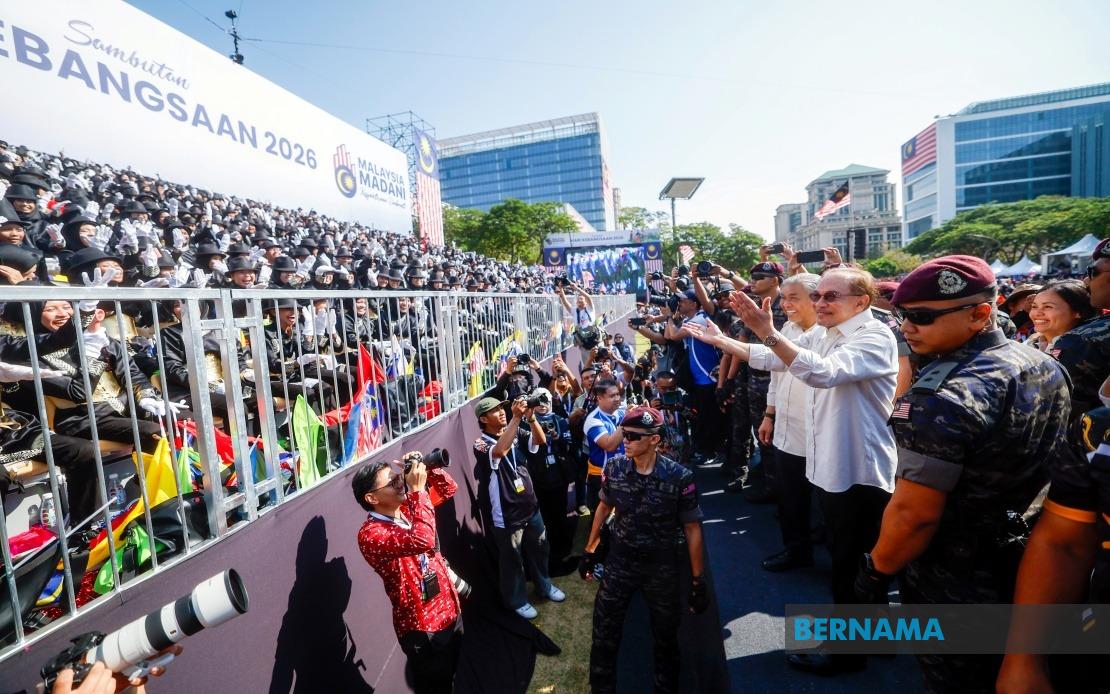
Prime Minister Datuk Seri Anwar Ibrahim expressed deep satisfaction with the turnout and enthusiasm demonstrated at Malaysia's 69th National Day parade in Putrajaya on August 31st, declaring the event a resounding success. After observing the elaborate procession and festivities, Anwar spent considerable time walking through the assembled crowds, covering more than half a kilometre as he engaged with citizens and accommodated requests for photographs. The display of national pride, he suggested, reflected a broader commitment among Malaysians to unity and shared values during a complex period for the nation.
The day's proceedings began at 8 am under the patronage of His Majesty Sultan Ibrahim and Her Majesty Raja Zarith Sofiah, the reigning King and Queen of Malaysia. Anwar received the royal couple alongside his wife, Datuk Seri Dr Wan Azizah Wan Ismail, and Communications Minister Datuk Seri Fahmi Fadzil, who chairs the National Day and Malaysia Day organizing committee. The ceremonial opening set the tone for what would become a spectacular display of Malaysia's diversity and governmental vision, with the event's official theme centred on "Malaysia MADANI: Kesejahteraan Dinikmati" — translating to well-being enjoyed by all citizens.
The parade itself represented a logistical achievement of considerable scale. Over 10,800 participants marched in 76 separate contingents supported by 22 musical ensembles, while the spectacle incorporated 328 military and civilian assets spanning land, sea, and air operations. The procession also featured decorated vehicles, 112 animals in service roles, and notably 22 electric vehicles, underscoring the government's commitment to environmental sustainability alongside traditional patriotic displays. A specially choreographed human graphics performance unfolded across the terrace areas, creating dynamic visual narratives that complemented the ground-level procession.
The extraordinary attendance figures underscore the appeal of Malaysia's national celebrations to ordinary citizens across the country. More than 100,000 people converged on Dataran Putrajaya for the event, with many demonstrating their commitment by arriving the previous evening and camping overnight to secure advantageous viewing positions. This level of participation reflects sustained public interest in national commemorations, even as Malaysia grapples with political divisions and economic pressures affecting household budgets across the region.
Anwar's public interaction with attendees took on particular significance given the government's recent policy announcements regarding fuel subsidies. During interactions with the assembled crowds, citizens directly acknowledged the Prime Minister's decision to restore the monthly basic fuel allocation under the BUDI MADANI RON95 programme from 200 litres back to the previous level of 300 litres. One member of the public explicitly thanked Anwar for this restoration, which the Prime Minister had formally announced during his National Day Address the preceding day. This spontaneous expression of gratitude highlights how fuel subsidy decisions directly affect public perception and sentiment toward the administration.
The restoration of fuel quotas carries particular weight for Malaysia's automotive culture and household economics. The programme, which serves more than 16 million citizens who rely on subsidized RON95 petrol, represents a tangible benefit that shapes monthly household spending patterns. The decision to increase allocations rather than impose reductions demonstrates governmental responsiveness to public pressure during a period when inflation concerns occupy prominent positions in citizens' minds across Southeast Asia. For Malaysian drivers, an additional 100 litres monthly can translate to meaningful savings depending on usage patterns and local fuel pricing.
Extending subsidy benefits beyond petrol consumers, the government simultaneously broadened support mechanisms targeting a different demographic. Anwar announced that owners of diesel-powered pickup trucks and jeeps — a substantial category encompassing commercial operators, agricultural workers, and small business proprietors — would receive monthly diesel allocations reaching 400 litres beginning September 1st. This programme expansion addresses segments of the population whose occupational needs differ fundamentally from urban commuters, reflecting administrative attention to Malaysia's diverse economic constituencies spanning rural and urban environments.
The National Day Address through which Anwar unveiled these initiatives outlined six distinct governmental priorities intended to advance citizen well-being across multiple dimensions. The fuel subsidy announcements comprised only two components within this broader policy framework, suggesting a comprehensive approach to governance extending beyond energy pricing into other domains affecting daily life. For Malaysian policymakers, balancing fiscal constraints against social spending commitments remains perpetually challenging, making National Day policy announcements strategically significant for demonstrating governmental capacity to deliver tangible benefits.
The Malaysia MADANI framework, upon which the celebration's thematic content centred, emphasizes governmental prioritization of citizen prosperity alongside respect for Malaysia's multicultural character. The parade's visual presentation and participating contingents attempted to embody these principles through inclusive representation of Malaysia's diverse communities and regional constituencies. For a nation with Malaysia's communal composition and historical complexities, National Day celebrations carry symbolic importance extending beyond simple patriotic expression to encompass narratives about national identity, governmental legitimacy, and social cohesion.
Anwar's extended engagement with crowds following the formal proceedings provided opportunities for informal political communication that formal addresses cannot easily replicate. Walking through masses of assembled citizens, accommodating photograph requests, and receiving direct expressions of public sentiment offers the Prime Minister unmediated feedback about citizen priorities and satisfaction levels. This accessibility, whether calculated political strategy or genuine engagement, shapes public perception of governmental approachability and responsiveness to ordinary citizen concerns in ways that parliamentary speeches and formal announcements struggle to achieve.
The scale and enthusiasm of participation in the 69th National Day celebration suggests that despite economic pressures, political polarization, and regional uncertainties affecting Southeast Asia, Malaysian citizens maintain capacity for collective national expression. The voluntary assembly of more than 100,000 people for ceremonial purposes, many traveling considerable distances and enduring overnight camping, indicates that patriotic sentiment and national pride retain mobilizing power across demographic categories. Whether this enthusiasm translates into sustained support for governmental initiatives remains an open question, though the immediate positive response to fuel subsidy announcements suggests that citizens recognize and appreciate tangible policy benefits affecting household economics.

