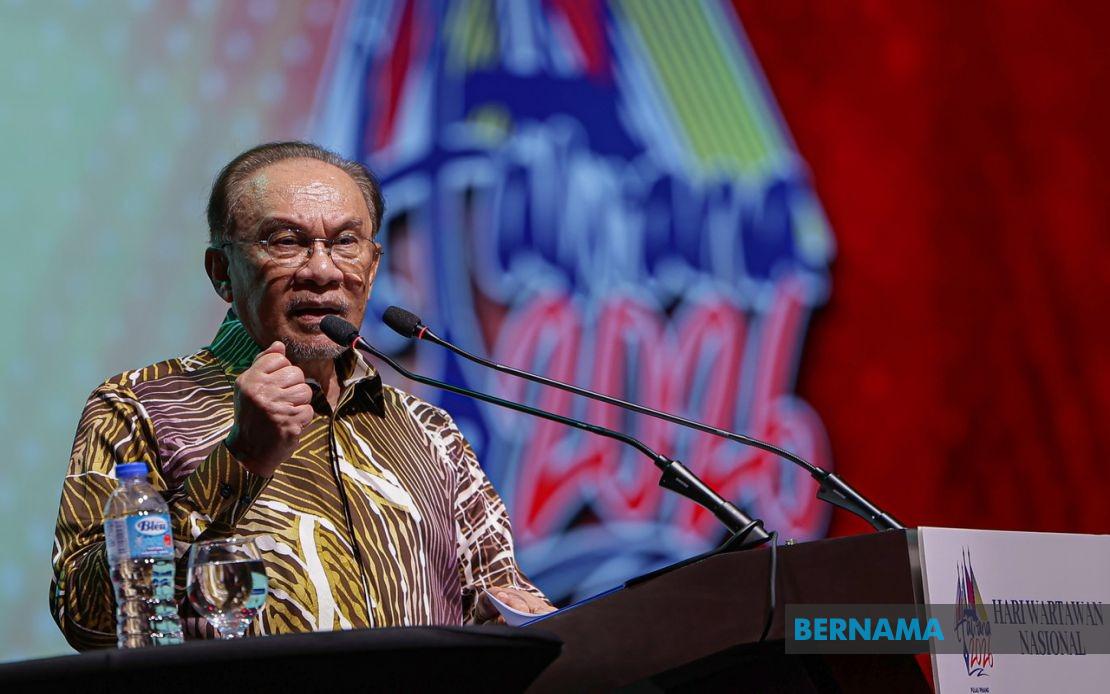
Prime Minister Datuk Seri Anwar Ibrahim has thrown his weight behind the appointment of former Federal Court judge Tan Sri Nallini Pathmanathan as the inaugural chairman of the Malaysian Media Council, anticipating that her judicial pedigree and personal integrity will substantially elevate the council's standing among the public. Speaking at the National Journalists' Day 2026 celebration in Butterworth, the Prime Minister underscored that Nallini's selection was the outcome of rigorous deliberation, with particular regard paid to her proven track record, unblemished reputation and extensive experience within Malaysia's highest courts. He further stated that her appointment represents a strategic effort to rebuild institutional confidence in the media regulatory framework, a critical priority for democratic governance at a time when public scepticism towards media institutions has grown across the region.
The Malaysian Media Council, formally established under the Malaysian Media Council Act 2025, operates as an independent self-regulatory mechanism tasked with upholding journalistic standards across the nation's news organisations. Its mandate extends beyond mere oversight, encompassing the investigation and resolution of public grievances concerning media conduct, the promotion of ethical journalism through industry guidelines, and the preservation of editorial autonomy as a foundational element of democratic society. This institutional design reflects international best practice in media self-regulation, wherein industry peers and respected external figures jointly ensure that journalism adheres to professional norms without direct government intervention—a distinction that has become increasingly important as governments worldwide face accusations of attempting to control media narratives.
Nallini's background as a Federal Court judge carries substantial symbolic weight within Malaysia's governance architecture. Judges at this level typically possess decades of legal expertise, demonstrated impartiality, and a reputation for upholding constitutional principles. Her appointment signals that the council intends to operate according to rigorous legal and ethical standards rather than succumbing to political pressure or commercial interests. For Malaysian journalists and media organisations, Nallini's leadership could provide assurance that complaints mechanisms and regulatory decisions will be grounded in established law and procedural fairness rather than subjective judgment or external influence.
The MMC's board unanimously ratified Nallini's appointment during a formal session held on May 26, suggesting broad consensus within the media industry itself regarding her suitability for the role. This unanimous endorsement is noteworthy in a sector often characterised by competing interests and ideological divisions. It implies that major stakeholders—from print and broadcast outlets to digital publishers—view her candidacy as non-partisan and professionally credible, qualities that are essential for any self-regulatory body to function effectively and command respect from regulated entities.
Anwar's public endorsement at a high-profile media industry event carries political significance beyond mere ceremonial approval. By attending the National Journalists' Day event and explicitly commending Nallini, the Prime Minister positioned his administration as supportive of independent media governance at a time when regional governments face persistent criticism over media freedom rankings. His remarks reflect an apparent strategic calculation that strengthening media self-regulation serves the government's broader interests in maintaining democratic legitimacy and regional standing, particularly given Malaysia's aspiration to be seen as a stable democracy with functioning institutional checks and balances.
The presence of other senior officials at the Butterworth ceremony—including Penang Chief Minister Chow Kon Yeow and Communications Minister Datuk Fahmi Fadzil—underscored the event's importance as a whole-of-government endorsement of the council's establishment. The Communications Ministry's institutional involvement indicates that government agencies will coordinate with the council on matters touching media policy and public communications, though maintaining operational independence remains crucial to the council's credibility. Such coordination is standard practice in democracies where government and media self-regulators coexist, provided that government relations remain advisory rather than determinative.
For Malaysian newsrooms and journalists, Nallini's appointment carries practical implications for how complaints and ethical disputes will be adjudicated. A regulatory chair with judicial experience is likely to apply formal procedural standards, demand substantiated evidence before making findings, and ensure that media organisations receive fair hearings before sanctions are imposed. These procedural safeguards matter considerably because media self-regulation functions only if journalists and publishers believe that the process is impartial, transparent, and grounded in published codes rather than arbitrary preferences. Nallini's judicial background suggests she will prioritise these procedural virtues.
The establishment of the MMC under dedicated legislation in 2025 represents an evolution in Malaysia's approach to media regulation. Rather than relying on scattered statutory frameworks or ad-hoc government intervention, the new council consolidates media standards oversight within a single, industry-led entity. This development aligns with global trends wherein democracies increasingly recognise that media self-regulation, properly structured and adequately resourced, can be more effective and acceptable to journalists than top-down state regulation. The council's explicit mandate to protect media freedom as a democratic pillar acknowledges this principle directly.
Regionally, Malaysia's move to establish an independent media council under judicial leadership may influence neighbouring countries' thinking about media governance. Singapore, Indonesia, and Thailand all grapple with comparable challenges of balancing media freedom, ethical standards and public confidence in news organisations. Should the Malaysian council gain a reputation for fairness and effectiveness under Nallini's stewardship, it could become a model for other Southeast Asian democracies seeking to modernise their media regulatory frameworks while demonstrating respect for editorial autonomy.
Looking forward, the council's success will depend substantially on whether it can adjudicate complaints in a manner that journalists, publishers and the public all perceive as fair and principled. Nallini's appointment provides an encouraging initial signal, yet the institution's credibility will ultimately rest on the quality of decisions issued, the transparency of its processes, and whether it proves willing to investigate complaints against powerful entities without fear or favour. Her judicial experience suggests she understands this challenge acutely.
%22%2F%3E%3C%2Fpattern%3E%3C%2Fdefs%3E%3Crect%20width%3D%22100%25%22%20height%3D%22100%25%22%20fill%3D%22url(%23ph8ac1g)%22%2F%3E%3Crect%20width%3D%22100%25%22%20height%3D%22100%25%22%20fill%3D%22url(%23ph8ac1p)%22%2F%3E%3Ctext%20x%3D%2250%25%22%20y%3D%2250%25%22%20text-anchor%3D%22middle%22%20dominant-baseline%3D%22central%22%20fill%3D%22rgba(255%2C255%2C255%2C0.95)%22%20font-family%3D%22Georgia%2C%20'Times%20New%20Roman'%2C%20serif%22%20font-weight%3D%22700%22%20font-size%3D%22320%22%20letter-spacing%3D%22-0.02em%22%3ETV3%3C%2Ftext%3E%3C%2Fsvg%3E)
%22%2F%3E%3C%2Fpattern%3E%3C%2Fdefs%3E%3Crect%20width%3D%22100%25%22%20height%3D%22100%25%22%20fill%3D%22url(%23ph4p6tog)%22%2F%3E%3Crect%20width%3D%22100%25%22%20height%3D%22100%25%22%20fill%3D%22url(%23ph4p6top)%22%2F%3E%3Ctext%20x%3D%2250%25%22%20y%3D%2250%25%22%20text-anchor%3D%22middle%22%20dominant-baseline%3D%22central%22%20fill%3D%22rgba(255%2C255%2C255%2C0.95)%22%20font-family%3D%22Georgia%2C%20'Times%20New%20Roman'%2C%20serif%22%20font-weight%3D%22700%22%20font-size%3D%22170%22%20letter-spacing%3D%22-0.02em%22%3EMalaysia%3C%2Ftext%3E%3C%2Fsvg%3E)