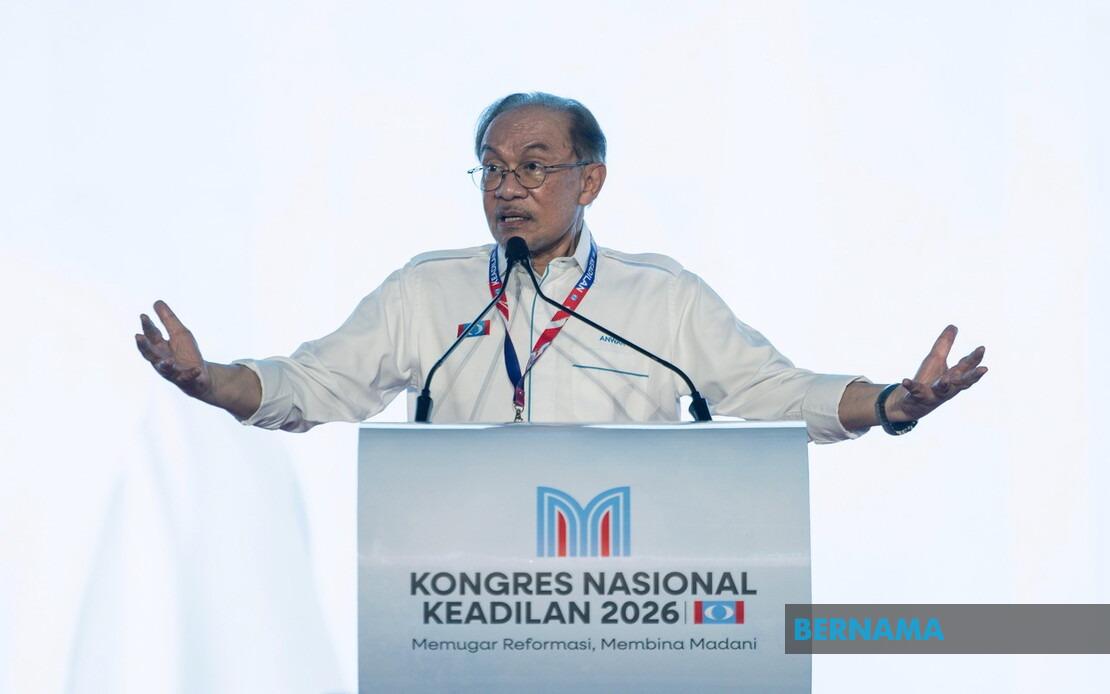
Prime Minister Datuk Seri Anwar Ibrahim has unveiled a fresh injection of RM1 million for every parliamentary constituency across the nation, with funds to be routed directly towards addressing pressing community concerns and delivering rapid assistance to residents. The announcement, made during his closing address at the 2026 PKR National Congress at the Melaka International Trade Centre, signals the government's determination to bypass administrative bottlenecks that traditionally slow welfare implementation at the grassroots level.
The supplementary funding represents a deliberate shift in how the MADANI Government approaches social delivery, emphasizing speed and accessibility in meeting local demands. Anwar, speaking in his dual capacity as Prime Minister and Finance Minister, characterized the initiative as fundamental to the administration's philosophy of translating national economic performance into tangible improvements in household finances and living standards. The commitment underscores recognition that macroeconomic gains remain distant abstractions unless they meaningfully reach ordinary Malaysians struggling with rising expenses and economic pressures.
This allocation operates in concert with existing social protection programmes already in operation. The government channels RM16 billion collectively through the Sumbangan Tunai Rahmah and Sumbangan Asas Rahmah schemes, both designed to cushion low and middle-income households. Anwar emphasized that the new allocation complements rather than replaces these initiatives, thereby expanding the overall support architecture available to vulnerable populations. The layered approach suggests governmental recognition that no single programme adequately addresses the multifaceted challenges facing Malaysian households.
Poverty reduction serves as a cornerstone justification for the spending announcement. Anwar highlighted that the hardcore poverty rate has declined to 0.09 per cent, presenting this as evidence of the government's effectiveness in tackling the nation's most severe deprivation. However, such headline figures mask persistent pockets of hardship and localized economic distress that centralised data sometimes obscures. By devolving an additional RM1 million to each of the 222 parliamentary constituencies, the government effectively creates RM222 million in decentralized capacity to address these granular problems without waiting for federal bureaucratic approval processes.
The mechanism of direct channelling fundamentally alters decision-making power over welfare expenditure. Rather than requiring communities to navigate multi-layered approval hierarchies in Kuala Lumpur, local stakeholders—presumably working through constituency representatives—gain authority to identify and fund pressing needs immediately. This devolution potentially accelerates response times for emergency situations, community infrastructure gaps, or sudden welfare crises that demand rapid intervention. The approach implicitly acknowledges that those closest to communities possess superior information about what genuinely matters at the granular level.
Anwar's remarks regarding poverty reduction efforts extended beyond the new allocation. He stressed that assistance extends comprehensively across income strata, encompassing B40 and M40 households alike through school aid, subsidized goods programmes, and housing finance schemes. This rhetorical emphasis on inclusivity across economic classes responds to perceptions that certain government assistance concentrates too narrowly on the poorest households, potentially leaving lower-middle-income groups feeling marginalized. By articulating universal provision across these segments, Anwar positions the government as attending to the entire non-elite population's welfare needs.
The Prime Minister explicitly urged PKR leadership and ground-level party machinery to mobilize themselves as information conduits explaining government initiatives to constituents. This directive reveals a significant challenge underlying the new allocation: many eligible beneficiaries remain ignorant of available support. Without active party communication efforts, programmes risk failing to reach their intended recipients despite adequate funding. The instruction effectively deputizes the party apparatus as delivery infrastructure, transforming grassroots political networks into channels for welfare information dissemination and programme uptake.
For Malaysian readers and Southeast Asian observers, this announcement carries implications extending beyond immediate budgetary reallocations. It reflects an emergent governance philosophy emphasizing decentralization and rapid-response welfare mechanisms over traditional centralized bureaucratic processing. As other nations in the region grapple with similar cost-of-living pressures and inequality concerns, Malaysia's experiment with devolving constituency-level resources offers potential lessons regarding effectiveness of local-level decision-making in welfare administration. The success or failure of this model may influence regional approaches to poverty reduction and community development.
The timing of this announcement during a ruling party congress reflects internal political calculations alongside policy substance. By announcing major new allocations before a PKR audience, Anwar simultaneously reinforces party legitimacy and demonstrates governmental largesse to supporters. This intertwining of policy announcement and political theatre illustrates how Malaysian governance increasingly blends substantive resource allocation with strategic messaging to key constituencies. The RM1 million per constituency becomes both genuine policy and rhetorical resource for party campaigning.
Implementation challenges loom despite promising intentions. Determining appropriate allocation of RM1 million across diverse local needs—whether prioritizing infrastructure, direct cash assistance, skills training, or other interventions—requires sophisticated local assessment. Elected representatives managing these funds face pressure to satisfy multiple constituent groups with competing claims. Additionally, the sustainability of annual RM222 million commitments depends on continued government revenue generation and macroeconomic stability. Economic downturns could render such allocations fiscally difficult to maintain, potentially creating disappointment if communities grow accustomed to such funding levels.
For parliamentary constituencies across Peninsular Malaysia, Sabah, and Sarawak, this allocation represents tangible federal investment in local problem-solving capacity. Constituencies encompassing high-poverty areas, elderly populations, or families dependent on declining industries might leverage funds towards welfare top-ups or livelihood programmes. Wealthier constituencies might prioritize infrastructure or community facility improvements. This flexibility allows resource allocation matching each area's distinctive circumstances, theoretically improving overall effectiveness compared to uniform national programmes.
The announcement ultimately reflects governmental conviction that economic success requires deliberate mechanisms channelling benefits to ordinary households. With inflation pressuring family budgets and cost-of-living anxieties pervasive throughout Malaysian society, the government signals continued commitment to welfare support despite global economic uncertainty. Whether RM1 million annually per constituency meaningfully alleviates household pressures or merely supplements already-existing programmes determines the initiative's genuine impact on Malaysian livelihoods.

