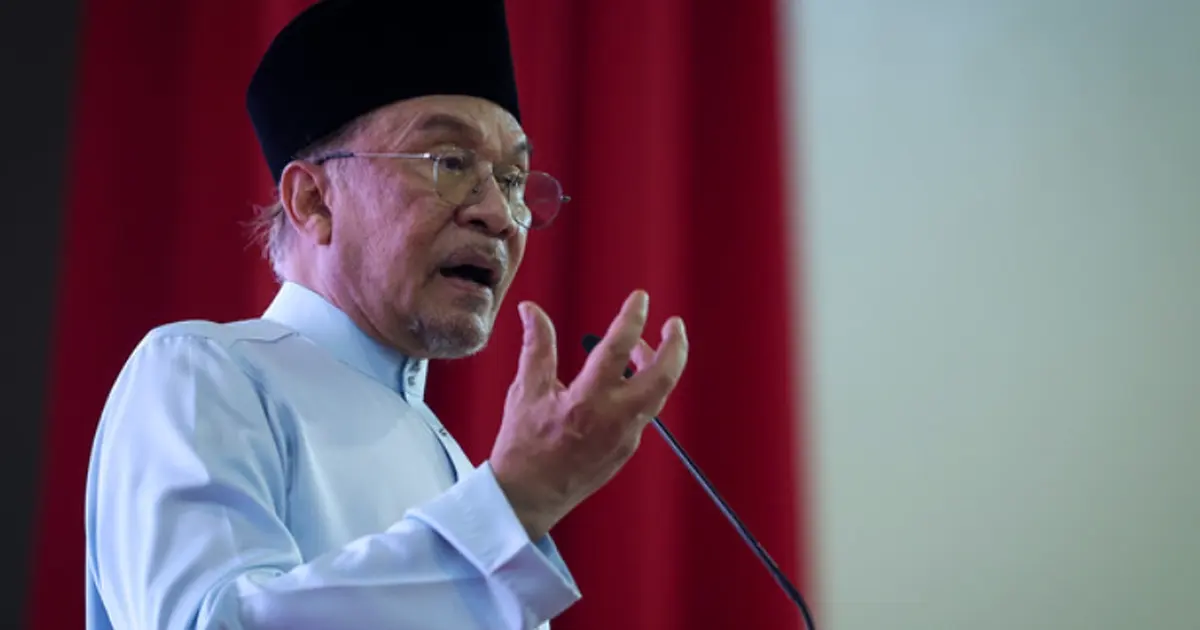
A senior PKR Youth figure has levelled sharp criticism at Umno, suggesting that Prime Minister Anwar Ibrahim's decision to prop up the party following the contentious 2023 general election outcome has been rewarded with disloyalty. Huraimi Husri, representing the Federal Territories chapter of PKR Youth, contends that Anwar's strategic political choice in the months after GE15 represented a generous gesture toward a faction struggling to preserve its relevance and parliamentary presence.
Anwar's emergence as prime minister in October 2023 marked a historic turning point in Malaysian politics. Rather than isolating Umno in opposition, a course that his party PKR might have pursued, Anwar opted to construct a coalition government that encompassed his traditional rival. This decision proved consequential for Umno's fortunes, rescuing the party from the electoral embarrassment of GE15, in which it failed to secure a sufficient majority within Parliament to govern independently. The Barisan Nasional coalition, historically Umno's base, had performed poorly, creating genuine uncertainty about the party's political trajectory and relevance in the new parliamentary arithmetic.
Huraimi's assertion frames this political arrangement not as a transactional bargain but as a fundamental act of political magnanimity. By deliberately incorporating Umno into a governing coalition rather than capitalising on the party's weakness, Anwar demonstrated a willingness to put national stability ahead of partisan advantage. This interpretation challenges the conventional understanding that such coalitions are purely mechanical arrangements born of mathematical necessity. Instead, it suggests that Anwar made a deliberate choice to rescue a rival party from political oblivion, even when he possessed the option to govern without it.
The broader context reveals the precarity of Malaysian politics in the aftermath of GE15. No single coalition secured an unambiguous mandate, leaving the construction of government heavily dependent on coalition-building and negotiation. Within this landscape, Anwar's decision to embrace Umno—historically his most bitter political opponent during decades of factional struggle within the Malay-Muslim political establishment—carried significant symbolic weight. It signalled a departure from the combative zero-sum politics that had previously characterised Malaysian governance and suggested a commitment to consensual administration.
Yet Huraimi's complaint points to a fundamental breakdown in this ostensible arrangement. The accusation of betrayal implies that Umno has since prioritised factional interests over the governing coalition's stability or, alternatively, has actively undermined Anwar's administration. Such dynamics are not uncommon in Malaysian coalition politics, where partners frequently oscillate between cooperation and obstruction depending on immediate political calculations. Umno's parliamentary representation and grassroots machinery remain formidable assets, making the party both valuable within a coalition and potentially destabilising if it chooses opposition.
The frustration evident in Huraimi's comments reflects deeper tensions within Malaysia's ruling coalition. While PKR and Umno nominally govern together, underlying rivalries persist, particularly regarding ministerial portfolios, allocation of government resources, and control over state-level governments. These tensions are exacerbated by competing visions for Malay-Muslim political representation and periodic disagreements over policy direction. What Huraimi frames as ingratitude may thus represent something more structural—the inevitable friction between coalition partners with fundamentally divergent interests and constituencies.
For Malaysian readers and regional observers, this dispute illustrates the fragility of consensus-based governance in deeply divided political systems. Anwar's gambit to construct an inclusive coalition depends critically on all partners accepting the legitimacy and necessity of power-sharing. If major partners like Umno begin behaving as if inclusion represents a concession rather than a mutual arrangement, the coalition's coherence deteriorates rapidly. The accusation of betrayal thus serves as a warning that even strategically constructed agreements can unravel when partners question the underlying distribution of benefits.
The timing of Huraimi's criticism is significant, arriving at a moment when Umno appears increasingly assertive within the coalition and when internal PKR pressures mount. By publicly articulating resentment toward Umno, Huraimi stakes out a position that resonates with PKR members who question whether the party's sacrifice of its opportunity to govern independently was justified. This rhetorical manoeuvre also serves to remind Umno leaders of the political debt they ostensibly incurred in 2023, potentially seeking to constrain the party's room for manoeuvre within coalition negotiations.
Historically, Anwar and Umno have occupied opposite poles of Malaysian politics. Anwar's rise through PKR represented a challenge to Umno's hegemonic control over Malay-Muslim affairs and government resources. The 2023 coalition arrangement therefore represented an extraordinary reconciliation, however pragmatic its origins. Huraimi's framing—that Anwar sacrificed this opportunity for the greater good—attempts to reconstruct this narrative as one of principled magnanimity rather than mere political necessity, thereby establishing a moral claim upon Umno's subsequent behaviour.
The tension between coalition partners reflects Indonesia and Thailand's historical experiences, where coalition governments frequently collapse amid partner defections. Malaysia's relatively stable systems of government, despite their constraints, have partly depended on understanding coalition politics as binding arrangements rather than temporary conveniences. Huraimi's complaints suggest this understanding may be weakening. For Southeast Asian analysts tracking institutional stability across the region, the trajectory of Malaysia's coalition governance carries implications beyond the peninsula itself, offering lessons about the viability of consensual executive arrangements in systems with deep structural divisions.
Looking forward, the durability of Malaysia's current governing arrangement depends substantially on whether all partners come to view inclusion as preferable to the uncertainties of opposition or alternative coalitions. Huraimi's public assertion that gratitude is absent indicates this consensus has fractured. Whether such fractures can be repaired through negotiation or whether they portend larger realignments remains an open question, but it is a question that matters increasingly for Malaysian political stability and for the broader Southeast Asian region watching how diverse societies manage their governance challenges.

