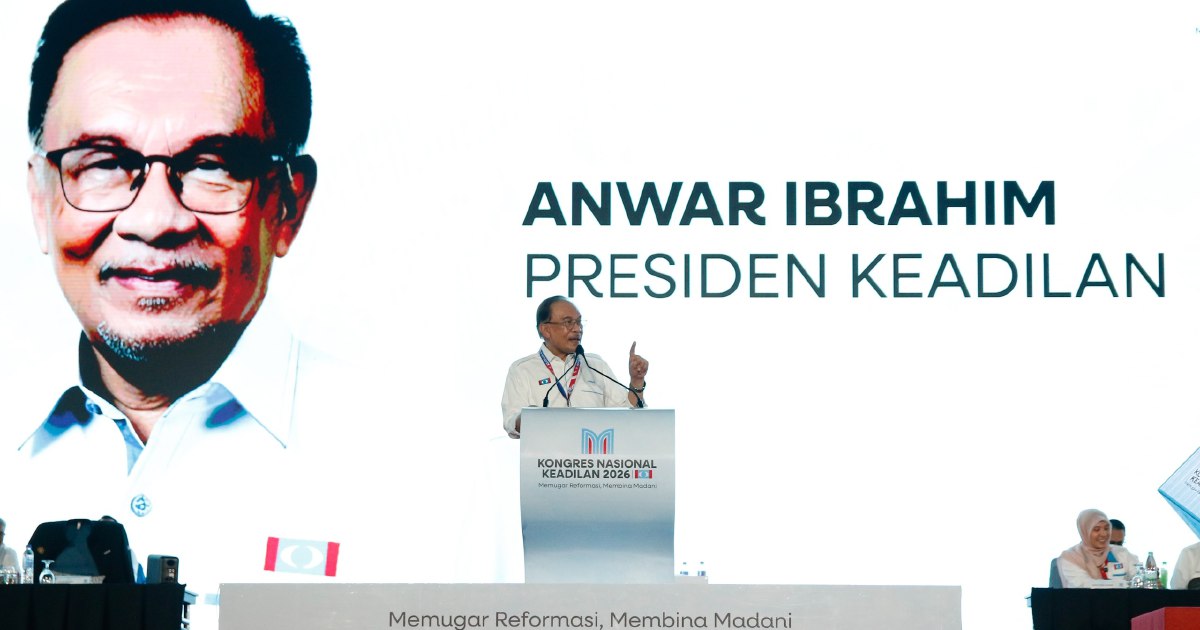
PKR president Datuk Seri Anwar Ibrahim has reaffirmed the party's commitment to maintaining a delicate political balancing act, working simultaneously with Barisan Nasional and Umno at the federal level whilst preserving its allegiance to Pakatan Harapan coalition partners DAP and Amanah. Speaking in Ayer Keroh, Anwar sought to clarify PKR's positioning amid ongoing scrutiny over the party's dual allegiances and the complexities of Malaysia's current political landscape.
The statement underscores the intricate nature of contemporary Malaysian politics, where coalition mathematics have become increasingly fluid and pragmatic. Since the 2022 general election produced a hung parliament, no single bloc has commanded an outright majority in parliament, forcing multiple parties to adopt flexible strategies to govern effectively. PKR's position as a bridge between the traditional Barisan Nasional establishment and the reform-oriented Pakatan Harapan reflects this new reality, though it has attracted criticism from various quarters regarding consistency and ideological coherence.
For Malaysian observers and political analysts, PKR's dual-coalition approach represents a fundamental shift from Malaysia's historical two-bloc competition. Rather than choosing definitively between the BN-led establishment and the opposition-rooted PH, PKR has positioned itself as an essential swing faction capable of delivering parliamentary support to whichever configuration the mathematics require. This arrangement has enabled PKR to participate in government whilst maintaining relationships with both traditional powerholders and reform advocates, a strategy that maximises the party's leverage but also creates perceptions of political opportunism.
Anwar's clarification becomes particularly significant given ongoing tensions between coalition partners. DAP and Amanah, both elements of the PH framework, have occasionally expressed concern about PKR's closeness to Umno and the BN apparatus. Meanwhile, Umno leaders have tested the boundaries of PKR's commitment through various policy initiatives and political manoeuvres. Anwar's public restatement appears designed to assuage concerns from PH allies that PKR's federal cooperation with BN does not signal an abandonment of the broader coalition commitment.
The timing of Anwar's comments reflects ongoing negotiations over resource allocation, ministerial positions, and policy direction within the governing coalition. As Malaysia faces economic challenges and policy differences between ideologically disparate coalition members, maintaining the delicate equilibrium becomes increasingly difficult. PKR's explicit affirmation of dual loyalty serves notice that the party intends to persist with this arrangement despite the inherent tensions and contradictions it creates.
From a practical governance perspective, PKR's strategy allows the government to command parliamentary support from diverse sources. The party functions as a swing faction whose votes prove essential for passing legislation and sustaining the prime minister's tenure. This arrangement has underpinned the government's stability, albeit at the cost of occasional policy compromises and the sort of murky political negotiations that characterise coalition politics throughout Southeast Asia. The arrangement essentially guarantees PKR continued ministerial representation and policy influence regardless of which partner might otherwise dominate.
However, this positioning exposes PKR to criticism from both directions. Reform advocates within PH question whether working closely with Umno—a party historically associated with patronage politics and resistance to institutional change—genuinely serves reform objectives. Conversely, BN traditionalists view PKR's maintenance of PH ties with suspicion, questioning whether PKR can be trusted as a reliable partner in protecting conventional political interests. Anwar's statement must be understood partly as an attempt to manage expectations from both camps.
Regionally, Malaysia's coalition arrangements attract attention from neighbouring countries managing their own complex multi-party democracies. The viability of such fluid, cross-cutting coalitions remains an open question, as institutional arrangements are repeatedly tested by conflicting interests and changing political circumstances. PKR's balancing act demonstrates both the flexibility of democratic politics and the challenges of maintaining coalition stability in environments lacking clear majority blocs.
Looking forward, PKR's ability to sustain this dual commitment will depend on managing the expectations of increasingly assertive coalition partners. Both BN and PH elements seek greater influence over government policy and resource distribution. The party's claim to remain loyal to both groups will face practical tests when coalition interests diverge sharply on significant policy matters. Political observers suggest that maintaining this equilibrium beyond the next election cycle may prove increasingly difficult.
Anwar's reaffirmation essentially constitutes a public commitment to a strategy that has served PKR's electoral interests and parliamentary position, even if it complicates the broader political landscape. The statement signals continuity in the party's approach, at least in the near term, whilst acknowledging the real tensions inherent in Malaysia's fractionalised parliamentary composition. As Malaysian politics continues to evolve beyond traditional two-coalition frameworks, PKR's experience may offer either a template for stable multi-party governance or a cautionary tale about the limits of coalition pragmatism.

