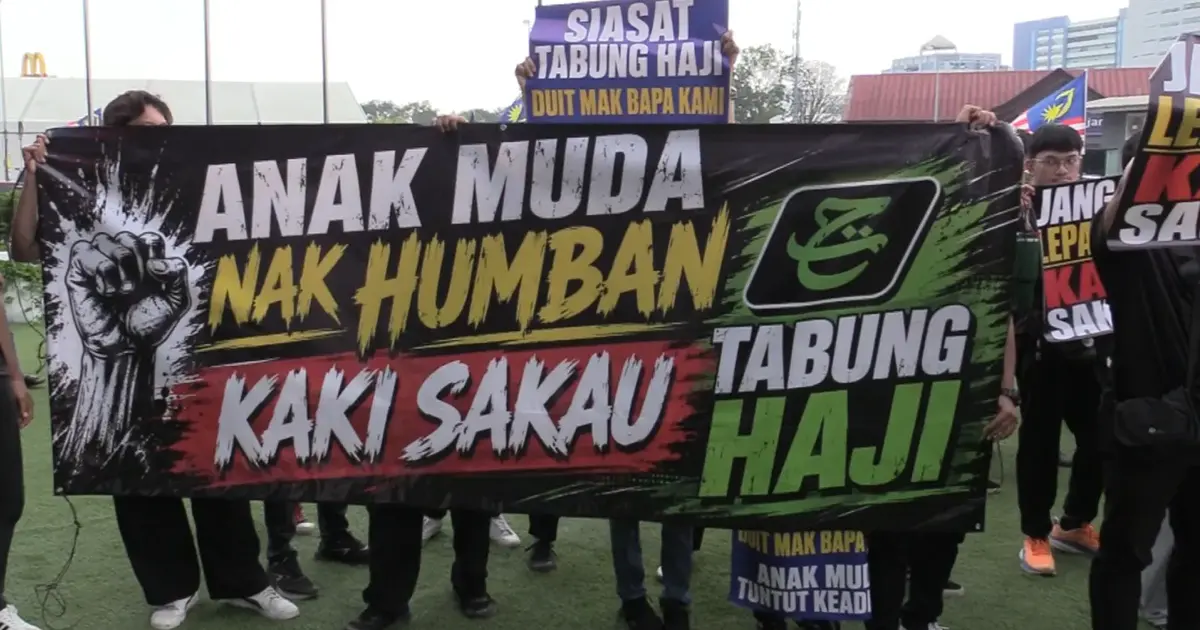
Roughly 250 members of the People's Justice Party (PKR) assembled outside their party's congress venue in Melaka, where they voiced mounting frustration over what they describe as the sluggish pace of investigations into Tabung Haji, the Malaysian pilgrimage fund that serves as a critical financial institution for Muslim Hajj aspirants across the country. The demonstration underscores simmering discontent within the party's grassroots regarding the handling of allegations that have centred on governance lapses and financial irregularities at the institution.
The rally reflects broader anxieties within PKR's membership base about institutional accountability affecting one of Islam's most sacred financial instruments in Malaysia. Tabung Haji, established to facilitate savings and logistical arrangements for Malaysian Muslims undertaking the pilgrimage to Mecca, holds emotional and religious resonance that extends far beyond its technical function as a savings mechanism. When governance or transparency concerns emerge at such an institution, they trigger concern not merely among depositors but across Muslim communities who view the fund as an embodiment of trust and religious stewardship.
Participants at the Melaka gathering articulated their conviction that the investigation into Tabung Haji must proceed with greater urgency and thoroughness. They contended that the matter strikes at the heart of Malay-Muslim interests and sensibilities, arguing that delays in establishing facts or holding accountable parties responsible for any misconduct fundamentally undermine public confidence in institutions designed to serve religious communities. This framing transforms the issue from a technical governance question into one laden with cultural and religious significance.
The timing of the rally, occurring during a party congress where senior leadership gathers to discuss broader policy directions, suggests deliberate positioning by grassroots members to ensure their concerns reach decision-makers within PKR's hierarchy. Party congresses serve as crucial junctures where rank-and-file members can articulate priorities and pressure leadership to adopt particular stances on contentious issues. By demonstrating outside rather than within the congress hall, the members created visual and symbolic pressure while maintaining separation from the formal proceedings.
Tabung Haji's governance structure and financial management have attracted scrutiny in recent years, with various stakeholders questioning transparency in operations and investment decisions. For a party like PKR that positions itself as reform-oriented and committed to institutional accountability, the question of how vigorously and visibly it pursues investigations into Tabung Haji carries implications for its credibility. Opposition members and critics within the party alike watch closely to see whether PKR's anti-corruption rhetoric translates into concrete action on high-profile cases affecting Muslim institutional interests.
The Melaka division's mobilisation also reflects factional dynamics within PKR, where different groups compete to demonstrate commitment to particular causes or communities. By spearheading this rally, the division positioned itself as vigilant guardians of Muslim interests and institutional integrity, a stance that builds internal party credentials and demonstrates responsiveness to grassroots concerns. Such actions can accumulate political capital within party structures, particularly where leadership roles are contested or where divisions vie for resource allocation.
From a regional perspective, Malaysia's experience with Tabung Haji offers lessons for other Southeast Asian nations with substantial Muslim populations and comparable pilgrimage savings schemes. Governance failures at religiously significant institutions generate community backlash that reverberates across political boundaries, touching questions of trust in state-backed mechanisms designed to serve faith communities. The speed and transparency of investigations into such bodies thus carries implications extending beyond individual national borders.
For Malaysian Muslim depositors who contribute portions of their income to Tabung Haji with expectations of security and ethical stewardship, the investigation's pace and findings carry direct financial consequences. Any revelations of mismanagement or fraud threaten not only individual savings but also the scheme's legitimacy as a trusted vehicle for pilgrimage preparation. This explains why grassroots members felt compelled to externally demonstrate, believing that official channels alone might not adequately prioritise their concerns.
The PKR rally also intersects with broader Malaysian political competition over who can most credibly champion Muslim institutional interests. Political parties across the spectrum recognise that positions taken on issues affecting Islamic institutions and Muslim communities carry electoral weight, particularly in constituencies with majority Malay-Muslim populations. PKR's response to these grassroots demands will signal to both supporters and critics where the party prioritises its reform agenda relative to community-specific concerns.
Moving forward, the incident suggests that investigations into Tabung Haji will remain politically salient across Malaysian politics. Opposition parties may seek to exploit perceptions of investigative delays for political advantage, while ruling coalition parties must balance transparency commitments against protecting institutional reputations. For PKR specifically, the Melaka members' demonstration constitutes a clear mandate that their party should pursue accountability measures with visible commitment and speed, demonstrating that reform pledges extend concretely to religiously and culturally significant institutions serving Malaysian Muslim communities.

