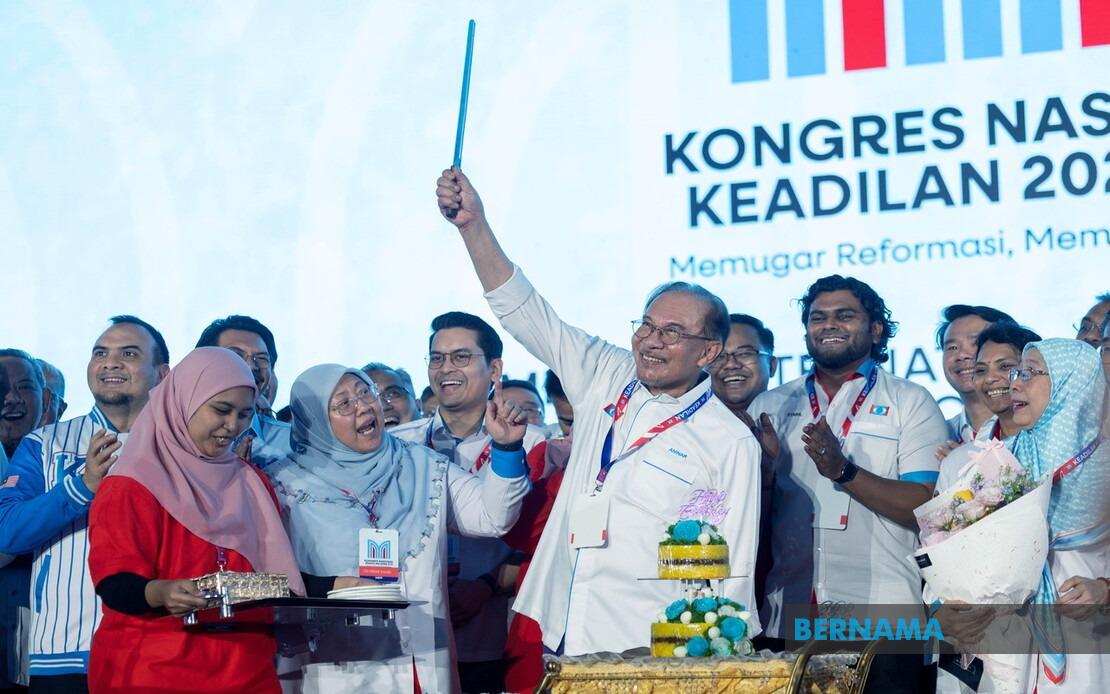
PKR's 2026 National Congress in Melaka concluded with party leadership doubling down on a delicate balancing act: sustaining the fragile political coalition that underpins Malaysia's current government while preserving the reform credentials that define the party's identity. The gathering underscored the tensions inherent in a party born from opposition politics now governing alongside former rivals, and the strategic choices required to navigate this new terrain without sacrificing core values.
Party president Datuk Seri Anwar Ibrahim used his closing remarks to position the Unity Government as essential for Malaysia's continued economic progress and political predictability. His framing centred on the practical benefits of stability—economic growth and prosperity for ordinary Malaysians—rather than ideological arguments for the coalition itself. This pragmatic emphasis reflects PKR's awareness that many supporters remain sceptical of cooperation with UMNO and Barisan Nasional, historic adversaries until the 2020 general election reshaped Malaysian politics. By grounding his defence of the coalition in tangible outcomes rather than abstract principles, Anwar attempted to address potential party grievances about compromising principles for power.
However, Anwar also signalled that PKR's commitment to the Unity Government is not unconditional. He made explicit that UMNO and Barisan Nasional's leadership choices would ultimately determine the coalition's longevity, effectively placing responsibility for the arrangement's future on his partners. This diplomatic move safeguards PKR's political position: should the coalition fracture, the party can argue it remained committed while others destabilised the arrangement. For Malaysian observers, this language hints at the underlying fragility beneath the Unity Government's veneer of solidity, a reality that influences investor confidence and business planning across the country.
Anwar cautioned all coalition partners against precipitous moves that could jeopardise governmental stability, a pointed reference to the factional tensions and leadership ambitions that periodically roil both UMNO and PKR. His explicit warning suggests behind-the-scenes friction within the alliance—whether over ministerial portfolios, policy direction, or succession planning—that occasionally threatens to destabilise the arrangement. For regional observers and foreign governments assessing Malaysia's political reliability, such internal reminders of coalition discipline are tellingly necessary.
DEPUTY President Nurul Izzah Anwar crystallised the congress's central intellectual challenge: how can a party committed to systemic reform function effectively as part of an establishment government? Her insistence that reform agendas must persist despite PKR's governmental role directly contradicts the typical trajectory of opposition movements that abandon radicalism upon achieving office. Nurul Izzah's argument that administrative reforms, party restructuring, and policy innovation remain essential demonstrates PKR's desire to distinguish itself from conventional ruling coalitions that entrench power and resist change.
The party pointed to the repeal of the Universities and University Colleges Act (AUKU) 1971 as tangible evidence that reform is achievable from within government. This move, liberalising student activism and removing Cold War-era restrictions on campus political expression, carries symbolic weight for PKR's younger members and urban constituencies. Anwar's additional assurance that his government will not replace AUKU with restrictive successor legislation reassures civil liberties advocates, though implementation challenges remain. For Malaysian academia and student unions, this represents a genuine expansion of freedoms, though political pressure could theoretically reverse course if campus activism becomes perceived as threatening to stability.
The congress also reflected upon strategic preparedness for future electoral cycles. PKR leadership emphasised the need for organisational readiness independent of parliamentary dissolution timelines or candidate selection announcements, suggesting the party recognises that Malaysian politics remains volatile and that elections could arrive with limited notice. This institutional focus indicates mature political management but also reflects the reality that coalition governments remain inherently unstable arrangements dependent on constantly managed factional relationships.
Women's representation emerged as a significant concern within PKR's ranks. Education Minister Fadhlina Sidek called for expanded space for female leadership and decision-making, reflecting broader patterns across Malaysian political parties where women occupy fewer senior positions than their contribution merits. Her dual emphasis on women's advancement and on cultivating openness to criticism among party and government leaders suggests internal conversations about democratising party structures and reducing hierarchical decision-making. For Malaysian feminists monitoring gender equality in politics, such statements indicate growing pressure but uncertain implementation.
Youth engagement featured prominently through Angkatan Muda Keadilan (AMK), the party's youth wing, which highlighted efforts to integrate younger Malaysians into high-technology sectors including artificial intelligence, semiconductors, and biotechnology. This forward-looking orientation addresses both economic competitiveness and generational equity. AMK's broader agenda encompassing gig economy recognition, enhanced social protection, skills development, and mental health support reflects contemporary labour market realities that traditional political discourse often overlooks. For young Malaysians navigating precarious employment and psychological pressures, PKR's acknowledgment of these issues represents a shift, though whether governmental action will match rhetorical commitment remains uncertain.
The congress ultimately illustrated that PKR remains intellectually engaged with Malaysia's development challenges and committed to progressive governance, even as coalition mathematics constrain its autonomy. The party must sustain both its reform identity and governmental cooperation—a balancing act that tests leadership capability continuously. For Malaysian voters and regional analysts monitoring the country's political trajectory, PKR's performance in maintaining this equilibrium will significantly influence whether the Unity Government's experiment in post-conflict coalition governance endures or eventually fractures under accumulated pressures and unresolved contradictions between coalition partners' divergent political cultures and interests.

