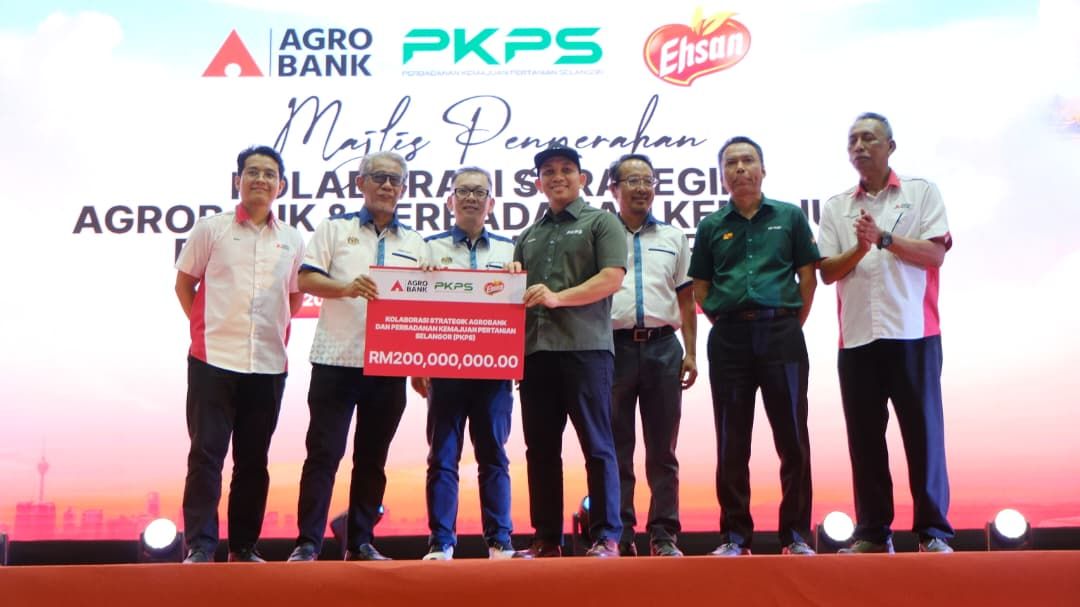
The Selangor Agricultural Development Corporation (PKPS) and Agrobank have entered into a strategic financing alliance worth RM200mil designed to fortify the state's agrifood ecosystem through targeted infrastructure investments and operational support. Formalised during the Malaysia Agriculture, Horticulture and Agrotourism Exhibition at MAEPS Serdang on August 29, the partnership represents a significant commitment to transforming Selangor's agricultural capacity and food supply resilience at a time when regional demand for locally-sourced produce continues to intensify.
The facility structure combines project-based financing with working capital support, addressing two critical operational challenges facing agricultural development corporations across Southeast Asia. By integrating both capital expenditure and day-to-day funding requirements, the arrangement acknowledges that infrastructure alone cannot sustain growth without corresponding liquidity to manage procurement, staffing, and distribution logistics. This dual approach reflects evolving best practices in agricultural financing, where lenders increasingly recognise that sustainable agribusiness development requires flexibility beyond traditional project finance models.
The halal food warehouse emerges as the partnership's flagship initiative, functioning as a regional storage and logistics nexus that will streamline Selangor's food distribution network. This facility carries particular strategic significance for Malaysia's broader halal economy objectives, positioning Selangor as a competitive hub for certified halal food processing and storage within Southeast Asia. For Malaysian consumers and exporters, such infrastructure reduces supply chain friction and strengthens the nation's capacity to meet both domestic demand and international halal certification requirements, particularly in high-value markets across the Middle East and Asia-Pacific.
The financing arrangement encompasses a diverse portfolio of complementary projects that collectively reshape Selangor's agrifood landscape. A dedicated halal chicken processing centre will add value to poultry production through advanced processing capabilities, while the Ehsan product processing centre targets value-added food manufacturing. Simultaneously, the upgrade and construction of central distribution warehouses across all districts represents a systematic approach to eliminating geographical bottlenecks that traditionally constrain agricultural productivity in Malaysia's most developed state. This geographically integrated strategy distinguishes the initiative from piecemeal infrastructure approaches that often fail to create coherent supply chain advantages.
Research and development activities constitute a substantial component of the RM200mil commitment, reflecting recognition that technological modernisation fundamentally determines agricultural competitiveness in an era of climate volatility and evolving consumer preferences. The Ehsan Agricultural Research Centre will focus on smart agriculture methodologies, addressing a critical knowledge gap within Malaysian farming. Concurrently, the Ehsan Agricultural Training Centre commits to human capital development, ensuring that technological advances translate into practical capabilities among farming communities. These investments acknowledge that infrastructure investment without corresponding skills development typically yields suboptimal returns, a lesson particularly relevant for Southeast Asian agricultural sectors competing against increasingly sophisticated global production networks.
The partnership's inclusion of operational support for ready-to-eat and ready-to-heat food products under the Ehsan brand signals a deliberate shift toward consumer-ready manufacturing rather than raw commodity production. This value-chain progression matters significantly for rural income stabilisation and export competitiveness. Malaysian agricultural stakeholders frequently struggle with commodity price volatility; by moving toward processed, branded products, PKPS positions Selangor's agrifood sector to capture higher margins while building brand equity that transcends regional boundaries. For Southeast Asian economies facing similar agricultural challenges, this model offers a replicable pathway toward higher-value agribusiness.
Agritourism development at the Ehsan Resort and Convention Centre represents an innovative cross-sector linkage that broadens the economic justification for agricultural infrastructure investment. By integrating hospitality, education, and production within unified facilities, the project creates employment diversification and revenue streams less vulnerable to agricultural commodity cycles. This approach aligns with global trends where agritourism increasingly functions as a demand driver for premium agricultural products, particularly among affluent urban consumers seeking transparent, traceable food sources. For Selangor, traditionally focused on urban-centric economic development, this represents strategic integration of rural agriculture into broader tourism and experiential economy trajectories.
The formal implementation timeline establishes March 2027 as the activation date, allowing interim months for regulatory approvals, detailed project planning, and contractual finalisation. This deliberate phasing contrasts with rushed infrastructure initiatives that frequently encounter cost overruns and quality degradation. The structured disbursement framework, contingent upon demonstrated project progress, embeds accountability mechanisms and ensures transparent capital allocation. Such methodical implementation timelines, while potentially frustrating for stakeholders seeking immediate results, typically correlate with superior long-term project outcomes and sustainable institutional capacity development.
Deputy Agriculture and Food Security Minister Datuk Chan Foong Hin's presence at the ceremonial handover underscores federal alignment with Selangor's agrifood ambitions, suggesting this partnership exemplifies broader national food security strategies. Malaysia faces mounting pressure to enhance domestic food production capacity while maintaining export competitiveness, particularly given regional competition from Thailand, Vietnam, and Indonesia. Selangor's agrifood development therefore carries implications extending beyond state boundaries, potentially establishing benchmarks for agricultural financing and infrastructure development that other Malaysian states might emulate or against which they will be compared.
The partnership's conceptual framework explicitly references MAHA 2026's thematic emphasis on value creation for food security, demonstrating strategic alignment between private financial institutions and state agricultural development mandates. This convergence suggests that Malaysian financial institutions increasingly view agricultural modernisation as aligned with long-term risk mitigation and market expansion objectives rather than exclusively philanthropic commitments. For the broader regional agrifood sector, this shift in financial institution attitudes may catalyse similar partnerships elsewhere, potentially creating competitive advantages for jurisdictions that successfully mobilise development finance toward agricultural modernisation.
Selangor's position as Malaysia's economic engine lends particular significance to this initiative's success or failure. As the most urbanised and industrialised state, Selangor faces competing land demands and rising production costs that constrain traditional agricultural expansion. The PKPS-Agrobank partnership essentially responds to this constraint through intensive, value-added production models rather than extensive acreage increases. For rapidly urbanising Southeast Asian regions facing similar pressures, this demonstration effect matters considerably, potentially validating intensive agribusiness models that smaller or less developed agricultural territories might otherwise overlook as economically unviable.
The sustainability dimensions embedded within the partnership framework—encompassing smart agriculture research, supply chain efficiency, and technological modernisation—position this initiative within emerging global paradigms emphasising environmental resilience alongside economic productivity. As Southeast Asia grapples with climate change impacts including irregular rainfall patterns and temperature fluctuations, agricultural systems incorporating smart technologies and diversified production approaches promise greater adaptive capacity. Selangor's commitment to research-intensive agriculture therefore serves not merely immediate food security objectives but contributes to regional climate adaptation knowledge that extends well beyond state boundaries.
Ultimately, the PKPS-Agrobank facility exemplifies how financial innovation and strategic infrastructure investment can recalibrate agrifood sector trajectories within mature, urbanised economies. By combining project financing with working capital support, embedding research and human capital development, and integrating diverse production and distribution elements within coherent supply chains, the partnership offers a sophisticated model for agricultural modernisation. As implementation proceeds toward March 2027 activation, the initiative's actual performance will yield critical evidence regarding whether strategically-structured financing, coupled with targeted infrastructure development and technological modernisation, can substantively enhance food security resilience within high-cost, densely-populated Asian contexts.

