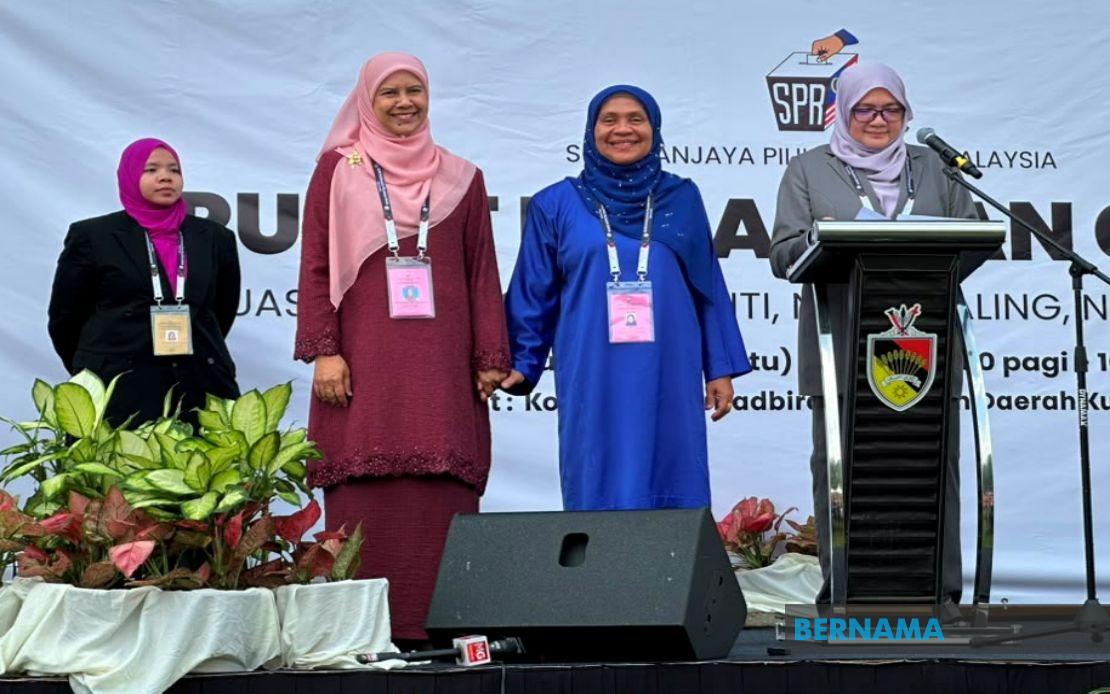
The Pilah state constituency in Negeri Sembilan will make electoral history on August 1 when incumbent Datuk Noorzunita Begum Mohd Ibrahim of Pakatan Harapan faces off against Barisan Nasional candidate S. Leza Md Yasin—a significant moment marking a direct contest between two female aspirants for the seat. The two candidates officially filed their nomination papers at the District and Land Office in Kuala Pilah, with Noorzunita Begum submitting her forms at 9.03 am and S. Leza following at 9.09 am, establishing what returning officer Nawal Mohammed Amin confirmed as a two-way race following the conclusion of the nomination process.
The Pilah encounter represents a noteworthy development in Malaysian state-level politics, where women candidates competing directly against each other remain relatively uncommon at the parliamentary and state assembly levels. Both women bring distinct backgrounds to the contest, with Noorzunita Begum's position as the sitting representative giving her the advantage of incumbent status and established connections within the constituency. The straight fight format removes the complexity of vote-splitting that might otherwise benefit either candidate, placing the contest squarely on the merits of their respective platforms and appeal to Pilah voters.
The 16th Negeri Sembilan state election is shaping up to be highly competitive across multiple constituencies. Beyond Pilah's bilateral showdown, three other seats—Juasseh, Seri Menanti, and Senaling—are poised for three-cornered contests that will test the coalition politics of the state. The Johol constituency will present another straight fight, creating a varied electoral landscape that reflects the fractious nature of current Malaysian politics, where Pakatan Harapan, Barisan Nasional, and Bersatu are all making serious efforts to expand or maintain their presence in Negeri Sembilan.
The Juasseh contest will pit Pakatan Harapan's Mohd Aidil Abdullah against the incumbent Datuk Ismail Lasim representing Barisan Nasional and Bersatu's Mohd Zuhami Md Yusof. Seri Menanti will feature a similarly crowded field with PH's Mohd Kamarul Arifin Mohd Wafa, BN's defending representative Muhammad Sufian Maradzi, and Bersatu's Datuk Seri Megat D. Shahriman Zaharuddin all competing. The three-way race in Senaling will involve PH's Mohd Hanis Mohd Alimin, BN's Mohamad Qayyum Abd Jalil, and Bersatu's Mohd Izzafi Khan, suggesting that Bersatu's strategic positioning in multiple constituencies reflects its ambitions to play kingmaker in a potentially hung assembly.
In Johol, Pakatan Harapan's Mohd Zailan Mohd Munawar will challenge the incumbent Datuk Saiful Yazan Sulaiman of Barisan Nasional without third-party competition. The presence of Bersatu in three separate contests demonstrates the party's calculated strategy to contest seats where it believes it can either secure victory or influence the outcome, a tactic particularly relevant in state elections where smaller vote margins can determine winners and where coalition arithmetic becomes critically important for government formation.
The high-level political engagement from both major coalitions underscores the significance of this election for Negeri Sembilan's political trajectory. Pakatan Harapan fielded candidates supported by PKR Wanita chief Fadhlina Sidek, the Education Minister, alongside Angkatan Muda Keadilan vice-chief Dr Mohammed Taufiq Johari, who holds the Youth and Sports portfolio, and Investment, Trade and Industry Deputy Minister Sim Tze Tzin, MP for Bayan Baru. The presence of these federal ministers and party leaders signifies that Kuala Lumpur views the Negeri Sembilan contest as consequential for the broader political landscape.
Barisan Nasional matched this effort by deploying Deputy Home Minister and UMNO Supreme Working Council member Datuk Seri Dr Shamsul Anuar Nasarah, alongside Perak Menteri Besar Datuk Seri Saarani Mohamad, who also chairs Perak UMNO. This concentration of senior leadership accompanying BN candidates during the nomination process reflects the coalition's determination to reclaim or solidify ground in Negeri Sembilan, a state where electoral fortunes have shifted considerably in recent years. The involvement of Perak's political establishment suggests coordination between neighbouring states' party structures to maximize campaign effectiveness and resource deployment.
The electoral calendar for the Negeri Sembilan contest has been tightly compressed, with the Election Commission scheduling early voting for July 28 and the main polling day for August 1. This accelerated timeline means campaigns will be intense and concentrated, limiting the time available for candidates to build grassroots movements or reshape perceptions. For female candidates like Noorzunita Begum and S. Leza, the compressed schedule may actually benefit their campaigns, as media attention focusing on their gender-historic matchup could amplify their visibility beyond what traditional campaign machinery might achieve.
The composition of candidates across the state reflects ongoing discussions about women's representation in Malaysian electoral politics. While the Pilah seat's all-female contest is noteworthy, it remains an outlier rather than a systematic pattern of increased female candidacy. The presence of established female politicians like Noorzunita Begum, who has been elected previously, alongside challengers like S. Leza suggests that opportunities do exist for women to compete at the state level, though barriers to entry and nomination remain substantial. The outcome in Pilah may carry symbolic weight beyond the constituency itself, potentially influencing how parties approach female candidate selection in future elections.
For Malaysian voters and analysts tracking state-level politics, the Negeri Sembilan election offers important insights into current coalition strength and voter preferences outside the federal sphere. State elections frequently signal shifts in public mood that precede or follow federal political developments, making the results consequential for understanding the broader trajectory of Malaysian democracy. The competitive nature of multiple constituencies, combined with Bersatu's multi-seat strategy and the clear determination of both PH and BN to contest aggressively, suggests that Negeri Sembilan voters will have genuine choices and that the state's political control remains genuinely contested rather than predetermined.
The election also occurs against a backdrop of evolving Malaysian political dynamics, where coalition alignments have become increasingly fluid. Negeri Sembilan, with its mixture of two-way and three-way contests, exemplifies this complexity. The results will contribute to the broader narrative about whether Pakatan Harapan can sustain its 2018 electoral breakthrough, whether Barisan Nasional has successfully stabilized after years of upheaval, and whether Bersatu can establish itself as an independent political force or remains dependent on alignment with larger partners. With early voting on July 28 and polling day on August 1, voters will soon render their verdict on which coalition and which local candidates best deserve their support.

