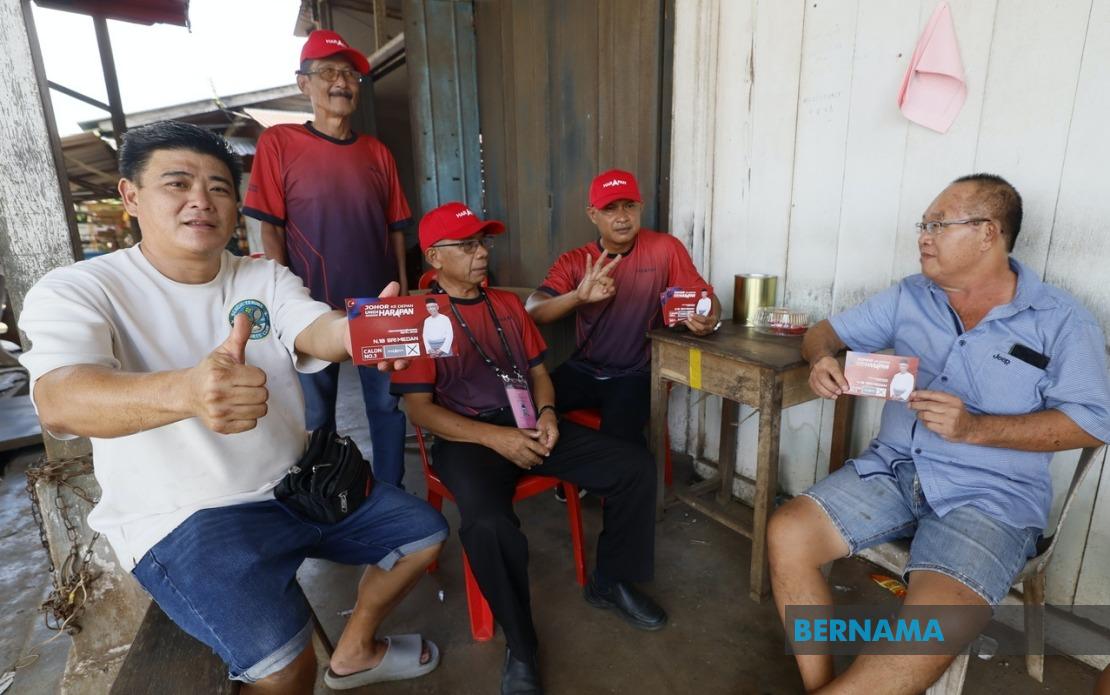
As the 16th Johor State Election enters its crucial phase, Pakatan Harapan's Sri Medan candidate Hishamudin Ishak is building momentum through grassroots engagement, projecting a refreshing political approach centred on tangible community solutions rather than grand promises. The former mathematics teacher, known colloquially as Cikgu Misrin, has adopted a hands-on campaigning style that involves direct dialogue with constituents, listening intently to their grievances and outlining concrete responses to address longstanding issues affecting the constituency.
Flooding represents one of the most pressing challenges in Sri Medan, with residents enduring recurring inundation that disrupts daily life and livelihoods. Hishamudin has prioritized tackling this infrastructure problem, recognizing that environmental resilience directly impacts quality of life and economic productivity. His commitment reflects a pragmatic understanding that voters increasingly demand action over rhetoric—a shift that has become more pronounced across Malaysian politics following the 2018 federal election and subsequent state contests. By positioning flood mitigation as a cornerstone issue, he signals alignment with constituent priorities whilst demonstrating awareness of the constituency's geographical vulnerabilities.
Central to his electoral messaging is a philosophy of "work first, talk later," a deliberate contrast to the blame-trading and policy announcements that characterize much of Malaysian campaign discourse. This approach resonates particularly in constituencies where previous administrations have generated frustration through unfulfilled pledges or partisan neglect. Hishamudin's emphasis on action-oriented governance suggests an intention to rebuild public trust through demonstrable results rather than extensive campaign promises that may prove impossible to deliver once elected.
The candidate's vision extends beyond infrastructure to encompass balanced development across urban, semi-urban and rural zones within Sri Medan. This articulation of equitable resource allocation addresses a common grievance in Malaysian constituencies—the perception that economic development concentrates in urban centres while peripheral areas stagnate. By explicitly committing to inclusive infrastructure investment, Hishamudin appeals to rural voters who frequently feel marginalised by development hierarchies and urban-centric policymaking.
Education and economic opportunity form another pillar of his campaign platform. Recognising that younger voters increasingly migrate to areas with superior employment prospects, he proposes establishing Technical and Vocational Education and Training (TVET) programmes and digital education initiatives. These proposals directly address Malaysia's ongoing skills gap and the need for workforce development beyond traditional academic pathways. By championing TVET, he acknowledges the reality that not all school-leavers pursue university education, yet require marketable skills to participate productively in the economy—a recognition that positions him as attuned to contemporary labour market demands.
Small and medium enterprise development constitutes a third economic pillar. Hishamudin's commitment to assist SME entrepreneurs in accessing broader markets reflects understanding of how local economies function and the constraints limiting small business expansion. Many Malaysian SMEs remain trapped in subsistence operations dependent solely on domestic demand, lacking the resources or networks to internationalise or scale operations. By offering market-access support, he addresses a genuine bottleneck affecting economic mobility and job creation within constituencies like Sri Medan.
His background as a village headman provides practical experience in local administration and community engagement. This experience distinguishes him from candidates whose political credentials derive primarily from party machinery or professional backgrounds disconnected from grassroots governance. Village-level service encompasses welfare administration, dispute resolution and resource allocation—skills transferable to state-level constituency management, where addressing residents' concerns and navigating bureaucratic processes become essential.
The political terrain presents formidable obstacles. Sri Medan is widely regarded as a Barisan Nasional stronghold, suggesting historical voter preference for the governing coalition and institutional advantages that come with incumbency. Facing both Barisan incumbent Datuk Zulkurnain Kamisan and Perikatan Nasional's Ahmad Rosdi Bahari, Hishamudin operates as a challenger in a competitive three-way contest. His characterisation of himself as a "fresh face" attempts to leverage anti-establishment sentiment that has periodically mobilised Malaysian voters, though its effectiveness depends heavily on local factors and voter appetite for political change.
Despite these structural disadvantages, Hishamudin reports encouraging constituent response during early campaign days, suggesting receptivity to his messaging or at least willingness among voters to engage with alternative options. This reception reflects broader patterns visible across Malaysian state elections, where even traditional opposition constituencies increasingly feature competitive contests as voter volatility increases and political alignments shift. The fact that Pakatan Harapan contests vigorously in a historically Barisan-held constituency indicates confidence in campaign mechanics and local organisational capacity.
The July 11 polling date creates urgency for all candidates to consolidate voter support and identify undecided segments. Early voting scheduled for July 7 assumes significance as election day approaches, potentially determining turnout patterns and which campaign operations prove most effective at mobilisation. For a candidate like Hishamudin, converting campaign engagement into actual votes requires translating constituent satisfaction with his accessibility into voting behaviour—a transition that campaigns cannot always guarantee despite strong grassroots support.
Hishamudin's people-centric positioning ultimately reflects evolving Malaysian voter expectations. Contemporary constituencies demand candidates who demonstrate local understanding, commit to specific problem-solving rather than abstract ideology, and project genuine commitment to constituent welfare. His background in teaching and community administration, combined with his willingness to address flooding, support education, and develop economic opportunities, constructs a candidate profile centred on practical competence rather than political seniority. Whether this approach overcomes Sri Medan's historical voting patterns remains uncertain, but his campaign articulates a vision of responsive, accountable governance increasingly demanded by Malaysian voters across demographic and geographical divides.

