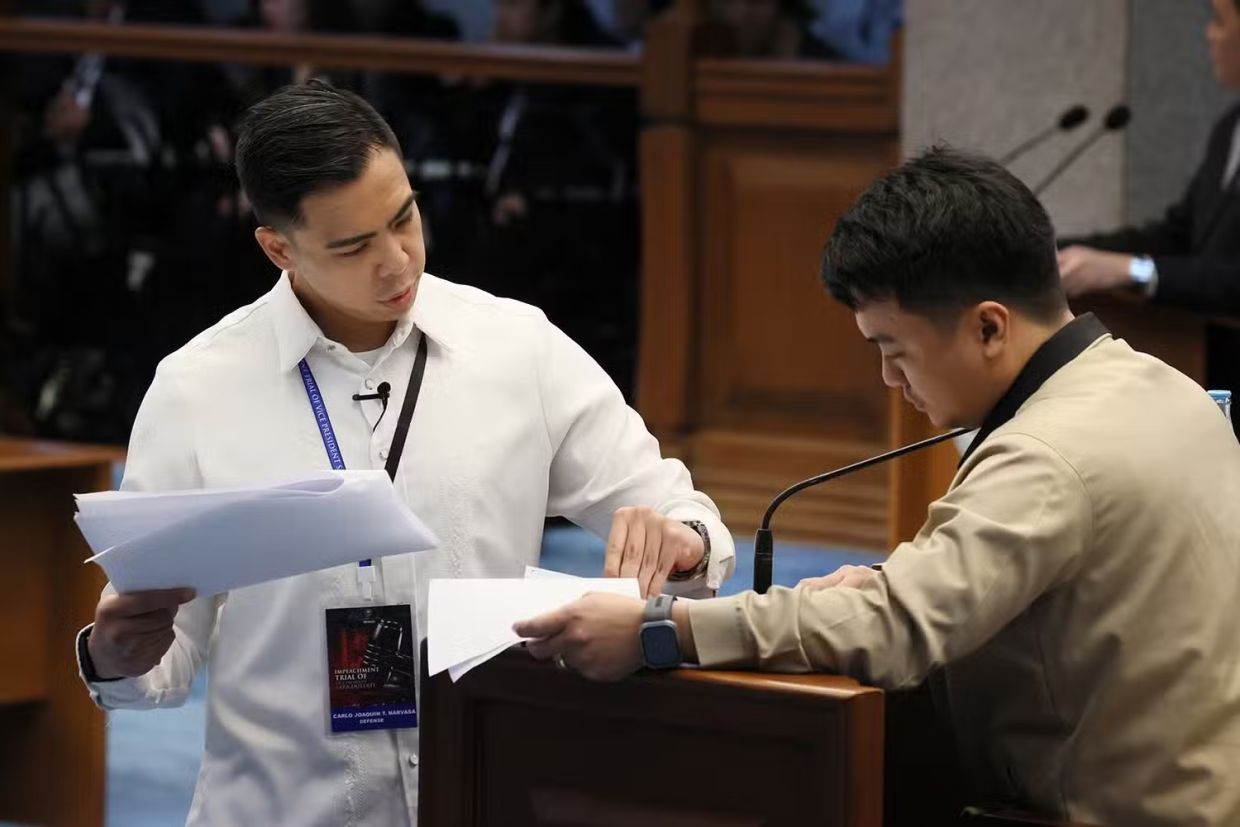
Philippine Vice President Sara Duterte's legal team mounted a vigorous challenge to her impeachment trial on Wednesday, arguing that the accusations against her fail to meet the constitutional threshold required for removal from office. In cross-examining the prosecution's opening witness during proceedings before the Senate impeachment court, defence counsel concentrated their efforts on undermining both the evidence presented and the legal basis for the charges, setting the stage for a protracted constitutional battle that could reshape expectations of executive accountability in the Philippines.
The core of the defence strategy hinged on a technical but consequential reading of the 1987 Philippine Constitution. Under Article XI, Section 2, impeachment requires proof of culpable violation of the Constitution, treason, bribery, graft and corruption, betrayal of public trust, or "other high crimes." Duterte's defence team argued forcefully that the statements she made during a November 23, 2024 online press briefing—which prosecutors characterise as grave threats against President Ferdinand Marcos, First Lady Liza Araneta-Marcos, and former Speaker Martin Romualdez—do not satisfy this demanding standard. By framing the case as fundamentally one of unconstitutional overreach by the House of Representatives, the defence sought to position itself as defending not merely their client but the institutional boundaries of impeachment itself.
During cross-examination of National Bureau of Investigation senior agent John Mark Calilung, defence counsel Mark Vinluan pressed a compelling evidentiary argument: the prosecution possessed no concrete proof that Duterte had actually contracted an assassin to harm any of the three targets. This distinction between rhetoric and actionable conspiracy proved crucial to the defence narrative. Prosecutors themselves had conceded during earlier questioning that the video recordings of Duterte's statements did not conclusively establish that she had hired anyone to commit murder, reducing the allegations to matters of interpretation rather than demonstrable fact. By extracting this admission, the defence weakened the causal link between Duterte's words and any alleged assassination plot.
The defence presented an alternative contextual framework that sought to reposition Duterte's statements as expressions of legitimate self-defence rather than criminal threats. Counsel argued that Duterte spoke not as Vice President but as an individual protecting her family and staff against what they characterized as "Operation Romanov," a covert intelligence operation targeting her household. This narrative repositioning aimed to transform her from aggressor to victim—a woman responding to unauthorised surveillance, the profiling of her homes in both Davao and Manila, and the systematic removal of trusted security personnel. By introducing testimony about alleged government surveillance and emphasising the emotional distress experienced by her chief of staff Zuleika Lopez during her detention, the defence attempted to establish context that might justify unconventional speech.
The focal point of the trial became the role of Lopez, whose detention and cited contempt by the House committee investigating the Office of the Vice President finances the defence identified as the immediate trigger for Duterte's statements. Video footage presented by the defence showed Lopez expressing fear for her safety and objecting to her planned transfer to a correctional facility, and the defence team argued that Duterte's subsequent remarks should be understood as a protective response to this personnel crisis. This framing introduced into the trial questions about whether the House committee's investigation itself had been conducted fairly and whether the emphasis on Duterte's words obscured more significant questions about governmental conduct towards her office and staff.
Critical gaps in the prosecution's investigative work became a secondary focus of the defence strategy. Through Narvasa's questioning, the defence highlighted that the National Bureau of Investigation had conducted its investigation without formal complaints from any of the three alleged targets. Neither President Marcos, the First Lady, nor former Speaker Romualdez had personally filed criminal complaints or appeared before the NBI to provide sworn statements. The bureau's revised affidavit of February 10, 2025, notably lacked affidavits from the offended parties themselves or from journalists who attended the November press briefing. These procedural absences suggested to observers that the case had been constructed bureaucratically rather than emerging from the complaint of actual victims, raising questions about the investigative rigour underlying the impeachment charge.
The defence's aggressive probing extended to the very foundation of the NBI's authority to act in this matter. By establishing that the investigation was conducted "motu proprio"—on the bureau's own initiative rather than in response to a formal complainant—the defence suggested that the case represented an extraordinary exercise of investigative power. Furthermore, the admission that Calilung relied on an affidavit attesting to investigators' interview minutes rather than conducting direct investigation and securing statements from the complainants themselves suggested procedural irregularities that might undermine the evidential foundation of the entire case. For observers familiar with Philippine legal procedure, these gaps represented significant vulnerabilities in the prosecution's presentation.
When Senator Risa Hontiveros probed whether the defence was arguing that grave threats could be justified by legitimate circumstances, defence counsel Carlo Narvasa demurred, walking back the implications of his contextual arguments. This careful retreat illustrated the tightrope the defence must walk—establishing context without explicitly endorsing a principle that threats become permissible under provocation. Yet the exchange also revealed tensions within the impeachment process itself. Senator Francis Escudero intervened to prevent senator-judges from asking questions requiring legal conclusions, noting that such determinations belonged to closing arguments, yet Hontiveros observed that previous impeachment trials had permitted broader questioning. This procedural disagreement hinted at deeper uncertainties about the norms governing impeachment trials in the Philippines, where precedent remains limited.
The defence's argument about "systematic oppression" by the House committee, led by Representative Joel Chua who now serves as a House prosecutor, introduced into the trial questions about the propriety of those driving the investigation. By documenting alleged unauthorised surveillance, the removal of security personnel, and the contentious detention of Lopez, the defence team painted a picture of institutional conflict extending far beyond the specific statements made during the November briefing. This broader narrative invited the impeachment court to consider whether the House committee's investigation had itself operated within appropriate bounds or whether it represented a form of political harassment masked as oversight.
The substantive constitutional question at the heart of the trial remained unresolved after Wednesday's proceedings. Whether statements made during a public address, however inflammatory or threatening in character, constitute "other high crimes" under Article XI of the Constitution represented the fulcrum upon which the entire case pivoted. The defence's insistence on this technical distinction between speech, however extreme, and impeachable conduct reflected a constitutional philosophy emphasizing that removal from office represents an extraordinary remedy requiring more than evidence of poor judgment or intemperate remarks. As the trial progressed, this constitutional dimension increasingly overshadowed the factual disputes about what Duterte actually said and what those statements signified.
For Malaysian observers and Southeast Asian readers more broadly, the Duterte impeachment trial illustrates the continuing constitutional and political tensions surrounding the definition of impeachable offences. In Westminster-influenced systems across the region, the expansion of impeachment beyond traditional categories of betrayal of public trust has proven controversial. The Philippine case demonstrates how much depends on whether impeachment is understood narrowly as a remedy for grave breaches of constitutional duty or more expansively as a mechanism for holding executives accountable for serious misconduct regardless of its technical categorization. The defence strategy in Duterte's trial reflects a view that constitutional boundaries matter even in politically charged circumstances—a position with implications far beyond Manila for how power and accountability operate in Southeast Asian democracies grappling with similar institutional questions.

