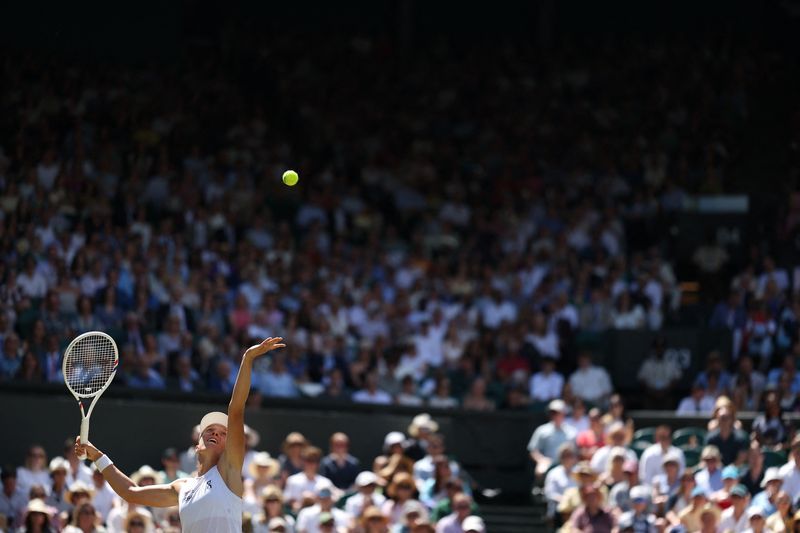
Alexandra Eala's remarkable breakthrough continued at the All England Club on Saturday as the Philippine rising star dismantled Iga Swiatek, the defending Wimbledon champion and third seed, with a commanding 7-6(9) 6-2 victory in the third round. The clash on Centre Court marked a significant moment for Asian tennis, with the Filipina delivering a dominant performance under difficult conditions to reach the final 16 of one of the sport's most prestigious tournaments.
Swiatek arrived at Wimbledon seeking to build on her triumph the previous year, which had silenced longstanding doubts about her capacity to excel on the demanding grass surface. Yet the Polish star's preparation had been far from ideal, arriving at the tournament nursing wounds from an early defeat at the Bad Homburg competition. Despite that setback, Swiatek had steadied herself with victories over Taylor Townsend and Karolina Pliskova in her opening matches, suggesting she possessed sufficient form to mount another deep run.
The meeting between Eala and Swiatek carried historical weight for the pair. Their previous encounter in Miami the previous year had seen Eala prevail, only for Swiatek to secure redemption when they clashed on the clay courts of Madrid. However, the grass surface of Wimbledon presented an entirely different arena for competition, one where both players would need to adapt their conventional playing styles. The question circulating through the tennis community was whether Eala could replicate her success against a player hunting redemption and familiarity with the venue.
The opening set unfolded as a gruelling examination of both players' technical abilities and mental fortitude. From the baseline, Eala's powerful striking capabilities created immediate problems for Swiatek, the left-hander's forceful shot-making putting constant pressure on the Pole's service games. The set proved to be an extraordinarily tight affair, with neither competitor willing to yield even a single point without fierce resistance. The tiebreak ultimately proved decisive, with Eala prevailing 9-7 in a dramatic climax that left spectators enthralled.
As the contest shifted into its second phase, Eala's momentum proved unstoppable. The Philippine competitor seized control immediately, establishing a commanding advantage early in the set by breaking Swiatek's serve consecutively and racing to a 3-0 lead. Her attacking positioning and aggressive court coverage suggested a player operating at a significantly elevated level, while Swiatek appeared momentarily overwhelmed by the intensity and precision of her opponent's assault.
Swiatek's competitive fire emerged as the set progressed, and she managed to salvage one of the stolen breaks, briefly suggesting a potential resurgence. However, this momentary spark could not ignite a sustained comeback. Eala's nerve remained intact, and she promptly reestablished her stranglehold on the match by breaking Swiatek's serve once more. The dramatic clash reached its conclusion when Eala dispatched a forehand winner that proved beyond her opponent's reach, securing a place in the fourth round.
The emotional contrast between the two finalists proved striking throughout the encounter. Swiatek's frustration became increasingly visible as the match slipped beyond her control, at one point venting her displeasure toward her coaching team in the stands before striking a chair with her racket in exasperation. By contrast, Eala absorbed the crowd's sustained ovation with the demeanor of someone operating exactly where she belonged, drawing energy from the enthusiastic support of a Centre Court audience thoroughly entertained by the competitive intensity on display.
Eala's triumph represents a landmark achievement for Philippine tennis on the global stage. The nation has produced remarkably few representatives who have achieved success at major tournaments, making her progress through Wimbledon's draw particularly noteworthy for sports enthusiasts throughout Southeast Asia. Her ability to neutralize one of tennis's most accomplished competitors on a surface traditionally dominated by European and North American players suggests genuine potential for future achievements at the sport's highest echelon.
With her passage to the fourth round secured, Eala now confronts Jasmine Paolini, the Italian competitor who reached the previous year's Wimbledon final. The contest between the young Philippine sensation and the experienced European campaigner will determine whether Eala can sustain her momentum and continue plotting an unlikely path toward the tournament's concluding rounds. Her remarkable performance against Swiatek has already established her among the tournament's genuine breakthrough stories.

