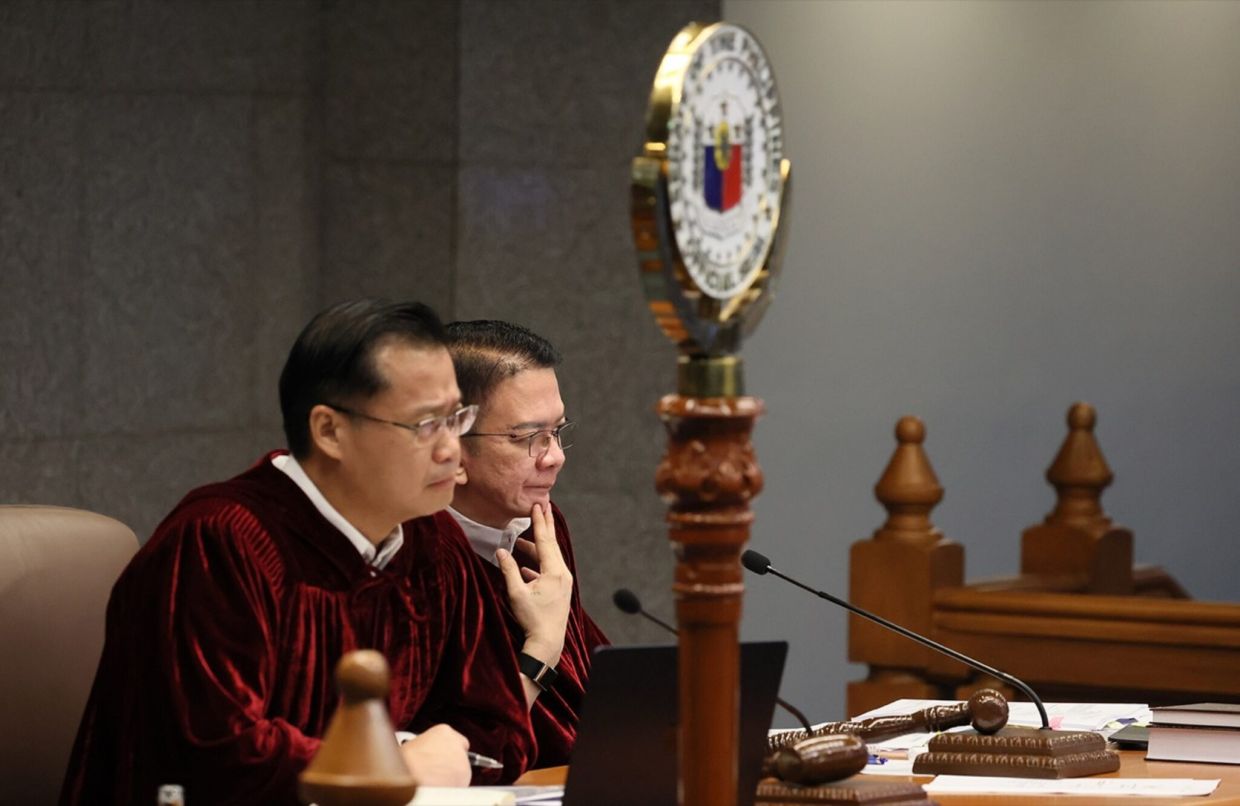
The Philippine Senate's impeachment court is poised for a pivotal procedural decision on Monday afternoon when it votes on whether to compel Vice President Sara Duterte to disclose her financial records. House prosecutors expressed confidence over the weekend that the court would approve their subpoena request, characterising the documents as indispensable to their case against Duterte, who faces four articles of impeachment including accusations of misusing confidential funds, accumulating unexplained wealth, and threatening President Ferdinand Marcos and his family. The outcome of this vote represents one of the most significant rulings thus far in Duterte's trial, which entered its seventh day amid heated procedural exchanges.
The prosecution's subpoena request targets comprehensive financial documentation spanning Duterte's bank accounts, personal tax filings, and records held by the Anti-Money Laundering Council, along with financial materials belonging to her husband, attorney Manases Carpio. Prosecutors argue that these materials are essential to substantiating charges under Article II of the impeachment articles, which specifically alleges that Duterte accumulated wealth beyond what her lawful income would justify. Spokesperson Benjamin Tolosa Jr. emphasised the prosecution's conviction that the Senate would grant the request, stating that their legal foundation rested on established precedent and the express exemptions built into Philippine financial privacy laws.
The legal framework supporting the prosecution's position draws heavily on the 2012 impeachment trial of former Chief Justice Renato Corona, during which the Senate successfully compelled the production of bank records despite standard banking secrecy protections. Tolosa underscored a critical provision in Republic Act No. 1405, the bank secrecy law, which explicitly carves out impeachment proceedings from its confidentiality requirements. This legislative exception recognises the unique constitutional status of impeachment as a mechanism for holding high office holders accountable, effectively positioning financial disclosure above the ordinary privacy protections that would shield ordinary citizens' banking information from disclosure. The prosecution's argument hinges on the principle that impeachment proceedings occupy a special constitutional space where public accountability supersedes financial confidentiality.
Prosecutor Chel Diokno expanded the prosecution's case by presenting evidence of Duterte's financial activities between 2007 and 2013, citing Anti-Money Laundering Council reports indicating transactions exceeding P3 billion during that period. Diokno contended that the Senate, functioning as an impeachment court, derives authority directly from the Philippine Constitution to compel disclosure of records that would ordinarily remain confidential. He argued further that the Data Privacy Act similarly permits disclosure when a valid subpoena exists, and that the impeachment exception in the bank secrecy law extends naturally to all related financial documentation. Critically, Diokno asserted that financial records predating Duterte's assumption of the vice presidency remain relevant because the impeachment allegations encompass unexplained wealth accumulated throughout her tenure as Davao City vice mayor and mayor, positions she held before becoming national vice president.
The defence mounted a vigorous counter-argument, with lead counsel Michael Poa characterising the prosecution's subpoena request as an impermissibly broad "fishing expedition" that lacks the necessary specificity and constraint demanded by due process principles. Poa argued that the real dispute centres not on whether the Senate possesses subpoena power, but rather on whether that power may be exercised in ways that violate established legal protections and procedural safeguards. The defence objected strenuously to the temporal scope of the request, contending that financial records spanning nearly two decades create an unreasonable burden and introduce materials from periods when Duterte held positions not subject to impeachment, such as her role as Davao City vice mayor. Poa cited a 2025 Supreme Court ruling in Duterte v. House of Representatives establishing that impeachable offences must occur while the official occupied an impeachable position, suggesting that extending the subpoena backward into Duterte's pre-vice-presidential career exceeds constitutional bounds.
The defence also questioned the legislative foundation for compelling disclosure of specific categories of records. While acknowledging the bank secrecy law's impeachment exception, Poa argued that disclosure is not automatic and must satisfy procedural due process requirements. More pointedly, he contended that the Anti-Money Laundering Act and the National Internal Revenue Code contain no corresponding impeachment exceptions, making compulsory disclosure of AMLC reports and tax records legally questionable. The defence additionally protested the inclusion of Carpio's financial records, emphasising that as a private citizen and non-impeachable official, his financial privacy deserves protection regardless of his relationship to the respondent vice president.
Civil society organisations have mobilised to urge the Senate to approve the subpoena, framing the vote as a test of institutional integrity. The August Twenty-One Movement recalled the controversial "second envelope" vote during former President Joseph Estrada's 2001 impeachment trial, when the Senate rejected evidence that subsequently fueled public outrage and contributed to Estrada's eventual conviction and removal. Atom's warning carried implicit reproach: withholding crucial financial evidence risks repeating a historical precedent where institutional decisions contradicted public expectations for accountability. The group emphasised that if Duterte truly amassed no ill-gotten wealth, disclosure would vindicate her rather than condemn her, reframing financial transparency as a clarifying mechanism rather than an inherent admission of wrongdoing.
The faith-based coalition Kingdom Keepers similarly urged Senate approval, advancing a broader argument about the obligations of public officials. Anchored by activist priest Father Robert Reyes and social anthropologist Dr Melba Padilla Maggay, the coalition asserted that those holding elected office must accept heightened scrutiny regarding their financial conduct as a fundamental corollary of public service. The group challenged Duterte's potential invocation of privacy rights, arguing that public officials cannot simultaneously enjoy the privileges of office while hiding behind financial confidentiality claims. Their framing cast the debate as one between competing values: the privilege of holding high office versus the right to financial privacy, with Kingdom Keepers asserting that accepting public responsibility necessarily entails surrendering ordinary privacy protections in financial matters.
Duterte's impeachment presents implications that extend beyond the immediate case to define how the Philippines' democratic institutions balance accountability against privacy rights. Conviction on the charges she faces would trigger her removal from the vice presidency and permanent disqualification from holding any future public office, making the stakes existential for her political career. The Senate's decision on the subpoena will substantially determine whether the prosecution can marshal the forensic evidence necessary to substantiate its core allegations regarding unexplained wealth accumulation. For Malaysian and Southeast Asian observers, the proceedings underscore ongoing regional tensions between strengthening institutional accountability for high officials and protecting financial privacy rights in democracies where such safeguards remain contested.
The trial's trajectory will continue beyond Monday's procedural vote. The prosecution expects National Bureau of Investigation Director Melvin Matibag to testify on Tuesday regarding the agency's investigation into Duterte's alleged threats against President Marcos and his family. The NBI's findings reportedly indicate that Duterte's remarks constituted part of a coordinated plan rather than spontaneous utterances, adding weight to the impeachment's allegation regarding threatening statements. This testimonial evidence complements the documentary evidence the prosecution seeks through the subpoena, suggesting a multifaceted case combining both testimonial and documentary proof. The combination of financial disclosure and investigative findings would provide the prosecution with comprehensive factual foundations for pursuing conviction on the assembled charges.

